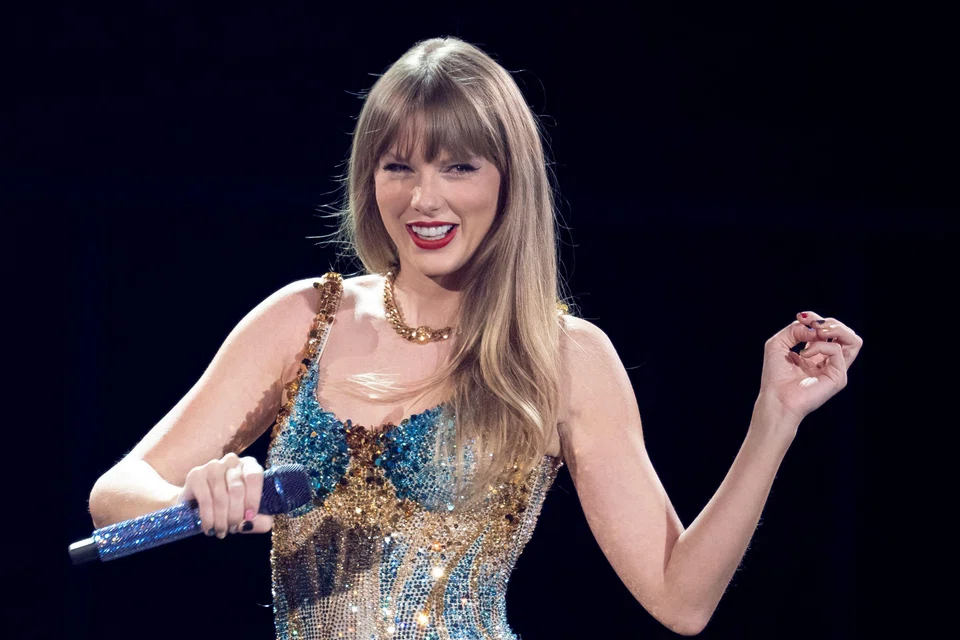
Welcome to Singapore, Taylor Swift
Singapore should hope she manages to quell any unhappiness among her fans for giving the rest of South-east Asia a miss

AFTER Thai Prime Minister Srettha Thavisin let the cat out of the bag earlier this month, about Singapore providing financial support to Taylor Swift’s concerts, there has been some chatter over the government’s use of subsidies or grants to bring big events here.
In June last year, it was initially announced that the singer-songwriter superstar would perform for three nights in Singapore as part of her Eras Tour.
Just over a week later, three more shows were added – due to “overwhelming response”.
It was also announced in June last year that Coldplay’s Music of the Spheres World Tour would increase its run in Singapore to six nights.
This made the Singapore concerts – which took place last month – the main stop in South-east Asia for the British band.
Then there was the Jacky Cheung 60+ Concert Tour, which ended up lasting a record-breaking 11 nights in Singapore in July and August last year.
This created a sense that Singapore had become the preferred destination in the region for big-name stars to hold concerts.
This seemed to reflect Singapore’s growing presence on the world stage, as well as the Republic having the necessary physical and organisational infrastructure to host such events.
Srettha challenged this narrative, however, with his revelation that money had changed hands.
During a speech on Feb 16, he claimed to have been informed that the Singapore government offered Swift’s Eras Tour as much as US$3 million per show in exchange for exclusivity in South-east Asia.
“If I had known this, I would have brought the shows to Thailand,” the Bangkok Post quoted him as saying. “Concerts can generate added value for the economy.”
Is Srettha right in suggesting that any country willing to pay enough could have persuaded Swift to turn up? Are these subsidies a good use of public money? And, wouldn’t this alienate fans in other countries?
Spurring economic activity
There is no doubt that big concert tours are a driver of economic activity. These events naturally draw large crowds, and spur spending on transport and accommodation.
Swift’s Eras Tour stop in Philadelphia in May last year created enough spending to warrant a mention in the Federal Reserve’s Beige Book, a report that gathers anecdotal information on economic conditions in the United States.
“One contact highlighted that May was the strongest month for hotel revenue in Philadelphia since the onset of the pandemic, in large part due to an influx of guests for the Taylor Swift concerts in the city,” said the report in July last year.
As a regional hub, Singapore stands to benefit in a similar fashion when the Eras Tour arrives on Saturday (Mar 2) – especially since this will be the tour’s only stop in South-east Asia.
The Eras Tour’s only other stop in Asia was a four-night run in Tokyo earlier this month.
Last week, The Business Times reported that some economists expect the Eras Tour’s six shows in Singapore to deliver S$500 million in tourism receipts.
Excessive subsidies?
Yet, the idea of Singapore paying Swift to perform only here does not sit well with some people.
Why does Singapore have to pay for exclusivity?
It also seems incongruous for Singapore’s public sector to subsidise the sold-out concerts of a hugely popular singer-songwriter from the US.
An alternative view, however, is that tiny Singapore might not be a viable venue for extended runs of big live concerts if these events did not attract large numbers of foreign visitors.
Incentivising concert organisers to draw foreign visitors to the Singapore leg of their tours seems logical.
After Srettha revealed that Singapore had subsidised Swift’s Eras Tour, the Singapore Tourism Board (STB) and Ministry of Culture, Community and Youth confirmed that a grant had indeed been provided.
It has also subsequently been reported by The Straits Times that an “only-in-Singapore event” had been negotiated with the promoters of the Eras Tour.
STB last year told BT that it supports events that enliven the local tourism sector, and that grants are provided to event organisers to reimburse them for some of their costs.
It might be worth remembering that the annual Singapore Grand Prix is still co-funded by the government.
Singapore also provided local units of Las Vegas Sands and Genting with casino licences back in the 2000s as part of its strategy to build up its meetings, incentives, conventions and exhibitions (Mice) sector.
The fact that Singapore has long provided subsidies and concessions in one form or another to its Mice and tourism sectors does not mean such subsidies and concessions should continue to be given out indefinitely.
After this episode, competition from neighbouring countries to play host to big events will likely intensify.
If the 2022 Fifa World Cup taught us anything, it is that countries can achieve almost anything with enough money.
Singapore should regularly review its strategies to ensure they are effective and delivering commensurate economic benefits.
Fan fatigue
As for the fans of Swift, I find it difficult to see how a deal for her to perform exclusively in Singapore serves their interests.
While her fans around the region would be forced to pay for flights and accommodation to attend her concerts in Singapore, her fans in Singapore would have to compete against relatively wealthy visitors for tickets.
Despite playing for six nights in Singapore, Coldplay also performed in Malaysia, Thailand and the Philippines. Its one-night concert in Malaysia reportedly drew some 75,000 fans.
Matters of money and profit are frequently a wedge between artists and their most ardent fans, of course. The pricing of concert tickets, for instance, results in the best seats being distributed to people with money instead of people who appreciate the music.
During an appearance on The Late Show with Stephen Colbert earlier this month, Billy Joel said that he stopped selling tickets to the front row at his concerts some 20 years ago.
“The scalpers sell the tickets to the front row, so people pay way too much money for the tickets. We’re not worth US$50,000,” he said.
These days, he sends his crew to the back of the venue to hunt for his “real fans” and brings them up to the front. “They are all enthusiastic to be there.”
Swift has been known to do the same thing. During her last show in Singapore in 2015, several young fans occupying cheaper seats were brought by her crew to the invitation-only pit located just metres away from Swift herself.
Singapore should hope Swift manages to quell any unhappiness among her fans for giving the rest of South-east Asia a miss during her Eras Tour. It could be the key to the city-state demonstrating that it is a viable venue for big concerts by superstars like her.