

Western leaders seek to shore up ageing Nato – and Biden too
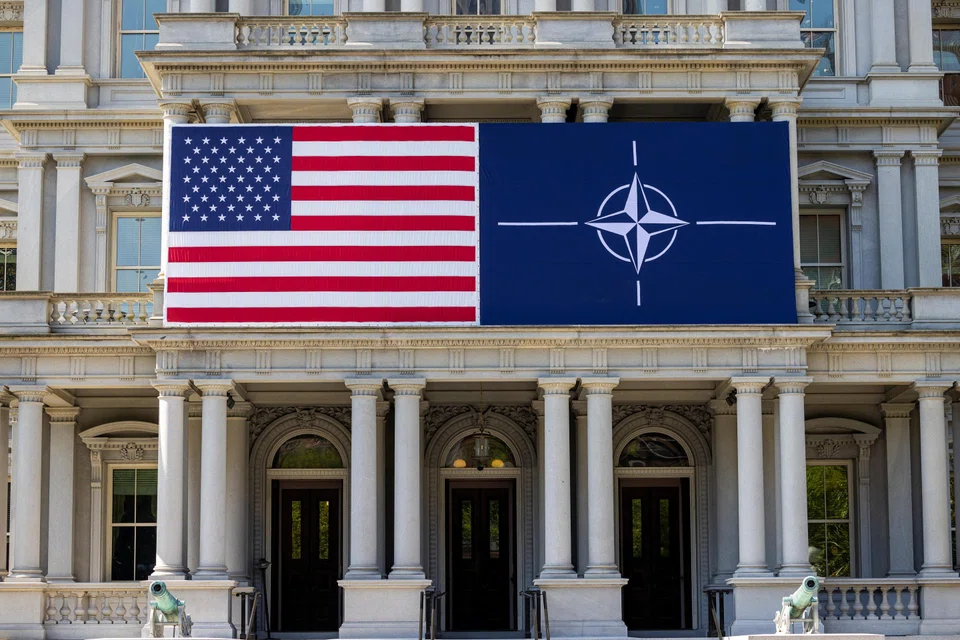
WESTERN leaders are this week commemorating the 75th anniversary of Nato, the creaking military organisation. Yet, attention is instead fast turning to another ageing figure at the heart of the transatlantic alliance, 81-year-old US President Joe Biden.
Multiple US allies around the world are alarmed by the recent presidential debate performance of Biden which has cemented growing expectations that he may lose the November election to Nato-sceptic Donald Trump. So much so, that at the next Nato summit in The Hague in June 2025, some in the military alliance are already projecting to transatlantic turmoil that characterised Trump’s first term from 2017 to 2021.
The continuing feasibility of Biden’s re-election campaign will therefore be an unofficial discussion point at this year’s summit. He is scheduled to speak several times, including at a press conference on Thursday (Jul 10) before heading back to the campaign trail in the US.
Yet, it is not just the United States where the alliance’s key members are in domestic turmoil. Another example is France where President Emmanuel Macron’s political wings have been clipped in recent weeks by the European Parliament elections and domestic legislative ballots.
One of the few areas where Trump, as US president, agreed with Nato was in a new-found focus on China. He will therefore be potentially very pleased that a key agenda at the summit is the threat posed by Beijing, including its sale of tools and technology to Russia.
For a third year in a row, top officials from key Western allies in the Asia-Pacific – Australia, New Zealand, Japan and South Korea – will attend the summit. Nato has low-level bilateral partnerships with all four of these allies, building from the bilateral partnerships that the US, the United Kingdom and France have in the region.
However, it will be Ukraine, and Nato’s broader future, that will be the main agenda topics. Here there will be positive announcements to make, despite the cloud over the US leadership.
Since Russia’s invasion of Ukraine, the alliance has grown in size in Northern Europe, and, in Washington this week, it will welcome Sweden to its first summit as a formal member. The 32 leaders can also flag progress on defence budgets – in 2024, 23 of the members are scheduled to meet the target of spending 2 per cent of their gross domestic product on defence, although key exceptions remain Canada, Italy and Spain.
On Ukraine, there will be a major one-year, 40-billion-euro (S$58.5 billion) pledge of support. While this is less ambitious than Nato’s initial proposal for a multi-year 92-billion-euro support package, it nonetheless provides some future clarity for Kyiv.
The alliance has also agreed to take over much of the coordination of arms deliveries from the Ukraine Defence Contact Group. This is a coalition of about 50 nations, also sometimes called the Ramstein group.
This gives Nato a more direct role in the war against Russia’s invasion while stopping well short of committing its own forces. The alliance will also coordinate the training of Ukrainian forces.
So the good news for new Nato chief Mark Rutte is that the context for the debate about the organisation’s future has been transformed in recent years. Only in 2019, there was widespread concern about Nato’s purpose with Macron saying that it had become “brain dead”.
Macron’s remarkable outburst was driven by what he saw as a rapidly changing geopolitical landscape. This included the diminished commitment of the US, under Trump.
Fast forward to today and Macron has said that Russia’s 2022 invasion of Ukraine has woken up Nato with the “worst of electroshocks”, even though big questions remain about its future. It is an unexpected turnaround of fortunes, in the most serious of circumstances, that could also be fuelled by Western concerns about China.
The Ukraine conflict has underlined the continuing relevance of Nato, with its collective member-state population of around one billion. For all its remaining weaknesses, Nato remains one of the world’s most successful ever military organisations, and has helped underpin the longest period of sustained peace in the West’s modern history with its combined membership accounting for around half of the global GDP.
Yet, while this is positive, Nato faces a major internal challenge if Trump wins the election in November. Former Trump administration officials, including former national security adviser John Bolton, have confirmed that the former president came close to announcing US’ withdrawal from Nato, throwing the alliance’s 2018 summit into disarray by threatening to pull the United States out.
Despite the strength of the other Nato members, there is no question that a US withdrawal would be a body blow to its future credibility. Trump, who originally called Russian President Vladimir Putin’s invasion of Ukraine “genius”, may also have advance plans to try to warm ties with Moscow, as was his intent from 2017 to 2021.
It should be remembered here that Trump not only criticised Nato colleagues, but also had cordial meetings with Putin, including in Helsinki. This erratic behaviour sent a chill down the spine of Eastern European states, many of which were formerly part of the Soviet Union.
Behind the scenes, there is much scenario-planning going on in Europe about the feasibility of a future Nato without US participation. It is possible that the Western alliance could try to keep the military organisation functional for a few years in the hope that the successor to any second Trump’s presidency might bring Washington back into the fold.
However, there are splits within the alliance on these issues as illustrated by Hungarian Prime Minister Viktor Orban whose nation currently holds the six-month presidency of the European Union. Orban recently made a controversial trip to Moscow to meet Putin. Orban, Nato’s most prominent critic regarding its support to Kyiv, leveraged his veto on Rutte’s appointment last month to secure an opt-out from Nato activities that support Ukraine.
In this context, Rutte and many other Western leaders assert in public that the best way forward for Europe to prepare for any change of the incumbent in the White House is to continue to transform the alliance, and increase defence spending. Here it is a combination of not just Russian military assertiveness, but also instability in the Middle East and Africa, and the legacy of Trump’s uncertain commitment to Europe’s security, that is turning this picture around. In the longer term, it is also plausible that higher defence spending is locked in by Nato concerns about wider shifts in the global security environment, including over China.
The writer is an associate at LSE IDEAS at the London School of Economics






