

What good is a newborn baby? Quantum tech in its infancy, but industry watchers see plenty of potential
The country’s investments into quantum technology 15 years ago have paved the way for a budding startup scene. Attracting investors is the next challenge.

Sharanya Pillai

A COMPUTER that runs at unimaginable speeds and cracks unsolvable problems – this is the next frontier of technology that countries, including Singapore, are racing towards.
The war is on to build “quantum computers” that, unlike traditional computers, are based on principles from the mind-bending field of quantum physics. In 2019, Google claimed that its quantum processor Sycamore took just three minutes and 20 seconds to perform a task that would have taken the world’s most powerful supercomputer 10,000 years.
The idea of achieving “quantum supremacy” has since captivated the world. Quantum computers and related technologies – such as quantum sensing and cryptography – could revolutionise everyday life in the same way computers and the Internet did. This could mean unprecedented connectivity, medical breakthroughs and superior artificial intelligence models, but also new threats to national defence and cybersecurity.
The global quantum race has mainly been playing out between the United States and China, as both countries pump billions into research. But this also creates an opening for Singapore, which has quietly invested in quantum research for over 15 years, to lead the way as a neutral player with new startups and innovations.
In 2007, Singapore set up a specialised institution, the Centre for Quantum Technologies (CQT), to advance research in this field. Alumni of the centre have since set up four local startups specialised in quantum technology and two companies have been spun off. Most have attracted venture funding from deep tech investors (see table).
The government has also formed a National Quantum Office and, earlier this year, announced three national quantum initiatives that will receive at least S$23.5 million in funding in total.
Developed in the early 20th century, quantum science is still in its infancy. This means the possibilities for new quantum innovations are still under exploration, says Artur Ekert, CQT’s founding director.
“Imagine we just discovered electricity,” Prof Ekert says at an interview in CQT’s premises. “It’s the early days, and you say: ‘Well, what is this good for?’ But you get the feeling that this is such a powerful resource, it will have to be used for something – even though your imagination is not yet up to it.
“We have exactly the same situation. We’ve discovered all kinds of interesting quantum phenomena; and with our imagination, we can have some sort of vision on what it may be (used for). But, most likely, something even more fascinating will happen.”
Big unknowns
No one has yet succeeded in building a functional quantum computer that can be commercialised and mass-produced.
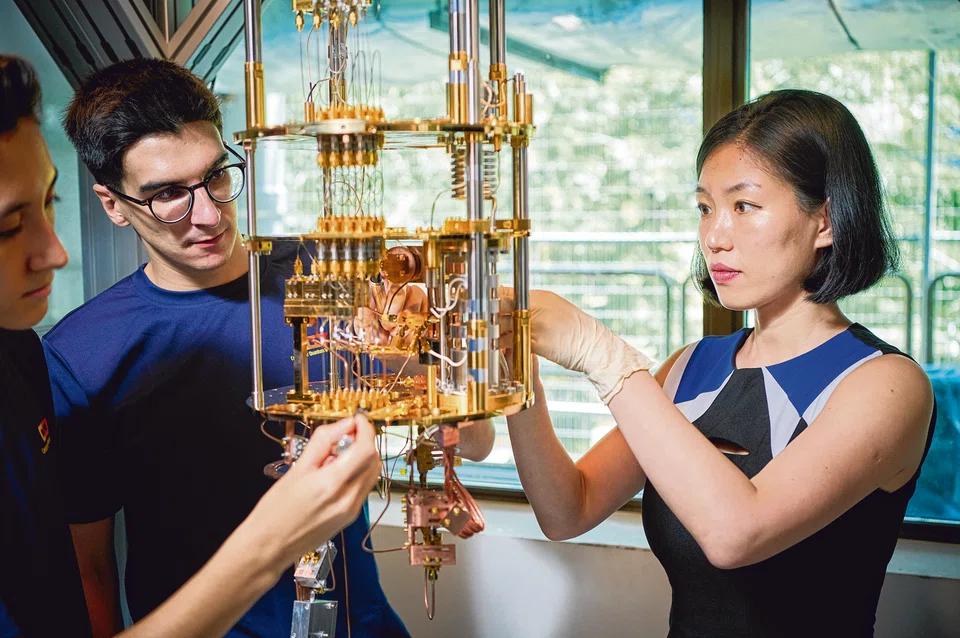
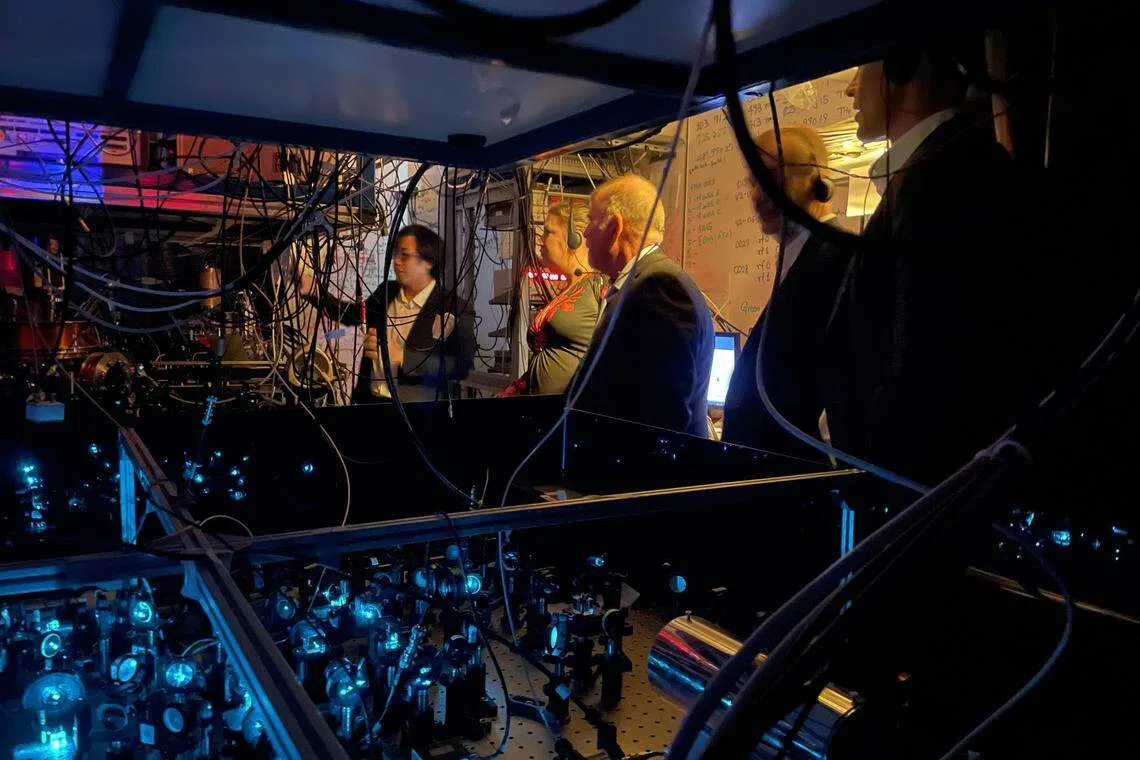
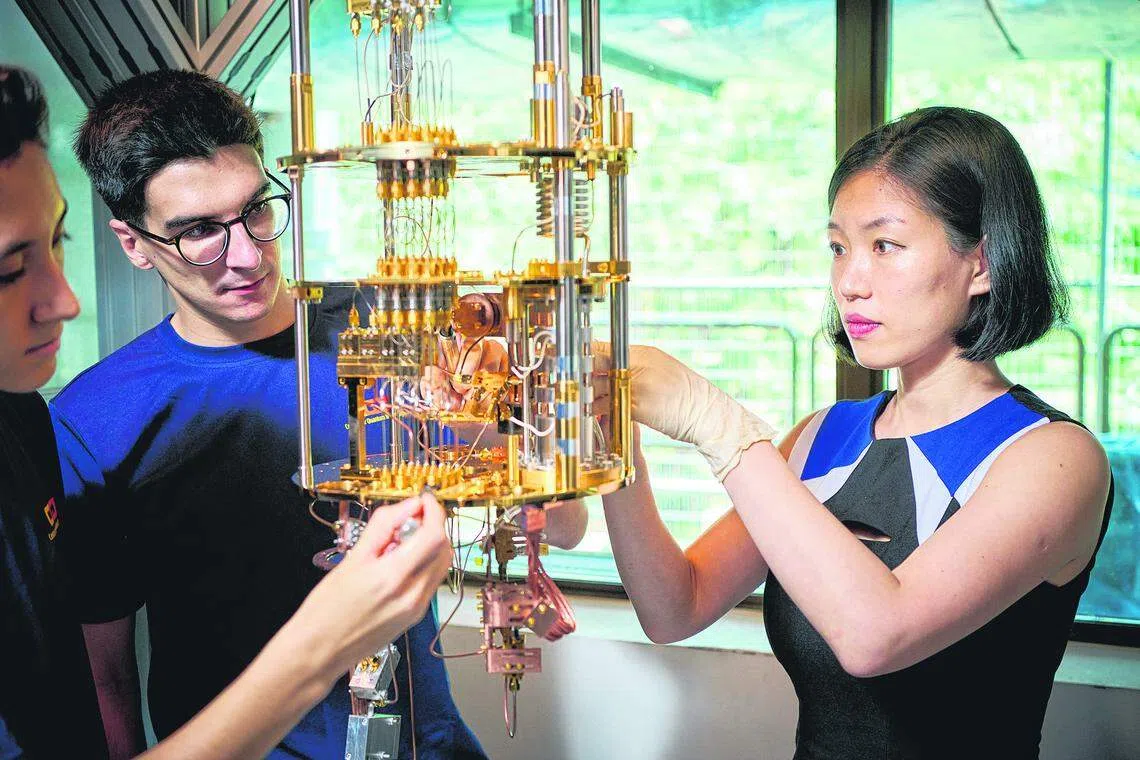
Researchers are still experimenting with several methods. Some use superconducting circuits to encode information. The circuits are then cooled to sub-zero temperatures by grandiose golden structures. Others manipulate trapped ions, or charged atomic particles held by electric fields.
Tong Hsien-Hui, executive director of investments at deep tech investor SGInnovate, notes: “It is still unclear which pathway will lead to the holy grail of a general quantum computer … A clear winner has yet to be declared, and the industry has yet to get behind any one path.”
That said, the past few years have brought about rapidfire advances in quantum hardware.
Several tech giants have built their own quantum computers, from Google to IBM and, most recently, China’s Baidu. Some US-based startups have also come up with their own systems, such as IonQ and Rigetti Computing. Both went public within the last year.
The big question in the industry is how large the market for quantum computers will be. Over at Singapore-based startup Horizon Quantum Computing, company T-shirts carry one sentence: “I think there’s a world market for maybe five quantum computers.”
It’s a riff on an infamous quote by IBM chairman Thomas Watson, who in 1943 is said to have pessimistically, and very wrongly, predicted that the global market for computers could perhaps be for five of the devices.
The quantum computing world is seeing some parallels with the early days of the computer. There are some people who see quantum computing as all-powerful, notes Horizon’s chief executive officer (CEO) and co-founder Joe Fitzsimons. Others believe in the extreme opposite: that quantum computers will never take off.
“The reality is that neither of these are correct,” says Dr Fitzsimons.
“Year by year, month by month, even week by week, progress is made in the field … From my view, it seems there is an inevitability that we will get to fairly large-scale quantum computers in the not-too-distant future.
“What that means is up for grabs.”
Singapore’s quantum innovators
Hardware is not the only barrier standing in the way of a quantum future; the other missing piece of the puzzle is software. Few are trained in both conventional and quantum computing. This means that even if hardware becomes available, Dr Fitzsimons says, companies may struggle to make use of it.
“There are very few people who have actually worked on quantum algorithms. If you ask what’s the intersection of them with domain experts in the different areas where quantum computing is likely to see applications, often the case is that there are zero people with expertise in both,” he says.
For instance, quantum computers could be immensely useful in the oil and gas industry for simulating geophysical conditions. But, Dr Fitzsimons says, “there is no one on the planet who is both an expert in computational geophysics and quantum algorithms”.
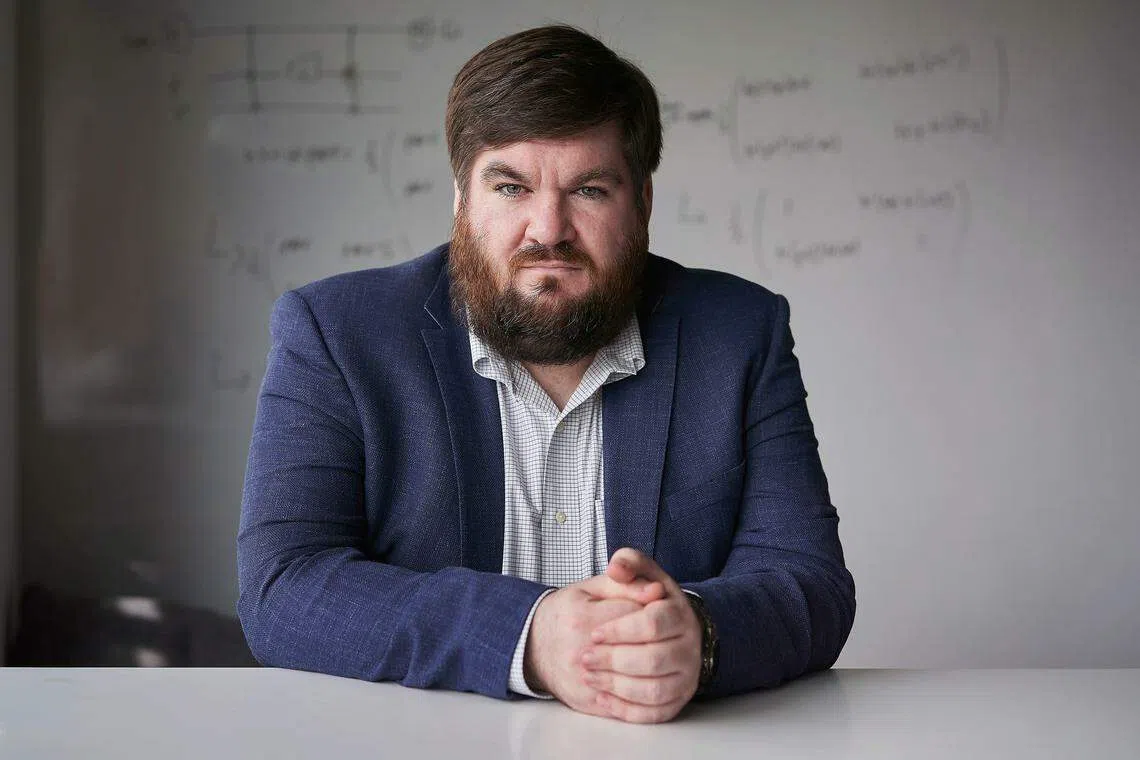
Horizon is out to tackle this problem. Dr Fitzsimons and his co-founder Tan Si-Hui, both former researchers at CQT, are developing tools that will make it easier to construct complex quantum algorithms.
With this value proposition, the four-year-old startup has caught the attention of investors. Regulatory filings show it raised US$12 million from an entity linked to China’s Tencent earlier this year and US$1.1 million from its early investor Sequoia Capital India. The startup is growing rapidly, with plans to add up to 25 new roles in science, product engineering and support.
Startups such as Horizon are bridging the divide between conventional and quantum computers, says Tong of SGInnovate, which is also invested in the company.
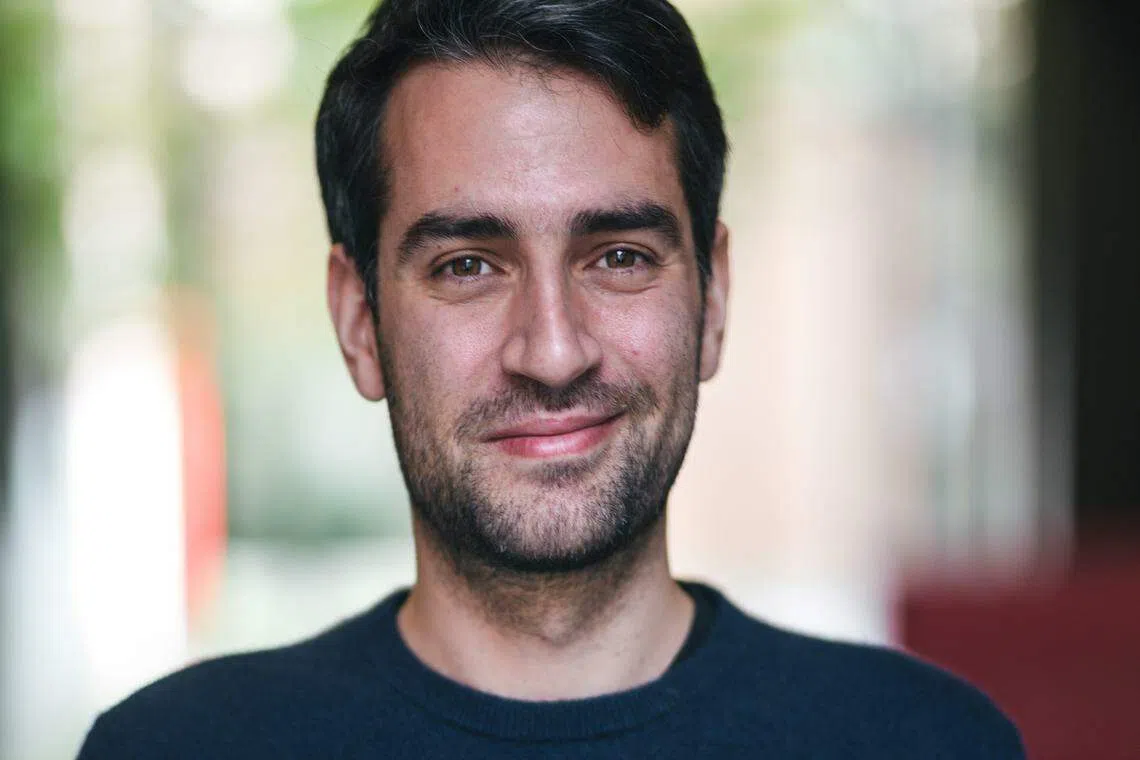
Another Singapore-based startup in this realm is Entropica Labs. Its co-founder and CEO Tommaso Demarie notes that many companies face optimisation problems, such as knowing how to delegate resources in the way to best maximise revenue. The former CQT researcher, who was once a postdoctoral fellow under Dr Fitzsimons, is interested in how to make quantum computing useful to companies.
“We said, ‘Let’s aim to build a software development kit that allows you to run a family of quantum algorithms on today’s quantum computers’, so that you can solve optimisation problems for research purposes,” explains Dr Demarie.
In 2020, Entropica Labs teamed up with Honeywell Quantum Solutions to help BMW with such a scenario. The carmaker wanted to benchmark the capabilities of small quantum computers to optimise its supply chain management. Entropica tested this experimentally and found the performance to be competitive with a conventional algorithm.
The startup’s technical expertise impressed Elev8.vc, a Singapore-based deep tech investor, says its managing director Aditya Mathur. “They’re already adding value to very large multinational corporations today that are starting to understand the impact of quantum computing on their businesses.”
As an investor, Elev8.vc was looking out for companies that, in the next three to five years, could potentially provide a de facto software solution in the quantum computing industry. “We believe (Entropica) will be an incredibly valuable software company, irreplaceable for all quantum users,” says Mathur.
Being safe from quantum
There is a fear, however, that quantum computers could easily break present-day encryptions, endangering secure networks and financial infrastructure.
Anticipating this problem, several startups are racing to build “quantum-safe” technologies that help businesses and governments mitigate the risks of a quantum future.
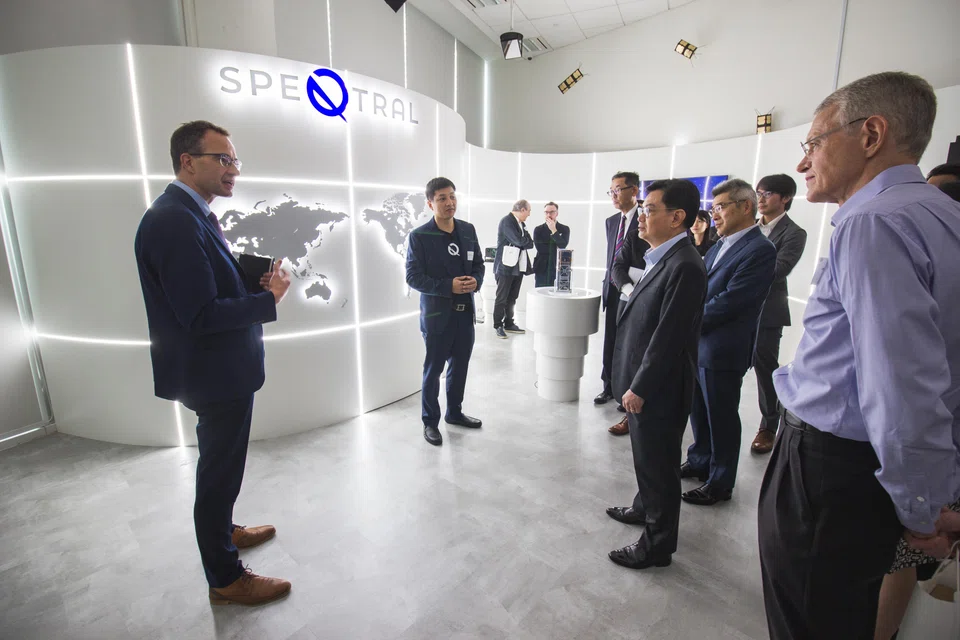
One such Singapore startup is SpeQtral, a CQT spin-off that designs and manufactures satellite-based quantum communication systems. It is backed by Temasek’s early-stage investment platform, Xora Innovation.
SpeQtral hopes to protect sovereign and enterprise telecommunication networks against classical as well as future quantum-based cyber-attacks. It taps a technology known as Quantum Key Distribution (QKD) to deliver secure encryption keys globally.
“This is a way to enhance existing communication infrastructure to be resilient against a possible quantum attack. It’s about upgrading your security and encryption standards,” explains Lum Chune Yang, SpeQtral’s CEO and co-founder.
SpeQtral is involved in several industrial projects. Last month, it launched a Quantum Networks Experience Centre (QNEX) with Toshiba for commercial partners, researchers, and government agencies to familiarise themselves with quantum cryptographic technologies. The startup is also set to launch a satellite, known as the SpeQtral-1 satellite, in 2024 or 2025.
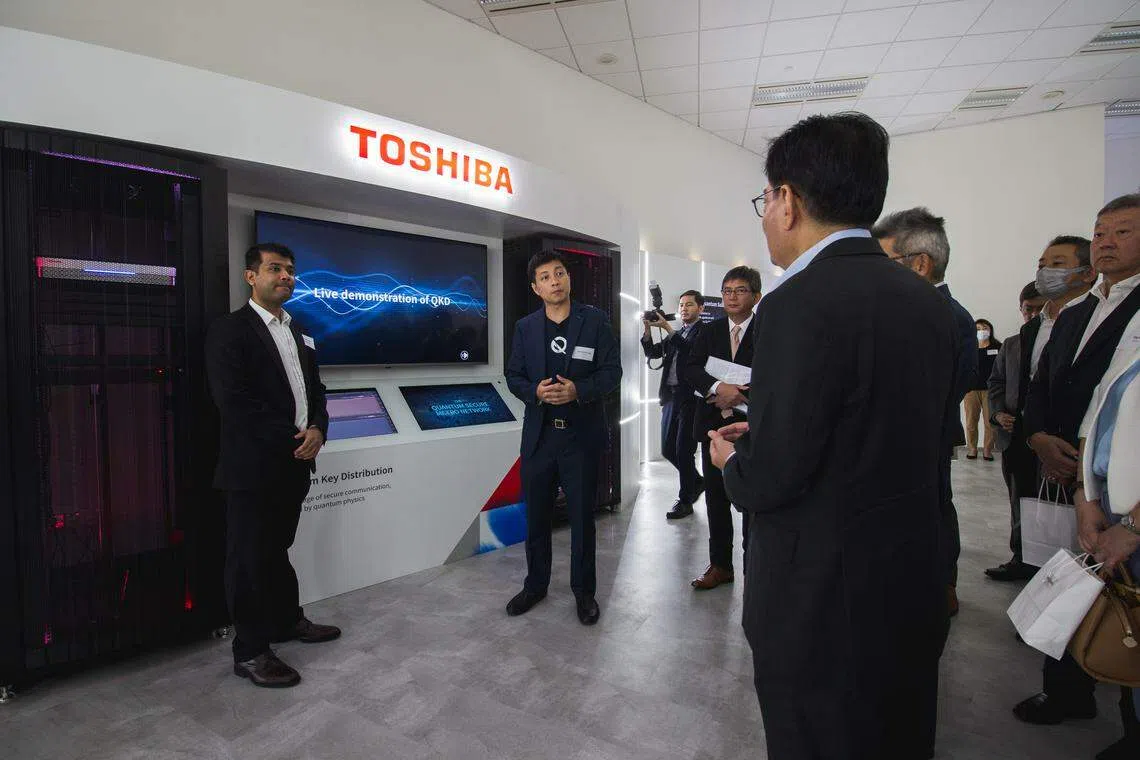
Investing in quantum safe technologies is a priority for Singapore. At the QNEX launch event last month, Deputy Prime Minister Heng Swee Keat said the country will continue to invest in the National Quantum-Safe Network – a national research programme that aims to advance quantum-safe communications and develop use cases.
The path ahead
It is still early days for Singapore’s quantum tech startup scene, but Prof Ekert of CQT is optimistic of its growth potential. He notes that many younger researchers are taking an interest in entrepreneurship and that early-stage venture capitalists have stepped in with support.
Attracting investors for the next stage of growth will be a challenge. He recounts how several investors he spoke to recently voiced fears of a “quantum winter”, when the hype dies down and funding for quantum technologies dries up. Shares of publicly listed IonQ and Rigetti are down 60.8 per cent and 90.2 per cent from their initial public offerings.
“Investors always ask about it: Are we heading for a quantum winter? I say: ‘How do I know? You guys tell me, do you still plan to invest?’” Prof Ekert says. He nevertheless believes deep tech investors will remain interested in not just quantum computing startups but also those that provide supporting infrastructure.
Singapore’s quantum entrepreneurs are cautious in their pitch to investors. Dr Fitzsimons emphasises the importance of managing investor expectations.
“It’s very important to be upfront about the reality of the field – what the risks are and the state of readiness of the technology,” he says. “To be honest, you’d be crazy not to be, because you need to build a long-term relationship with your investors.”
Dr Demarie of Entropica echoes this, adding: “Today, the cost (for investors) to enter the market is still relatively low, and I believe that the opportunity is massive.
“So, there is a real opportunity to enter the market early at a good price – not only potentially reaping the financial benefits, but also to play a very active role in the industry.”
For those who are still sceptical of the usefulness of quantum computing, CQT’s current director, Professor Jose Ignacio Latorre, offers an anecdote: It is said that physicist Michael Faraday was once asked by a politician what electricity would be good for. Faraday’s famous response: “What good is a newborn baby?”
TRENDING NOW

Once staunchly pro-China, Malaysian Chinese businesses are now distancing themselves from Beijing

The middle power moment arrives in South-east Asia – but not for Asean

DBS, OCBC, UOB face rate hike reality check

Vietnam’s northern provinces, not Hanoi or Ho Chi Minh City, are powering near 10% GDP growth

