What makes a coincidence meaningful?
THERE are two kinds of people in the world: people who say, “What a coincidence”, and people who say, “Just a coincidence”. Same facts, different reactions. Are you the “what a” kind or the “just a” kind?
I’m a “just a coincidence” person. I attended an economics conference in the World Trade Centre on Sep 10, 2001, and decided not to go back for the second day. I read nothing into it. (The conference was below ground level, so everybody who stayed for Sep 11 got out safely, for what it’s worth.)
Coincidences are hard to define. It’s not just two things happening at once. There has to be an element of surprise. But what counts as surprising is subjective and squishy.
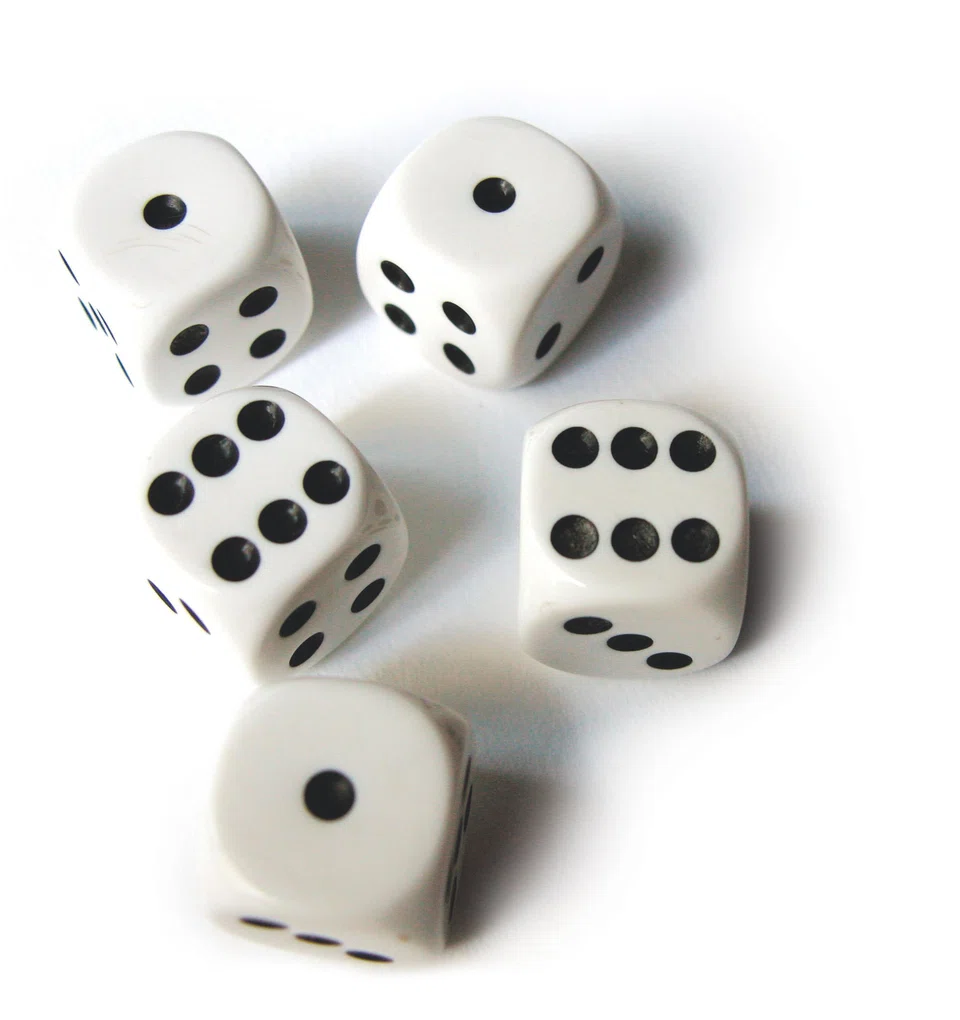
For example, rolling a die and getting 6-6-6-6-6-6-6-6-6-6 seems more surprising than getting, say, 6-2-4-5-1-3-2-5-4-6, but the two are equally probable. If you live in Eldena, Illinois, you’d be amazed to roll 6-1-3-2-4 because that’s your ZIP code. For everybody else, meh.
How many people do you think need to enter a room before there’s a 50-50 chance that two of them will have the same birthday? Just 23. Remember that it’s any two people, not necessarily you and someone else, so there are many potential pairs.
Our brains don’t “do” randomness. To prove it to yourself, try spitting out digits randomly as fast as you can. You’ll find yourself stupidly repeating 1, 2, 3 and other obvious patterns over and over. The only way to make your digits sound random is to slow way down, which only means you’re concealing your thought pattern. No wonder we see faces in clouds and portents in lottery numbers.
I interviewed Persi Diaconis, a mathematician and statistician at Stanford as well as a former professional magician. “What’s surprising to me is how easily surprised people are by coincidences,” he told me.
“It feels to me as if we’re hard-wired to overreact to coincidences”, because it’s often safer to see patterns that don’t exist than to overlook patterns that do exist, Diaconis said. “Take primitive man in the jungle. He sees something moving. If it looks like stripes, maybe it’s a tiger. He’s going to just get out of there and not stop to figure out the odds that it’s a tiger.”
Diaconis said that he’s been planning for years to write a book on the subject, but that psychology and evolution aren’t his fields. But then someone asked him just a week ago when he was going to do that book, and then he got my call. (What a coincidence!)
Conspiracy theorists, among others, are fond of saying there are no coincidences. It seems reasonable, then, that people who are prone to believing in conspiracy theories are especially hard-wired to detect patterns in randomness.
But that does not seem to be the case, according to a 2015 article by Sebastian Dieguez of the University of Fribourg in Switzerland and two others in the journal Psychological Science. When presented with a series of X’s and O’s, conspiracy theory believers were no more likely than others to perceive patterns in random strings of characters.
“Conspiracy theory believers are not simply naïve or mistaken; they chose to endorse some alternative explanations of events and then find the ways to rationalise them,” Dieguez wrote me in an e-mail.
He said his latest research indicates that people who see lots of coincidences have a “deep-seated bias to look for an ultimate cause, function or purpose for things, nature, people, events and the world in general”. That ultimate cause can be God, but it can also be “a preordained plan designed by a powerful and malevolent agency”, he wrote.
Hallucinations by large language models in artificial intelligence are, I think, weirdly related to the coincidence problem. Large language models are essentially autocomplete machines that fill in the words that seem most likely, given the words that came before. So they’re very good at creating sentences that seem plausible, even though they may be detached from reality, just as “what a coincidence” pattern spotters unintentionally do.
I also spoke with someone who has much warmer feelings toward “what a coincidence” people – Bernard Beitman, a retired professor of psychiatry who calls himself a recovering academic. He founded the Coincidence Project in Charlottesville, Virginia, and wrote a book, published in 2022, titled, Meaningful Coincidences: How and Why Synchronicity and Serendipity Happen.
As a young man, Beitman wrote in the book, “I was a part-time psychiatric resident and part-time hippie, spending half the week at Stanford and half the week on the streets of the city. During those days, coincidences flew rapidly into my consciousness.” The book contains a quiz to determine how open you are to seeing coincidences as meaningful. (I confessed when I interviewed him that I scored as “ultra closed”.)
He shared with me two meaningful coincidences from his life. When he was nine, he was searching for his lost puppy, got lost and, in getting lost, found his puppy. As an adult, he had a sudden choking fit, only to find out later that at the same time 3,000 miles away, his father was choking on his own blood and dying.
Beitman directed me to a kindred spirit, Philip Merry, a Singapore-based therapist and counsellor whose practice is based on what the psychoanalyst Carl Jung called synchronicity, or meaningful coincidence. Merry’s personal catalogue includes a time when he realised he needed US$15,000, and 10 minutes later was offered a speaking engagement that paid exactly that amount.
I have nothing to say about these particular stories, but I find that some of the amazing coincidences one reads about have been sandpapered and fortified more than a little over time.
On the other hand, dismissing every surprising outcome as just a coincidence can also be a mistake, and Beitman’s book has a great example from mathematics.
The number 196,883 is important in one branch of maths, while the number 196,884 is important in another. The first person to notice this was John McKay, in 1978. The connection between the branches came to be known as “Monstrous Moonshine”. Since then, “the Moonshine topic has blossomed into a field of study in its own right”, according to the mathematician Mark Ronan.
So coincidences can be surprisingly fruitful at times. Just don’t get all Agent Mulder. Most of the time, it’s just a coincidence.