What the US presidential election means for China and the rest of Asia
Would Beijing consider one particular outcome more aligned with its interests?

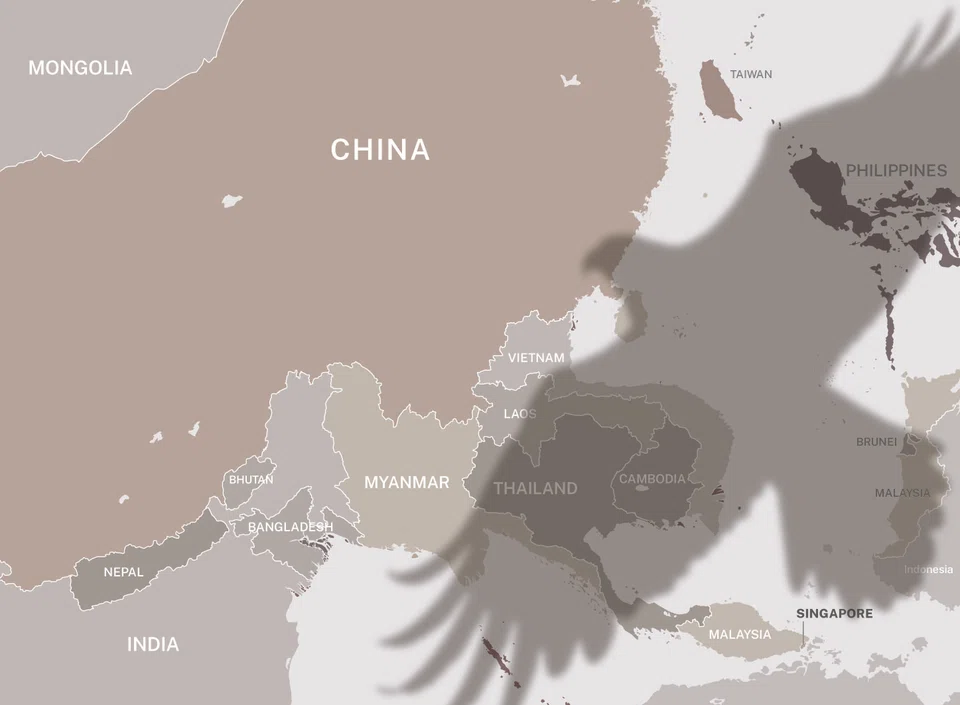
WILL the outcome of next week’s US presidential election alter the trajectory of America’s relations with its largest rival, China?
The short answer, according to analysts, is “no”. The long answer is more nuanced.
One reason for saying “no” is that China and the West have in recent years been on a “fairly specific and predictable” path, Alex Capri, adjunct senior lecturer at the National University of Singapore Business School tells The Business Times.
“What we’re looking at is a reorganisation of the global economy, a bifurcation around strategic supply chains,” says Capri, likening the current climate to a “hybrid Cold War environment”.
“That trajectory is fixed, regardless of the election in the US.”
Krystal Tan, Asia economist at ANZ, agrees that trade relations with China are likely to remain challenging due to bipartisan US support for restrictive trade policies.
While former US president and Republican candidate Donald Trump was the one who waged a trade war against China during his term in office, it is notable that President Joe Biden has neither removed nor lowered these tariffs, she says.
“Instead, the Biden administration has imposed new tariffs and strengthened export restrictions on advanced technologies.”
Cedomir Nestorovic, a geopolitics professor from Essec Business School, notes that Democratic presidential nominee Kamala Harris is perceived to be the more balanced candidate, but it is not in her power to dial back the political “machine against China”, which is now in full swing.
Yet, points out Tan, despite this continued broad trajectory, US trade policies – which are crucial for Asian economies – should still differ somewhat depending on who wins.
Different standpoints
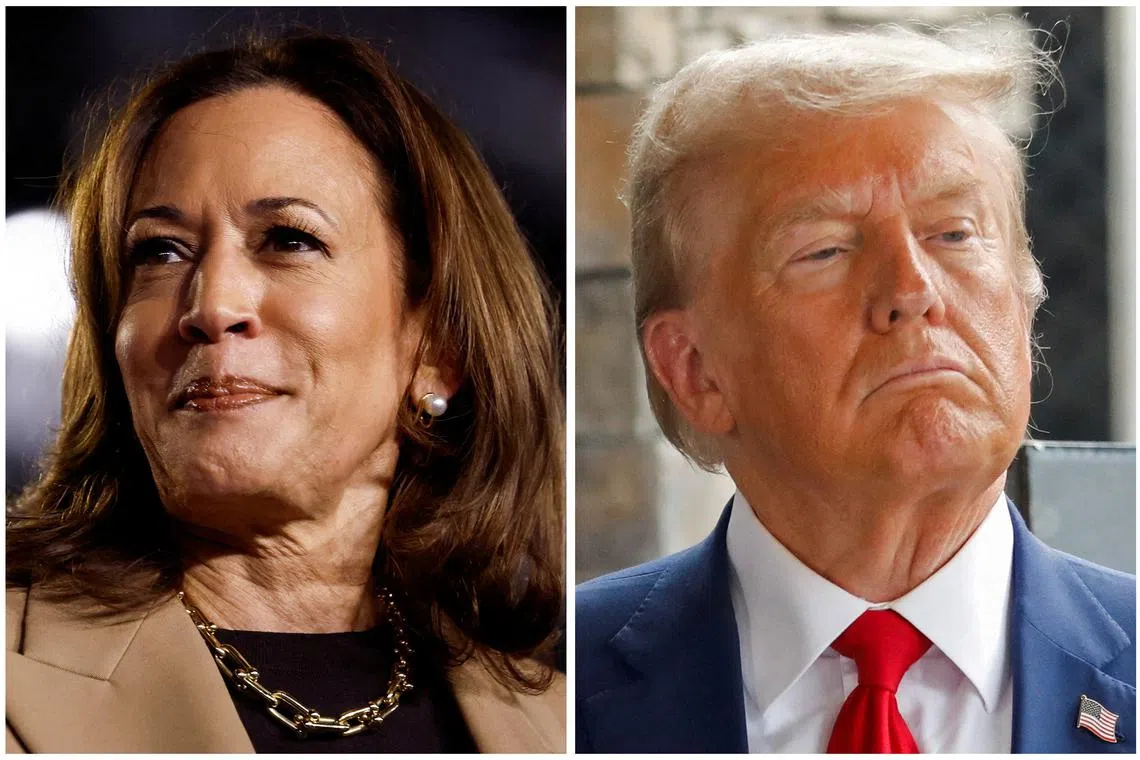
Observers say the nuance comes from the drastically different personalities and standpoints of the two presidential candidates, which will influence how they approach relations with other world leaders.
Trump, who hopes to return to the White House for a second term after losing to Biden four years ago, is seen to favour pragmatism over ideology, notes Prof Nestorovic.
Vice-President Harris, he adds, is more likely to adopt the Democrat approach of being ideologically driven, giving consideration to what is moral, good or preferable.
At the same time, a Harris administration may not necessarily be an extension of Biden’s.
“Early expectations were that Harris would continue Biden’s approach, but she’s signalling she’ll chart her own course,” says Simon Tay, chairman of the Singapore Institute of International Affairs (SIIA). “It’s still early to tell, but continuation now seems less likely than initially assumed.”
Nonetheless, Harris is expected to embrace a rules-based approach that promotes stability and strategic engagement, if elected.
In contrast, if Trump wins, watchers expect a return of the volatility that pervaded his four years as president.
“A Trump presidency will see a very transactional, mercurial, almost impulsive sort of environment that will be less predictable than a Harris presidency,” Capri observes.
As president, Trump was almost predictably unpredictable. Prof Nestorovic recalls how people would check Twitter in the morning to see what the latest statement from the then president was. “Even his administration didn’t have a clue.”
Trump is also likely to reject multilateralism, given his disdain towards such an approach during his first term in the Oval Office. “He doesn’t like a situation where the United States is not free to implement anything that it wants,” Prof Nestorovic adds.
Tariffs galore
Trade is one major area where the election result will matter. If re-elected, Trump is expected to double down on protectionist measures.
Vasu Menon, managing director for investment strategy at OCBC, notes that the tariffs Trump introduced in 2018 and 2019 covered only about 4 per cent of US imports and were smaller than those he now proposes.
“This time around, the tariffs that he’s talking about are very draconian, and it is across the board – it is not just directed towards China or certain goods and industries,” he points out. These include tariffs of 10 to 20 per cent on all imports and 60 per cent on those from China, as well as a 100 per cent tariff on countries that shift away from the US dollar.
Business think tank Tax Foundation estimates that if these tariffs come to pass, they could shave 0.8 per cent off US gross domestic product and cause the loss of 684,000 jobs.
Menon also notes that while the S&P 500 index rose by nearly 70 per cent over Trump’s four-year tenure, this was because he slashed the corporate tax rate to 21 per cent in his first year, from 35 per cent.
The massive 14-percentage point cut lifted the US economy, which in turn gave the stock market a boost that lasted several years, he says.
Trump has now indicated that he wants to cut the rate further, to 15 per cent. But Menon adds: “This time around, I don’t think he can do the same. He cannot do it unilaterally, he has to take this to Congress, and even the US Republican Party is not clear whether (it) will buy into something like that.”
And while Trump hopes that tariff revenue will make up for the tax cuts, a tool as blunt as tariffs could hurt the economy, observes Menon.
“Under Trump, inflation rates were lower, but I think many of them may not be able to realise that tariffs could actually push up inflation quite significantly.”
Former diplomat Bilahari Kausikan expects another Trump administration to be “tougher” on Chinese exporters using South-east Asia and Mexico as a “back door” into the US, as well as “Chinese companies ‘Singapore-washing’ themselves”.
Harris is unlikely to go to such extremes – but may not represent a change of stance either.
In a Facebook post, Bilahari wrote: “It is not that a Harris administration will ignore these issues, only that she may not pursue them with the same sharpness, but pursue them in some way she will.
“We have to understand that the US attitude towards trade has fundamentally changed, and adapt ourselves to the new reality.”
Similarly, Prof Nestorovic believes that it is not a given that tariffs will be eased under a Harris presidency, saying: “When Joe Biden was elected, many countries in Asia believed that he would introduce a reset of the relationship with China, and that he would abandon the tariff wars with China. What happened was the contrary.”
For example, the Biden administration imposed a 100 per cent tariff on Chinese electric vehicles.
Prof Nestorovic thus sees “no big difference” between Trump and his Democrat counterpart, where tariffs are concerned.
What China wants
China has not publicly thrown its support behind either candidate. The real question is whether Beijing would consider one outcome more aligned with its interests.
Observers who believe that China would prefer Trump cite reasons such as a familiarity with his style. Harris has not engaged with Asia much in her last four years as vice-president.
Prof Nestorovic says that Trump’s pragmatic point of view is also generally aligned with the Asian world view, “meaning we are not really obsessed with the ideological differences with what is good, what is bad, et cetera, but we are purely concerned with what works and what doesn’t work”.
Capri believes that Beijing “probably thinks they can play Trump a little bit better than Harris”. The perception is that what Trump says and what he does may not necessarily be the same, which implies he is open to negotiations.
“He’s looking to bargain and get some kind of quid pro quo, so everything is a transaction,” he explains. “If, in fact, one can figure out what Trump wants and figure out how to play that in some kind of quid pro quo, I think the Chinese think – as does (Russian President) Vladimir Putin – that that might be better in the long term for their interest, than to have a very well-structured Harris administration that builds upon multilateralism and rule frameworks.”
Yet, observers who think China may prefer Harris cite a similar reason: predictability.
“They would also prefer a continuation of the Biden policies that a Harris administration will deliver,” says Pushan Dutt, an economist at Insead.
He notes that Biden regularly sent senior administration officials to China and met Chinese President Xi Jinping on the sidelines of an Asia-Pacific Economic Cooperation meeting in San Francisco last year. All this has led to a pullback from the heated rhetoric of the Trump administration.
“Trump has become more volatile and some would say unhinged over time, and his administration will not have ‘adults’ in the room,” adds Prof Dutt. “With (its) economy struggling, China needs stability and predictability right now.”
And while the Biden administration did keep the Trump tariffs in place, it also adopted a more targeted approach.
“Trump, on the other hand, is ratcheting up rhetoric on tariffs, which should be taken seriously and literally,” he says.
OCBC’s Menon notes that Harris also favours global diplomacy, which means that trade relations are likely to be less contentious.
The view from Asean
For businesses in Asean, a Harris win is probably the more favourable outcome, given the associated stability and predictability.
Insead’s Prof Dutt lists three risks that businesses could face with a Trump re-election. First, Trump’s tariffs could result in retaliation from the rest of the world, worsening the environment for global companies.
Second, the US under Trump is likely to turn more isolationist, even as geopolitical uncertainty grows across the world.
The third risk is more subtle – he expects Trump to meddle in the Federal Reserve’s composition and its decisions.
“He has contemplated ending (its) independence,” Prof Dutt says. “With the US dollar as the world reserve currency, markets will be roiled if he does so.”
Under Trump, uncertainty about trade, tariffs, Fed policies and foreign policy would make businesses in the region more nervous, he adds.
OCBC’s Menon sees Harris as being more open to engaging with Asia, including Asean. This is particularly relevant for small countries such as Singapore that have an existential preference for multilateralism and a rules-based approach.
“(Trump’s) Maga (Make America Great Again) policy is more inward-looking, less interested in what happens around the world, less interested in how others are negatively impacted by his policies, more interested in how it benefits Americans,” continues Menon.
But SIIA’s Prof Tay argues that Asean has not benefited much under either Trump or Biden. “Trump ignored Asean, and Biden said Asean is essential but there’s been little follow-through.”
Still, this may not necessarily be a bad thing, he adds. “In some ways, perhaps it’s better for Asean to stay off the president’s radar, especially if the sentiment is anti-China.”
Staying off the radar means that Asean might avoid being pulled into the US-China rivalry, he points out. “This allows Asean countries to maintain balanced relations and regional stability without the pressure to choose sides.”
For Menon, the “best outcome” is a Harris victory with gridlock in Congress, as that could curb her more “drastic” policy intentions.
“Harris also talked about the possibility of taking the corporate tax rate up – from 21 per cent currently back up to 28 per cent – and that’s going to be negative for companies.” That would reduce earnings for US firms, hurting the economy.
If the Democrats sweep Congress – which looks unlikely – then Harris will be free to do so. Gridlock would prevent this, notes Menon. It would also prevent Harris from “being able to spend as much as she wants” or cut taxes so dramatically that it worsens the US budget deficit.
“As it is, the US budget deficit is very significant – it’s almost 7 per cent of GDP – and the markets are questioning the sustainability of the fiscal policy and debt sustainability in the US,” he adds.
As to whether gridlock could also stymie useful Harris policies to boost the economy or fight climate change, Menon says that some of these are ongoing projects that already have bipartisan support.
While Trump is against sustainability, Menon believes the Republican Party as a whole is not, and is thus unlikely to challenge Harris on that front.
For now, the presidential election remains too close to call, even in the final days leading up to Nov 5.
Pundits believe the election is down to just seven “swing” states that had victory margins of less than three percentage points in the 2020 election.
Says Prof Dutt: “A tiny fraction of undecided and disengaged voters in seven US states will determine how the future unfolds for all of us.”