What will happen when the small Pacific states disappear under the sea?
There are many questions but few answers about the fate of small island nations like Tuvalu
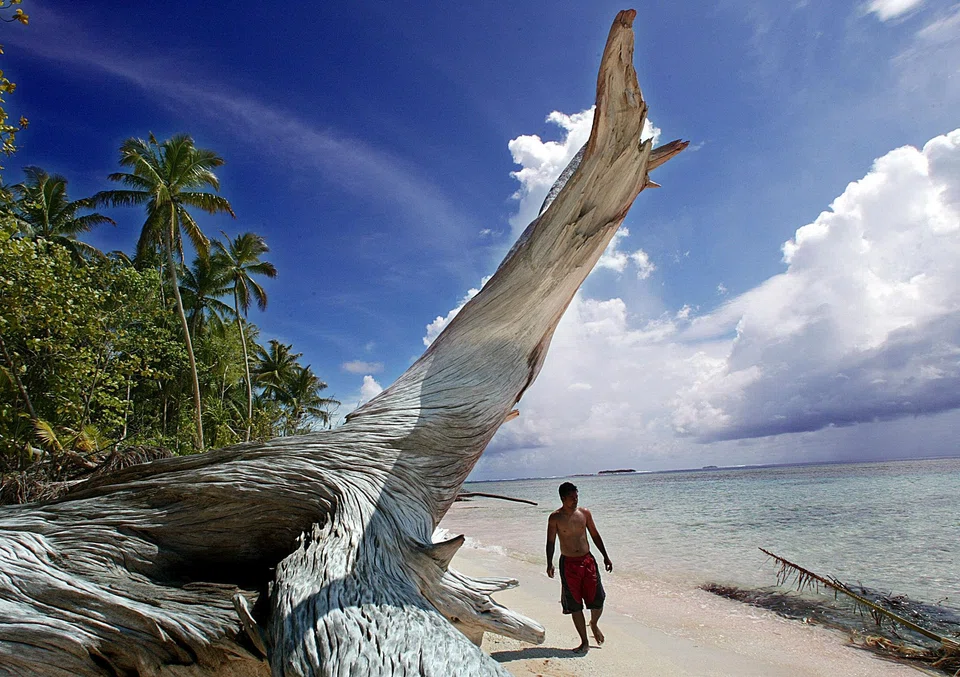

WHAT happens when climate change meets the 21st-century version of the Great Game? The destiny of the tiny Pacific nation of Tuvalu may hold some clues. This country has a population of just 10,643 at last count and is located midway between Hawaii and Australia.
Tuvalu is an archipelago of six coral atolls and three islands with an area of just 26 sq km. To say that the islands are low-lying – most inhabited places being just four to five metres above sea level – is to belabour the point. There are no rivers. Rain and wells provide the fresh water.
The islands used to be a British colony but became independent in 1978 and a member of the United Nations on Sep 5, 2000. And it has a functioning government answerable to an elected parliament.
Despite the dearth of farm land and the fact that most people make a living through fishing and from overseas remittances, it is classified as an upper middle-income nation. But then the government has a steady revenue stream, estimated at US$10 million a year, thanks to its internet domain designation as “.tv”. Video streaming companies pay good money to use that designation.
Yet, their situation must be dire. Otherwise, how can anyone account for the fact that, in July 2025, about half of its citizens applied for a visa to permanently migrate to Australia? The islanders were availing themselves of a scheme Canberra offered to the Tuvalu government in return for a say in its foreign policies. Only 280 people are allowed to permanently migrate to Australia each year.
The overarching rationale behind the scheme was not any outpouring of Australian generosity or concern for the plight of islanders facing rising sea levels. Rather, it was a geostrategic move to counter any ambition China may have of getting small island states on to its side. Australia has a similar deal with Nauru, another tiny Pacific island nation.
Canberra’s initiative grew out of a reaction to a deal the Solomon Islands struck with Beijing in 2022. China had agreed to help Honiara maintain social order, provide aid during natural disasters and help safeguard Solomon Islands’ national security.
Western media played it up as Beijing’s thrust into Australia’s backyard and, by extension, into the West’s bailiwick. This triggered much anxiety in Canberra and consternation in Washington.
Since then, rivalry between the West, in this particular instance led by Australia, and China, has meant that Australian taxpayers have had to shell out large sums in grants and loans as Pacific islanders set their terms for leaning politically their way. Thus, the Great Game is playing out, this time in the Pacific.
But Tuvalu faces a unique problem. Even at the current pace of migration, Tuvalu will be mostly empty of people in about 15 years. What happens then, assuming that some bits of the archipelago remain above sea level in 2040?
There will be marine and seabed resources to be had from the exclusive economic zones of almost 720,000 square metres under the Law of the Sea. Could Australia take it over and build artificial islands, a la China in the South China Sea? Would the former citizens of Tuvalu still have a claim on its wealth?
There are many questions but few answers in what might become the common fate of small island nations facing the rising sea.