

What’s deterring developers from tapping perks to juice up Singapore’s urban centre?
Industry watchers say the incentives offered under the two schemes launched five years ago may not be attractive enough for developers to bite


WHEN Nov 26 rolls around, two urban-rejuvenation schemes of the Urban Redevelopment Authority (URA) will complete the five-year terms earmarked for them, so it may be time for a review of the Central Business District Incentive (CBDI) Scheme and the Strategic Development Incentive (SDI) Scheme.
One seeks to liven up the CBD with a broader mix of uses, including residential.
The other aims to encourage owners of existing commercial buildings in strategic areas such as Orchard Road, the CBD and Marina Centre, to team up with their neighbours to undertake a comprehensive redevelopment that would transform the street or precinct.
So, how have the schemes fared? Do they need tweaking? Should they be extended? It might well depend on whom you ask.
“The take-up rate for the schemes could have been better if not for several black-swan events over the past five years.”
Tricia Song of CBRE
To date, URA has given in-principle approval for 13 out of the 17 applications received for the CBDI Scheme. Of these, three projects are under development. For the SDI Scheme, URA has granted the in-principle nod to seven out of the nine applications received; of these, two are under development.
URA’s group director of conservation and urban design, Chou Mei, says: “The results have been encouraging so far, with approved applications – three of which under the CBDI and two of which under the SDI are under development – set to inject a larger mix of uses, more opportunities for city living, improved connectivity and increased quality of public spaces.”
But some observers think that, after nearly five years, more can be done to speed up progress. These market watchers suggest that if the aim is to encourage building owners and developers to undertake rejuvenation projects, the incentives offered – such as higher plot ratios – may not be sufficiently attractive.
The land betterment charge (LBC), payable to the state for such redevelopments, is a major cost hurdle eroding the returns for such projects.
Industry players also point to restrictions governing the schemes: For example, the SDI Scheme requires owners of two or more adjacent sites to jointly come up with a redevelopment proposal, although URA has said exemptions from eligibility criteria can be considered.
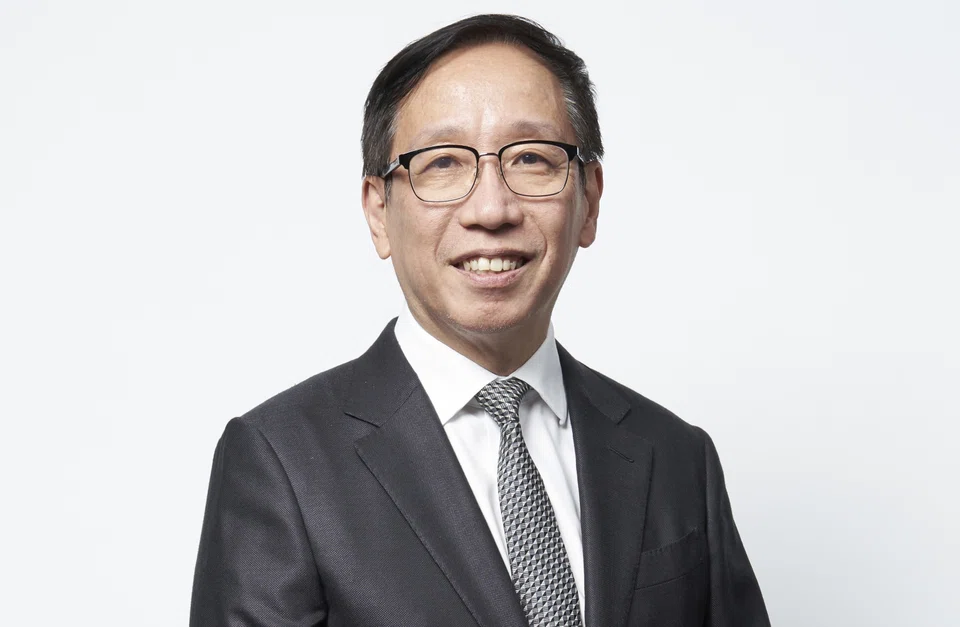
Savills Singapore’s executive director of research and consultancy Alan Cheong says since the two schemes took effect in November 2019, sea changes have taken place that have altered the narrative for the demand for office space in Singapore. Covid-19, for one, triggered the work-from-home (or anywhere else but the office) wave, and the 2022 rollout of generative artificial intelligence (AI) to the commercial world changed work flow and how jobs are structured.
Industry players say URA ought to extend the two schemes, but Cheong is more specific. He suggests that they be extended for only a year. “These two schemes should be thoroughly reviewed, modified or reconfigured to suit the times.”
He adds: “The CBDI Scheme and the SDI Scheme have, by now, had their day in the sun, and after five years, the results appear to show that they may not be suitable for a post-pandemic world. Also, the high LBC and lease top-up premiums may be deterrents.”
To be fair, URA is already reviewing both schemes. Chou says: “We will provide updates when ready. We will also continue to engage developers and industry professionals to explore other ways to rejuvenate our CBD and strategic areas across Singapore.”
“The incentives are too prescriptive, and do not allow developers to make adjustments to market conditions or policy changes.”
Tang Wei Leng of Colliers Singapore
Putting things in perspective, CBRE’s head of research for South-east Asia, Tricia Song, says: “The take-up rate for the schemes could have been better if not for several black-swan events over the past five years – the pandemic that locked down the city centre between 2020 and 2022, and the subsequent sharp rise in construction costs and interest rates that significantly delayed investment decisions and raised risks for many developers.”
Unlike Cheong, she makes the case for the two schemes to be extended for at least another five years to “allow market conditions to normalise, and market dynamics to play out over a few property cycles”.
Catalyst to remake precincts
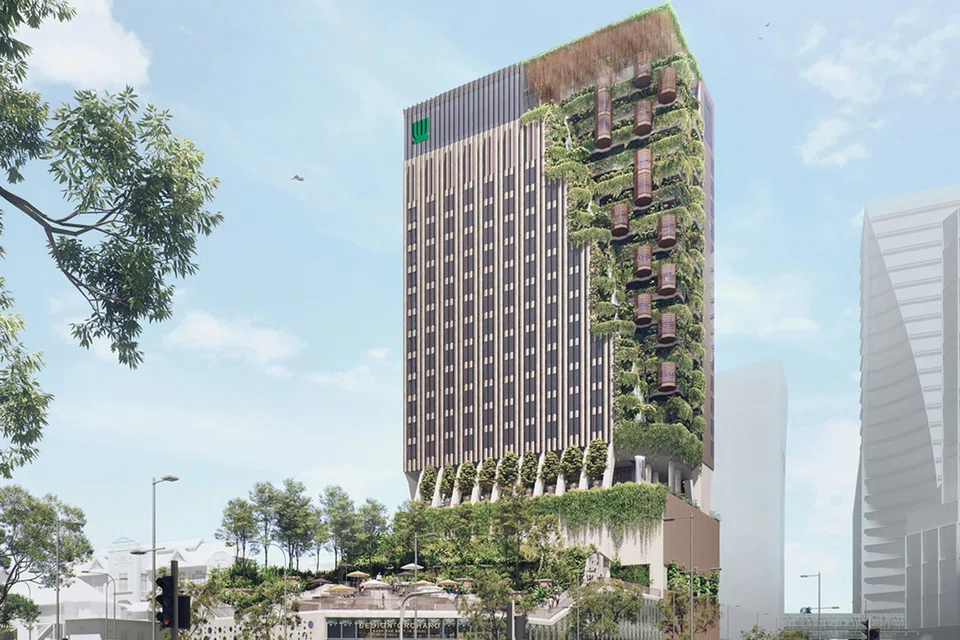
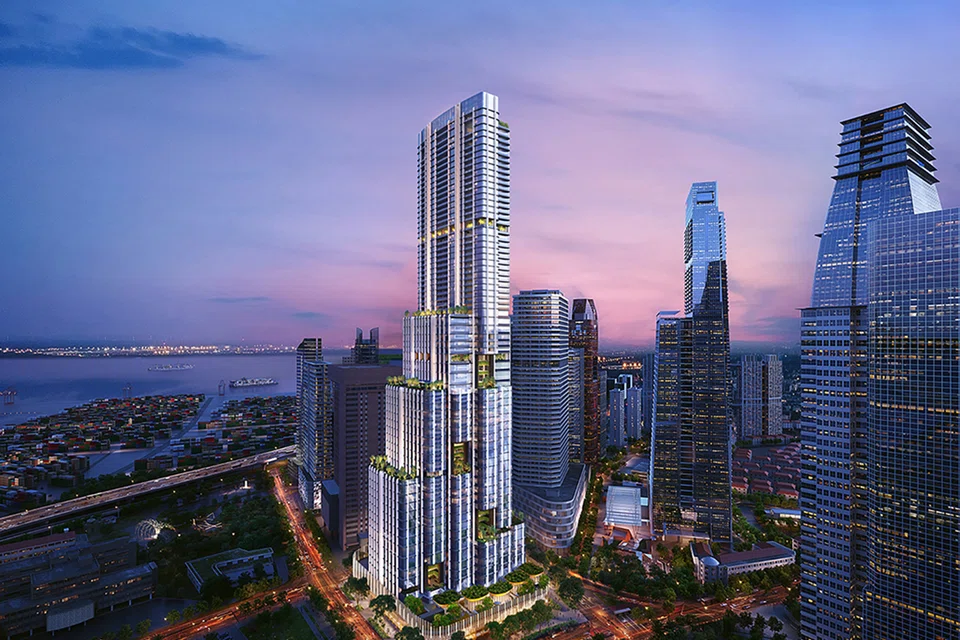
Of the three projects currently being developed under the CBDI Scheme, two are mixed-use developments. They are: The Skywaters, to be Singapore’s tallest development at 305 m on the former AXA Tower site opposite Tanjong Pagar MRT station, and Newport Plaza on the former Fuji Xerox Towers site in Anson Road.
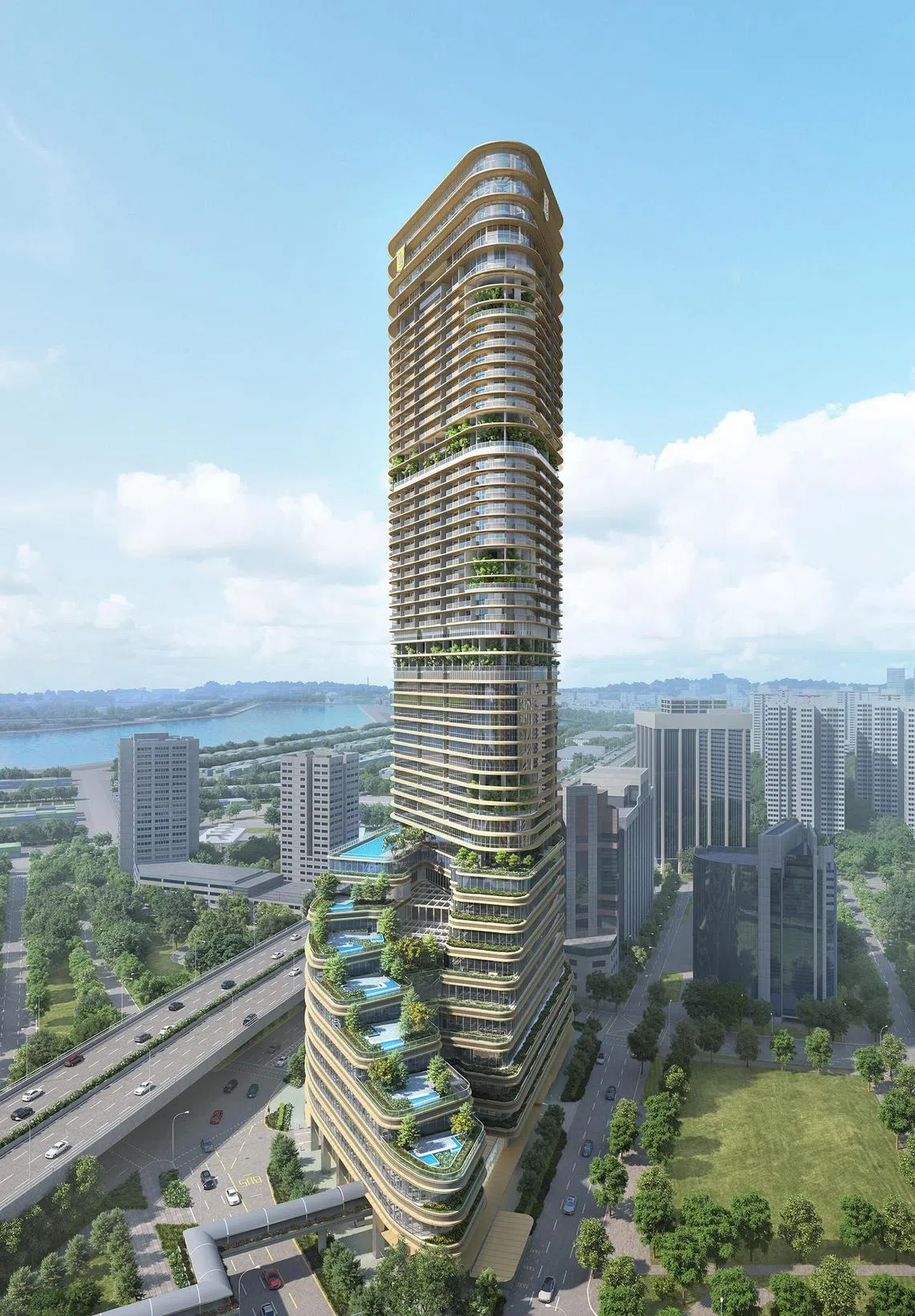
The third development underway is a hotel and serviced-apartment project on the former Tower Fifteen site in Hoe Chiang Road.
For the SDI Scheme, the two projects currently under development are: a hotel project on the site of the old Faber House office block in Orchard Road; and a mixed-use project named Union Square on the Central Mall and Central Square sites.
The latter project, sited near Clarke Quay, will have offices, retail space, residential apartments and a co-living component with a hotel licence.
Both schemes target older buildings.
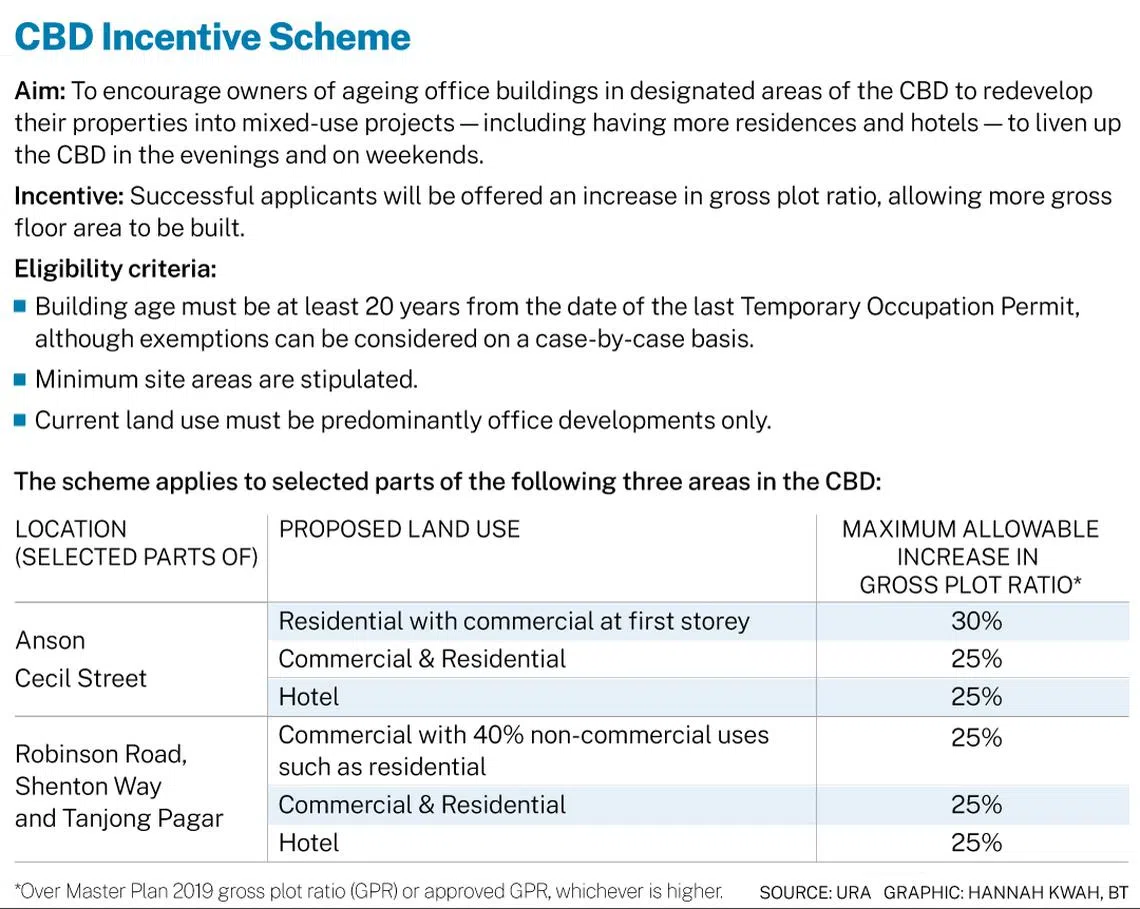
The CBDI Scheme aims to encourage the conversion of predominantly office developments in designated areas of the CBD into mixed-use projects. The idea is to have a wider diversity of uses, including more residences and hotels, to inject a bigger live-in population into the CBD.
The scheme applies only to selected parts of Anson, Cecil Street, and the Robinson Road/ Shenton Way/ Tanjong Pagar area (see table).
As an incentive, developers are offered increases in plot ratio, which allow additional gross floor area (GFA) to be built beyond the Master Plan 2019 gross plot ratio (GPR), or the approved GPR, whichever is higher.
The allowable increase in plot ratios is capped at 25 per cent for most proposed land uses, and at a higher 30 per cent for residential with commercial at first storey use in the Anson and Cecil Street locales.
Under the SDI Scheme, eligible building owners and developers may submit proposals, seeking higher plot ratios as well as flexibility on land use and use quantum, and building height.
Only existing commercial, or mixed-use developments with predominantly commercial use, qualify.
The SDI Scheme requires proposed redevelopment projects to involve at least two adjacent sites so that the overall redevelopment has a stronger transformational impact on the area.
URA’s Chou says, however, that the agency is “prepared to consider exemptions in exceptional cases, such as where the proposed redevelopment is assessed to positively contribute to the rejuvenation of the larger street block or precinct, beyond the confines of a single site”.
Veteran developer Liam Wee Sin, the group chief executive of UOL, says: “The SDI scheme can be a catalyst in the remaking of a precinct. There is often a commitment to good, innovative and green building design.”
Deterrents for developers
Additional plot ratio granted under either scheme will attract payment of LBC to the state, where relevant. The current LBC formula, effective since July 2007, creams off 70 per cent of the increase in land value when some sites are built on more intensively or put to higher use.
Colliers Singapore managing director of capital markets, Tang Wei Leng, describes this as a major deterrent to developers exploring projects under the two urban rejuvenation schemes.
Another big-ticket payment to the state for some redevelopment projects is the lease-extension premium for sites requiring a lease top-up to 99 years, for example, if the project includes residences for sale.
The LBC and the lease-extension premium, together with high construction cost and, for new buyers of a building, the high land costs in Singapore, weigh down on the return on investment for developers contemplating on embarking on projects under the CBDI and SDI schemes, says Savills’ Cheong.
Colliers’ Tang adds: “The process of getting approvals is long and exposes developers to financial uncertainty.”
“The area of coverage for the CBDI Scheme could be expanded to other city locations with ageing office buildings such as Beach Road and Orchard fringe area.”
Desmond Sim of Edmund Tie
Liam of UOL, which is redeveloping the Faber House site, says: “While there is GFA intensification as an incentive, developers have to take the risk in the form of business disruption, market fluctuations and uncertainties in construction cost.”
Knight Frank Singapore head of consultancy, Alice Tan, says the SDI Scheme’s requirement that owners of at least two adjacent sites have to join forces for redevelopment has good intentions, but may have discouraged developers. “Redevelopment involving two adjacent sites is more likely to take place if they are owned by the same group; if the owners are unrelated parties, they would need to share similar goals to rejuvenate their properties as well as the surrounding precinct.”
CBRE’s Song points to another factor depressing the take-up of the two rejuvenation schemes. “The many property cooling measures for the residential market, of which the most punitive was the doubling of the ABSD (additional buyer’s stamp duty) on foreigners to 60 per cent in April 2023, have also dampened confidence in residential sales in the city centre, which traditionally targets foreigners, dealing a blow to redevelopment plans involving residential sales.”
Constructive suggestions
Industry players offered suggestions to improve the two schemes and make them more attractive to developers.
One would be to increase the bonus GFA, says Song: “Costs and construction periods have increased significantly, and a 25 to 30 per cent increase in GFA may not justify undertaking a change in mix, and the loss of recurring income over extended construction periods.”
Colliers’ Tang says that, to give developers an incentive to build public spaces and infrastructure to better integrate developments under the two schemes, the authorities should reimburse developers for such costs.
Cheong from Savills says that to get the rejuvenation engine firing on all cylinders, LBC and lease-extension premiums will need to be reduced. The schemes’ conditions also may have to be relaxed.
A recurring theme among property consultants is the need for greater flexibility on the mix of uses and use quantums, and to reduce the for-sale residential component.
“The incentives are too prescriptive, and do not allow developers to make adjustments to market conditions or policy changes,” says Tang.
“URA should control only what it wants to control – for example, restricting the office component in a redevelopment project approved under the CBDI Scheme – but leave the developer to decide what are the other complementary uses to include,” she adds.
In a similar vein, Edmund Tie’s chief executive officer, Desmond Sim, recommends that for the CBDI Scheme, the authorities incorporate a percentage of “white zoning” (which allows for a range of uses). “A white zone does not need to be an alternative use, but could provide a buffer for the developer to put, for instance, more commercial space, to suit its specific area of strength, as well as market conditions.”
“So, if you have that ‘white’ component as just a small portion, that is, technically, the extra hole in the belt, if you think the belt is too tight,” he says.
CBRE’s Song, too, advocates allowing a more flexible proportion of the commercial component in proposed projects. “There’s already an ample supply pipeline of residential projects in and around the CBD, which may weigh on developers’ confidence for redevelopment projects with a residential component,” she says.
Sim of Edmund Tie suggests that “the area of coverage for the CBDI Scheme could be expanded to other city locations with ageing office buildings – such as Beach Road, South Bridge Road and the fringe of the Orchard area”.
Leave well alone
Savills’ Cheong argues that it could make more sense to offer owners of ageing office buildings incentives to improve the upkeep of their properties and make them more energy-efficient, rather than redevelop them. This is because the office rentals that they would command post-redevelopment in some stretches of Cecil Street and Robinson Road are too low to justify the capital outlay.
Instead, well-maintained buildings in these locations can offer a cheaper option for office tenants who are on tighter budgets but need to be in the CBD, he adds.
“Leave the decision to redevelop such buildings to market forces. As things stand, this could be in a decade or more.”
He notes that the major forces at work globally in the last five years include the Covid-19 pandemic, which triggered a move out of big-city work spaces; the environmental agenda then took a ride on the coat-tails of the work-from-home argument, he adds.
“The rollout of generative AI to the commercial world in 2022 is creating a wave of applications, most of which will improve productivity and do away with the hordes of uninspired workers.
“At about the same time as the unveiling of the new-age AI, start-ups that were founded on previously fashionable tech buzzwords hit a funding famine. Even established tech companies are laying off thousands of workers.”
TRENDING NOW

Government to bring forward raising of retirement age, give employers more financial support to create flexi-load jobs
Former minister Maliki Osman, Revolut chairman join Asia Gulf Holdings advisory board

Is Manila Asia’s new dining hot spot?

Simba at risk of losing operating licence over spectrum misuse

