

Why Asia should worry about a G1 world as China’s power grows
Chinese leapfrogging is showing up in a host of other sectors, including defence
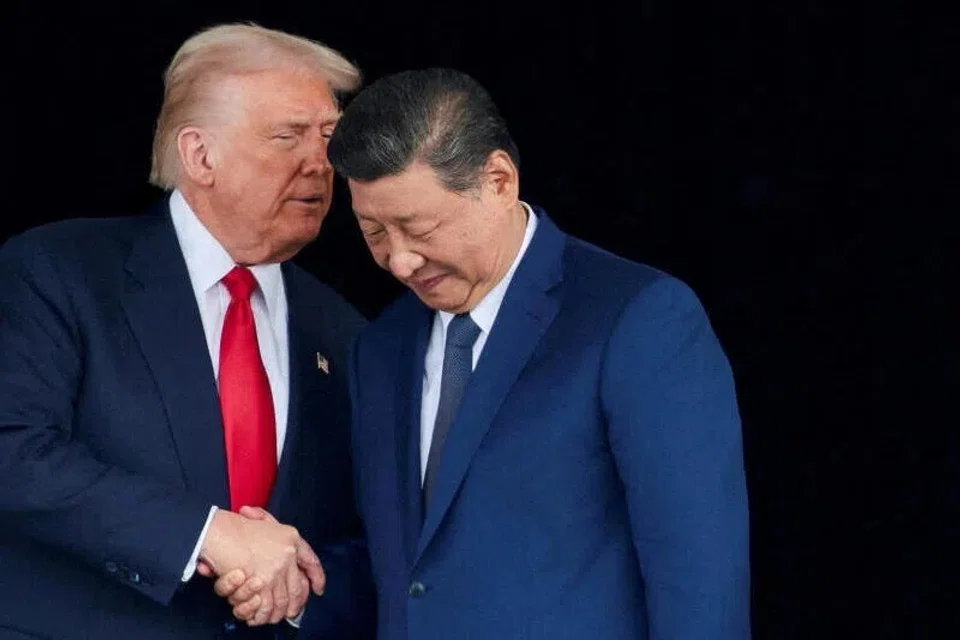
DONALD Trump’s frequent references to a Group of Two (G2) ahead of his summit meeting in October with his Chinese counterpart President Xi Jinping – one that involves just the US and China – has triggered angst in Asian middle powers, amid a time of declining US influence. Several other Asian states that have their own views of the world, and their place in it, are uneasy as well.
Professor Tomohiko Taniguchi, the eminence grise of Japan’s Conservative movement and the former foreign policy adviser to the Shinzo Abe Cabinet, describes a potential “G2” world order as a “nightmarish” scenario. Tokyo, he told me, “does not want to have (that happen) at any cost because under those circumstances, it would mean that Japan would become an integral part within the Chinese sphere of influence”. Indian officials are similarly alarmed.
I would not worry too much. As Foreign Minister Vivian Balakrishnan told a global forum in Singapore last week what is on view is perhaps more of a tactical pause than strategic realignment. The fundamental lack of trust between the US and China is deep, and possibly growing.
That said, there is another way of looking at the shifting power dynamics. Instead of seeing things through a G2 lens, we may want to ask ourselves: Is it time to think of a “G1”, and what would that mean for Asia? In other words, what happens when China wins?
The Lowy Asia Power Index 2025 released on Nov 26 unequivocally states that the US is losing ground in Asia, recording its lowest ever score in the index. It goes on to say that the Trump administration’s policies have been “a net negative for US power in Asia”, but their true effect will only be felt in the years ahead. As the former Nato official Jamie Shea put it recently, the US is on a path of “soft power suicide” thanks to Trump.
The tech juggernaut
Meanwhile, with every passing week China pulls ahead in so many directions critical to the future – from electric vehicles (EVs) to cutting-edge pharmaceuticals and humanoid soldiers – that it would seem only a matter of time that it stands alone, and above the rest of the world.
There’s enough written on Chinese EVs, and debilitating competition between Chinese car makers, and their dumping on Asian markets. But look beyond the market dynamics and cast a strategic lens on the situation: On view is a technological juggernaut at play, whose companies are startlingly agile and what’s more, operate in an industrial ecosystem so advanced and well-resourced that few can stand in its way.
The path charted by Xiaomi, until recently known as a maker of phones and smartphones, is emblematic of these reflexes.
As CEO Lei Jun describes it, in January 2021 the company had been shocked by the initial tariffs the Joe Biden administration placed upon the firm, and vowed to never allow itself to be cowed by them. Two months later, Xiaomi announced that it planned to build EVs from scratch.
SEE ALSO


In March 2024, three years after deciding on the firm’s strategic turn and committing no fewer than 3,400 engineers to the project, Lei unveiled the result – the Xiaomi SU7 electric vehicle.
Swifter than a Porsche Taycan and with longer endurance than a Tesla Model S, it clocked 359.7kmh on Germany’s Nurburgring racetrack a few months ago to become the fastest car in the Electric Executive Car category. The car in fact exceeded its claimed top speed of 350 kmh.
Is it any surprise that European carmakers no longer complain about China stealing their secrets? Rather, they insist that China share its technology with them in exchange for market access. What a turn of events!
The story is not much different in much of the emerging field of renewables, where China’s lead will only widen as the US anchors itself on a “drill, baby, drill” thrust of producing and exporting fossil fuel-based oil, gas and coal reserves.
“China’s impact globally will be even bigger because they get less competition in the fastest-growing industrial areas globally, which are solar, wind and batteries – and EVs,” the noted energy sector analyst Jarand Rystad told me recently.
Chinese leapfrogging is showing up in a host of other sectors, including defence. It could extend even to artificial intelligence (AI), where the US is now ahead. Look how China’s aircraft carriers have steadily advanced in size and sophistication. The nation’s third carrier Fujian, which was commissioned on Nov 5 by President Xi, features an electromagnetic aircraft launch system or EMALS. Only the US Navy’s most modern carrier, the Gerald R Ford, has EMALS.
Or examine the recent conflict between India and Pakistan, where China-supplied PL-15 air-to-air missiles of the Pakistan Air Force performed impressively against India’s French-made Rafales – so-called 4.5-generation warplanes. The PL-15 is not even the most advanced missile in the Chinese arsenal; PL-17 and PL-21 missiles fly faster and longer. It is an easy bet that the People’s Liberation Army will be the first military to introduce humanoid robots on the battlefield.
Strength needs to be measured not just by raw power but also in terms of a nation’s ability to cope with vulnerabilities, fix immediate problems and plan for the future. The Trump tariffs, which come on top of the trade restrictions placed by previous administrations, are no doubt sand in the wheels of the Chinese economy. But they are anything but a hard brake; Beijing has steadily worked to diversify its trade basket and today, counts Asean as its top trading partner, followed by the European Union. America is only No 3 on that list.
China may lag the US for now in the most advanced chips that run AI machines but when it comes to the power that fuels AI, it is ahead by a country mile. It generates so much electricity that storage and grid capacity struggles to keep up. Meanwhile, American consumers are finding their energy bills rising at twice the pace of general inflation as power companies struggle to build capacity to keep pace with the rising demand from AI data centres.
Why focus only on guns and microchips – look at the way it is cleaning up its environment and focusing on its ecology. Since 2001, China has reforested no less than 425,000 sq km of land, or about the size of Japan. In the same period, Indonesia’s forest cover has shrunk by about a fifth, thanks mostly to excessive logging.
Remember Beijing’s spectacular sunsets that were caused by the refraction of light on dust particles, a result of terrible atmospheric pollution? Today, those sunsets are a distant memory; the Chinese capital’s “good air days” have risen dramatically. The global attention around poor air quality has shifted instead to the nightmarish air over Delhi, and much of northern India.
Sand in the gears
To be sure, there is much to worry about the current state of the Chinese economy, its real estate woes and “involution” – the fratricidal competition in many sectors that have sent some firms into operating losses and massive price-cutting.
While involution was unexpected, the rest is not really a surprise. As early as April 2020, in an article titled The Risks of Putting All Eggs in the China Basket, I had flagged the issues gathering around its economy, specifically pointing to real estate giant China Evergrande’s mounting debt pile and its worrisome implications.
So, why am I now inclined to look past the current woes? Because, no industry – or economy for that matter – is immune from cycles. The building of excess, and its subsequent draining, is a part of the rhythms of the capitalist economy. Demand and supply approach each other from different directions and frequently overshoot.
Granted, in China’s case, the domestic demand side of the equation is getting complicated by factors such as an ageing population and plunging fertility levels. But this is also partly why China’s population of factory robots today exceeds two million, and grows by 300,000 a year. And it explains why Beijing will do everything in its power to prise open markets elsewhere for its goods.
As for its supply side – where technology, design, input costs, logistics and planning combine – it is unassailable. Give the dragon its due; China, as I recently heard an awed Western businessman describe it, remains the “fitness centre for global manufacturing”.
Add up everything and you begin to get the picture. Beijing’s goal once may have been to simply catch up with America. Today it seems confident it can surpass it.
‘China First’ fears
What Asia should worry about is what happens then. If China’s recent attempts to cow new Japanese Prime Minister Sanae Takaichi – who leads a Group of Seven nation, an advanced economy, and a significant military power – is any indication, many of us could be in for a sweltering time.
It wasn’t too long ago that China put the squeeze on Australian wine and lobster, after Canberra asked for an international investigation into the origin of the Covid-19 virus. South Korea had earlier been punished for allowing the US to install a THAAD missile system on its territory.
As for India, which gained “major power status” in 2025 according to the Lowy index, days after New Delhi started issuing tourist visas to Chinese this month, an Indian woman transiting Shanghai claimed she had been harassed because her place of birth was listed as Arunachal Pradesh, a state in India’s north-east claimed in its entirety by China.
Beijing’s recent threat to weaponise rare earths – admittedly in response to a fresh round of American tariffs and Washington’s expansion of the so-called Entity List to deny China key technology – shows that Beijing is not nervous about taking on even the US.
All the nations cited above are powerful in their own right. It will be interesting to see how China treats lesser powers and in turn, how they respond to the creeping Chinese dominance.
The Indonesians already seem intimidated, prepared to consider buying Chinese fighters even as one of Jakarta’s most important bilateral issues is Beijing’s claim on a significant part of Indonesia’s exclusive economic zone in the Natunas. Malaysian officials only whisper that even their ethnic Chinese businesses are complaining of the dumping of industrial goods from the mainland.
A “G2” world should be the least of our worries, since it would mean that the US retains a measure of relevance and influence in this region. Rather, we might end up yearning for it. It is G1 that you should fear, and it is no longer unthinkable. THE STRAITS TIMES
Decoding Asia newsletter: your guide to navigating Asia in a new global order. Sign up here to get Decoding Asia newsletter. Delivered to your inbox. Free.
Share with us your feedback on BT's products and services
TRENDING NOW

LTA proposes combining car COE categories, adding rebate-surcharge system

StarHub to acquire MyRepublic’s mobile business amid ongoing telco consolidation

DBS, OCBC, UOB rout lops billions off STI as inflation, rate concerns spook investors

Grab CEO’s wife Chloe Tong on life with Anthony Tan and finding her purpose

