Why do we feel empathy for robots?
The hardest governance problems may not be what these systems can do, but how they make us feel
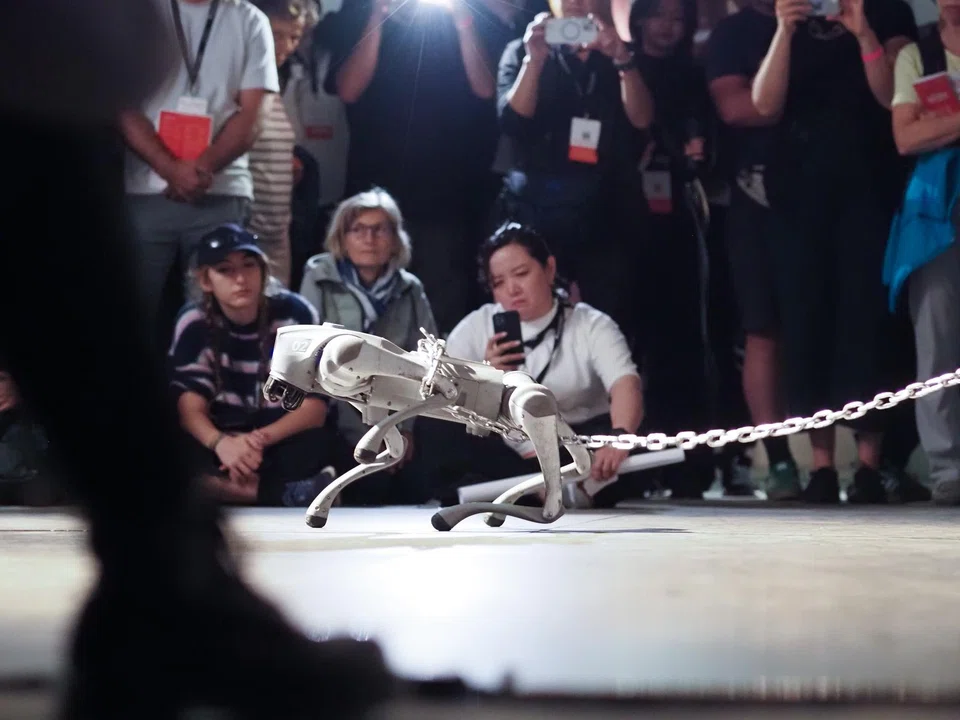
IT IS a scene from a futuristic nightmare: A robot dog thrashes and lunges towards me, held back only by a metal chain that hits the floor with a heavy thud each time it pounces.
The harder it fights, the more it snarls itself in the links, a machine trapped by its own struggle. Beside it, an identical quadruped from Hangzhou Unitree Technology lies motionless, like a dead friend.
This was not a lab accident. It was an art exhibit on the 45th floor of the swanky Toranomon Hills Station Tower in Tokyo. And despite the brute force of this metal animal hurling itself at onlookers, the biggest reaction I heard – in the room and again when I shared the clip with friends – was simple: “Free him.”
Why do we feel sympathy for a chained robot that appears ready to attack us?
“Although it already has sufficient athletic ability and lethal power, this artificial beast is barely under control by a single ‘chain of ethics’,” Takayuki Todo, the multimedia artist behind the piece, writes on his website. The question his exhibit asks is an unnerving one: When it locks eyes with us, do we start treating it like a “living other”?
Todo told the AFP that he’s being attacked online as a “robot abuser”. He even visited Unitree offices in China in 2025 to excuse himself for how he treated its device, Todo added.
Video of the exhibit did not just ricochet around Tokyo’s art scene. It went viral far beyond Japan, especially among artificial intelligence (AI) safety circles. There’s a reason it struck such a nerve. The exhibit isn’t just about a robot dog, it’s about what’s coming next.
So-called “physical AI” has been prophesied by the likes of Nvidia chief executive officer Jensen Huang as the next wave. China, in particular, has intensified its efforts on humanoids and quadrupeds, pushing them out of stage demos and towards real deployment.
Analysts expect the nation’s humanoid robot sales to jump 133 per cent this year as production prices fall. And Asia’s demographic crunch has tech leaders and policymakers envisaging robots not just as tools, but also as the answer to labour shortages, eldercare holes and for companionship. This future is closer than we think.
Researchers have been studying human-robot interaction for years. But it is often artists who drive the debates around uncomfortable questions.
In 2021, an art collective armed Boston Dynamics’ quadruped robot, Spot, with a paintball gun and gave random Internet users the ability to control it. They aimed to show how these devices could potentially be weaponised for destruction. The company was not pleased.
Todo’s exhibit begs the question of what turns a bundle of computer parts into something we feel obligated to spare. One study found it is remarkably simple: The best way for an AI system to trigger “moral reactions” in people is to give it a humanlike form and programme it to seem like it has good intentions.
I’ve long argued that I don’t want my humanoids or quadrupeds to have a “personality” at all. The devices that will make the biggest difference will be the ones that focus on efficiency rather than companionship. But it turns out people don’t actually seem to like “robotic” traits, even in robots.
In 2025, a University of Chicago-led team gave service robots, presented as restaurant greeters, three different personalities: baseline, highly neurotic and highly extroverted. They found that the neurotic and extroverted bots “significantly enhanced” human participants’ emotional states.
People ultimately rated the high-extroversion personality as the most enjoyable to interact with, and the findings suggested that sprinkling in a bit of neuroticism make a hunk of metal feel more relatable.
Researchers in the Netherlands looked specifically at quadrupeds and found that people felt safer around robot dogs with “submissive” rather than “dominant” personalities. They induced this sense of ease simply through stature, positioning and movement patterns.
It gets worse (or, depending on your business model, better). As we reflexively feel for robots, researchers have found that they mimic empathy right back to us.
AI is now perceived to be more compassionate than human experts. The risk isn’t merely that we’ll love robots, but that we’ll trust them. A computer can be cute, apologetic, even “submissive” while still operating on incentives you can’t see.
Watching a machine strain against a chain and seeing people empathise with its yearning to be free is a preview of one of the most quietly consequential shifts in AI.
As robots move from stage demos to pavements, hospitals and homes, the hardest governance problems may not be what these systems can do. It’ll be how they make us feel, and how easily designers, companies and authorities can use that to soften fear and disarm scepticism.
Maybe the danger isn’t the dog breaking free, but us letting it off the chain. BLOOMBERG