Why Italy’s PM will get warm White House welcome
The US hopes Italy will withdraw from China’s Belt and Road Initiative
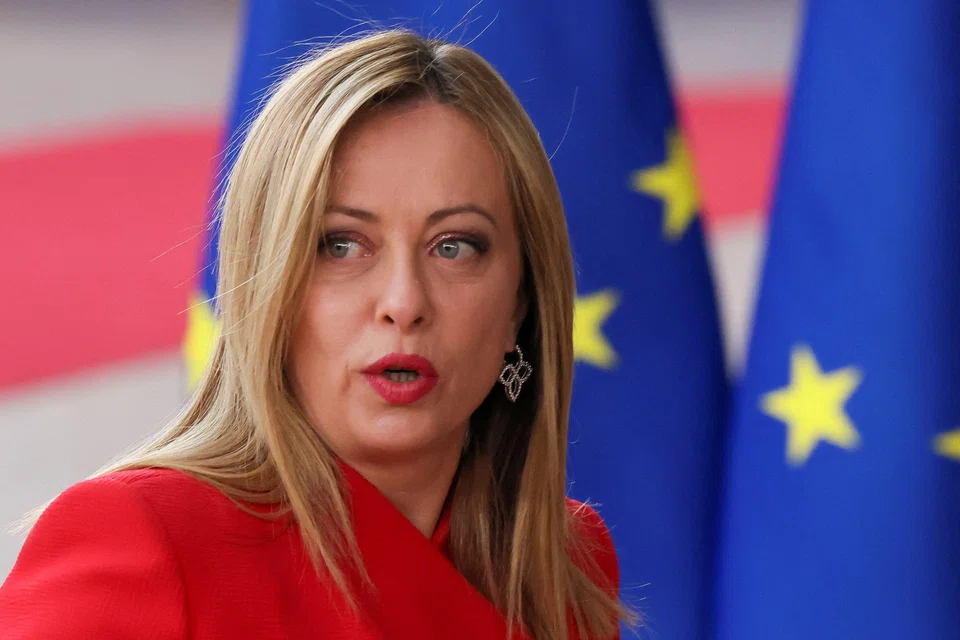
GIORGIA Meloni on Thursday (Jul 27) makes her first visit to the White House as Italian prime minister. Yet even with the Ukraine war ongoing, it is China that will top her agenda with President Joe Biden.
Rome is not always seen as being among the top-tier global powers, but the Meloni-Biden relationship could have significant implications because of Italy’s continued systemic importance in Europe and the wider West.
Not only is it a key G7 country, it will also chair this club of Western powers next year, when the conflict in Ukraine could still be underway.
Italy’s structural importance in the West also comes from being the third-largest eurozone economy, and posing perhaps the biggest threat to the future of the single currency area.
This is because it has the second-biggest debt load in the eurozone, at well over 100 per cent of gross domestic product (GDP), and its banking sector is under significant stress with massive underperforming loans.
Belt and Road worries
For these reasons, seismic shockwaves rippled across the western world in 2019 when Italy became the first – and so far only – G7 member to sign up to China’s Belt and Road (BRI) project, under then-prime minister Giuseppe Conte.
This saw a strong rebuke from the Trump administration, with then-National Security Council spokesperson Garrett Marquis asserting that there is “no need for the Italian government to lend legitimacy to China’s infrastructure vanity project”.
US concerns about the over-one-trillion-euro BRI stem from its immensely ambitious nature, at the centre of a geopolitical struggle between Beijing and Washington.
China has big plans to boost trade and stimulate economic growth across Asia, Africa and beyond, by building massive amounts of infrastructure and connecting countries around the globe.
According to some forecasts, the initiative has the potential to overshadow even the legendary postwar Marshall Plan.
It potentially covers about 65 per cent of the world’s population and one-third of its GDP, and could help move about a quarter of its goods and services.
Indeed, some assert Beijing’s scheme as the biggest development push in history.
While the Trump team was vexed with Italy over BRI, concern about China’s influence in Europe is bipartisan in Washington.
Democrats’ worries were underlined during the Obama administration, when US officials raised concerns about the degree to which London seemed to be cosying up to Beijing under the government of David Cameron.
Then-UK finance minister George Osborne pledged to make the UK “China’s best partner in the West”. This ruffled the feathers of the Obama administration, following the UK’s decision to become a founder member of the Asian Infrastructure Investment Bank – championed by Beijing as a potential alternative to the World Bank.
Brussels itself is concerned by Italy’s involvement in BRI. EU officials are increasingly conscious of Beijing’s influence across the continent, with a growing number of EU states having signed related memoranda of understanding, including Croatia, Czech Republic, Hungary, Poland, Greece, Malta, and Portugal.
Like Washington, Brussels has reservations about BRI, not least given wider frustrations over Beijing’s perceived slowness to open up its own economy, and a wave of Chinese takeovers of European firms in key industries.
EU officials also have concerns over Beijing’s “16+1” multilateral initiative with countries in Eastern and Central Europe.
Fast forward to July 2023, however, and Meloni – who is about a year into office – is giving signals that an Italian U-turn on BRI may be underway, noting that there “are ongoing evaluations” and “the issue must be handled carefully and respectfully, also involving the parliament”.
The four-year contract that Rome inked in 2019 can be renewed automatically in March 2024 for five years, if neither side withdraws by giving three months’ notice.
To be sure, Meloni has claimed that Biden has never challenged her on the issue of Italy’s BRI participation. However, the White House would without question welcome a reversal from Rome.
The rationale for a U-turn is not just related to Western security. So far, there is too little evidence that Italy has benefited economically from the deal.
Italian exports to China have risen modestly to around 16.4 billion euros (S$24.1 billion) in 2022, from 13 billion euros in 2019. Bilateral trade was up some 5.4 per cent year on year in 2022.
While this is not stratospheric growth, China defends it, highlighting that the period includes disruption from the Covid-19 pandemic.
Foreign Minister Wang Yi has said Italian withdrawal from BRI would be a short-sighted decision as China’s economy recovers.
He asserted that “despite Italy’s repeated claim that the development of ties won’t be thwarted without BRI, announcing (Meloni’s) decision in the United States will be seen as a clear signal that Italy is leaning closer to Washington”.
China’s ambassador to Italy, Jia Guide, echoed these warnings from Beijing. He said that if Italy chooses to withdraw from BRI – a platform that, he asserts, demonstrates political mutual trust and strategic cooperation – it will have a negative impact on Italy’s image, credibility, and cooperation.
Issues elsewhere
This big decision for Italy will shape the Biden-Meloni meeting. In a related vein, the two leaders will also discuss the Ukraine war and Italy’s preparations for next year’s G7, which will come amid a big US election year.
Meloni has already declared that a priority will be “working on the reconstruction of Ukraine as a way to bet on a future of peace, freedom and Euro-Atlantic prosperity for this nation”.
Biden will be pleased by Meloni’s support not just for Ukraine but also Nato, despite significant unease within the Italian populace about the war. The US president is also aware that before the Ukraine conflict, anti-establishment parties such as The League – part of Italy’s governing coalition – had sought a re-evaluation of Rome’s relationship with Moscow, including calling for the lifting of pre-2022 EU sanctions.
The two leaders will also discuss Africa, which will be another key feature of Italy’s G7 presidency. Meloni argues that more help is needed for nations such as Tunisia, to prevent migrants from making perilous attempts to cross the Mediterranean to Europe.
Taken overall, Thursday’s meeting could be the first signal of a strengthened Italian-US bilateral relationship. Most significantly, a Rome withdrawal from BRI will be welcomed in Washington across both sides of the political aisle.
The writer is an associate at LSE IDEAS at the London School of Economics