
Why the melt-up is still on

As 2026 begins, optimists are talking down bubble anxiety
Summarise
    • Casting an eye across the outlooks of the major investment banks and big asset managers, one would be hard-pressed to find a naysayer.
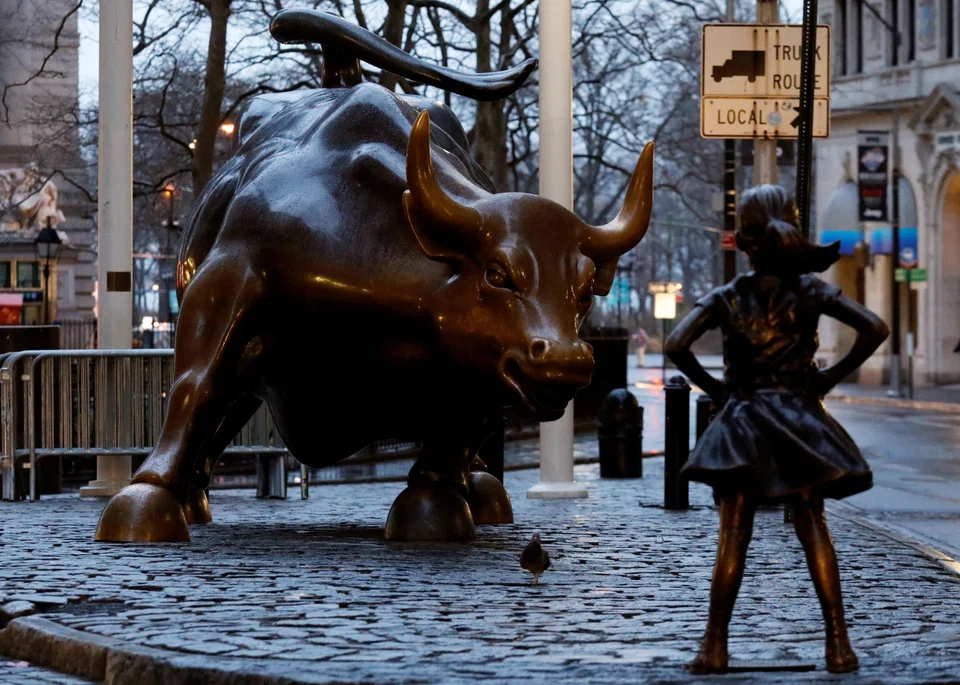
    • Casting an eye across the outlooks of the major investment banks and big asset managers, one would be hard-pressed to find a naysayer. PHOTO: REUTERS
    Published Tue, Jan 6, 2026 · 07:00 AM

    LAST year was terrible for financial predictions, but I am happy to make another for 2026, which is that stocks and other risky assets will power higher. The muck is still sliding off Teflon-coated markets, pessimists appear to be giving up the fight and the melt-up is very much in play.

    Casting an eye across the outlooks of the major investment banks and big asset managers, one would be hard-pressed to find a naysayer. US policy on trade and interference in central banking remains a clear and present danger to every portfolio, but the astonishing market resilience of 2025 makes it very difficult to justify whining from the sidelines.

    The dark days of April, when US President Donald Trump’s wackadoodle global trade policy sent markets careering lower, are an increasingly distant memory.


    Alexandra Wilson-Elizondo, global co-head of multi-asset solutions at Goldman Sachs Asset Management in New York, said: “In April, if you had told people we would be at all-time highs and looking at economic growth of 2.4 per cent... and that we would be moving down the scale on trade tensions, people would tell you that’s the best-case scenario.”

    And yet, here we are, living in the best of all possible worlds, with stellar corporate earnings having done all the heavy lifting on asset prices in the US, the world’s dominant financial market. Big investors readily confess to being stunned.

    This sits very awkwardly alongside a widespread suspicion that stocks, especially tech stocks, are in a bubble, and that the US economy is showing some hairline cracks.

    Bubble anxiety stems in part from the frequent presence of this narrative in the media, Wilson-Elizondo said. Maybe so, although it is not just grumpy journalists making this case – even masters of the tech industry universe freely acknowledge that excessive exuberance has set in. Whatever the reason, unease permeates every conversation in markets, and bubble fears are the neatest way to express that.

    “People are trying to reconcile the performance of the asset class when not all the data is Goldilocks,” she added. Unlike the fabled porridge, some (inflation) is too hot and some (jobs data) is, at best, lukewarm.

    The sheer scale of sparkling market performance in recent years also gives investors pause. Jordan Brooks, co-head of macro strategies at AQR Capital Management, said in all honesty, he could not say when, where or why the next market shock will evolve. No one can, and humility is an underrated quality in finance.

    But, he added: “I can say that with valuations as stretched as they are, I have a very high degree of confidence that the forward-looking five to 10-year performance in the market is going to be worse. I have exceptionally high conviction there.”

    Still, with all the potential downsides taken into consideration, the mood in the opening days of 2026 remains “OK, doomer”.

    Wall Street thinks we are heading into a great year. Deutsche Bank is pencilling in 17 per cent gains in the benchmark S&P 500 index from current levels by the end of 2026, taking it up to 8,000. Several other influential banks are clustered around the 7,500 area, from 6,845 now.

    Analysts and investors alike say they are not complacent about the risks staring them in the face, and claim they are focusing on quality and diversification, as if they usually buy any old rubbish in only one sector. But if we could get through 2025 in one piece, we can get through anything. Setbacks are close to certain in 2026, some potentially hefty. But few expect them to stick. Buying the dip is popular for a reason.

    It is cool to be pessimistic. It makes you sound clever. But now it is hard to justify that stance. “We definitely see that markets are optimistic, but our baseline is that’s right,” said Karen Ward, chief markets strategist for Europe at JPMorgan Asset Management.

    The US Federal Reserve is still cutting rates, for now at least, and governments are still spending. Potential tax rebates in the US will look and feel to people like free money, probably giving consumers a useful boost. 

    The strong performance of markets in 2025 produced “bafflement”, said Ward. “How is it that we’ve had tariffs and geopolitics are bleak, and the French government has failed twice and markets are at record highs? That’s the question we’re asked all the time.”

    Part of the answer has to be the monetary and fiscal stimulus busted out by central banks and governments as a response to seemingly every crisis. Moral hazard has set in, and it is a perfectly rational response to everything we have seen in markets for a decade and half.

    Fundamentals be damned. In the age of easy-peasy index-tracking passive investment and reliable knee-jerk financial support to any shock, it is very much starting to feel like the only way is up. Markets track the volume of money pouring in to them, not just the nitty gritty of the assets underneath, which means negative shocks have to be truly enormous to knock them off course. 

    This is uncomfortable for those still wedded to quaint notions like corporate strategy and government debt sustainability, but you fight the crisis-battling prowess of the Fed and US government at your peril. It seems that this year, few intend to bother trying. FINANCIAL TIMES


