
Why Trump remains Republican favourite, despite everything
Trump is leading Republican rivals on two historical indicators of nomination success
IN NOVEMBER 2020, US Democrats were not the only ones who breathed a sigh of relief at then-president Donald Trump’s re-election loss. Many US allies around the world were also hugely relieved, hoping that Trump’s political career had ended.
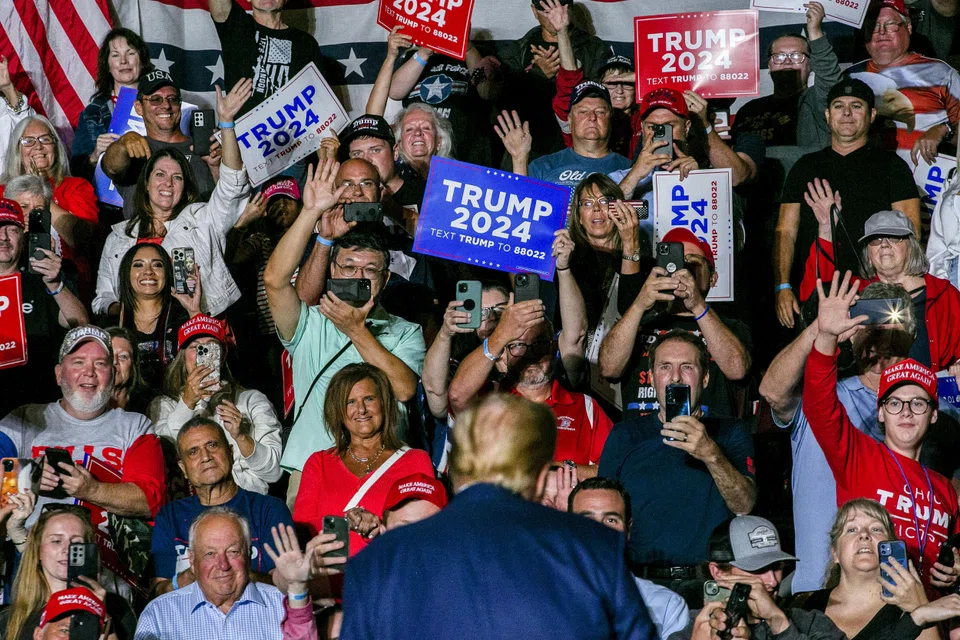
Almost three years later, however, Trump’s 2024 campaign appears strong, even gaining momentum as he faces mounting legal peril.
Little wonder that key allies from Europe to the Asia-Pacific are concerned that Trump could again be elected president, given the game-changing geopolitical impact this could have.
While most elected officials are unwilling to comment publicly on their fear, others – who no longer have to face the ballot box again – have done so. Former UK prime minister Tony Blair said another Trump presidency would be a “disaster” given how international relations have changed, especially following Russia’s invasion of Ukraine.
Trump, infamously, was close to Russian President Vladimir Putin and called his invasion of Ukraine an act of “genius”. He had a much cooler relationship with Ukrainian counterpart Volodymyr Zelensky, whom he asked to investigate then-vice-president Joe Biden and his son Hunter.
It is by no means certain that Trump would win a general election. However, such a ballot may be much closer than many anticipate. Some commentators, including this writer, have asserted since 2020 that the ex-president is highly likely to become the Republican standard-bearer in 2024, despite being unfit for public office.
Shattering precedents
If Trump does become the nominee, as looks increasingly likely, there is a significant possibility that he could be the second person in US history to enter the White House in non-consecutive terms. The first was Grover Cleveland, who won in 1884 and 1892.
For all the wrong reasons, Trump is a precedent-shattering politician. His prospects of becoming the Republican nominee only appear to increase with the number of lawsuits and indictments filed against him. This reflects the nature of his political base of voters who, for a range of reasons, believe their candidate is the victim of wide-ranging “deep state” conspiracy theories.
Trump played to this theme last Friday (Jul 28), when he told Republicans at the annual Lincoln Dinner fundraiser in Iowa that he was the only candidate who can win next year’s election. He suggested that this was the reason he faces a raft of criminal and civil charges from political opponents, and insisted he will run in 2024 even if convicted.
While Trump is now 77, he is three-odd years younger than Biden. There are no personal or political obstacles to his running again, if his health holds up. Following his impeachment acquittal in the US Senate, there is no legal barrier either.
Moreover, in refusing to concede the November 2020 ballot outcome, his game plan may be to emulate the approach of Andrew Jackson, an insurgent president to whom many have compared Trump.
In 1824, Jackson came close to winning the presidency, with the most electoral votes but not enough for the necessary majority in a field of four candidates. In what Jackson later termed the “corrupt bargain”, the House of Representatives elected John Quincy Adams as president, despite Jackson’s electoral college advantage. Jackson went on to win the presidency in 1828 and 1832.
While the circumstances of Trump’s loss to Biden are different from those of Jackson’s in 1824, the billionaire businessman has sought to nurture a similar sense of grievance over his defeat – despite overwhelming evidence that points to Biden’s clear 2020 electoral college win.
Despite the many disgraces of Trump’s behaviour, he will be a formidable contender for the Republican nomination. The appeal of “Trumpism” remains strong with key US groups, evidenced by polls of Republican party identifiers in 2023.
It is worth noting that Trump secured a larger vote total in 2020 than in 2016. While he lost to Biden, he performed above the expectations of pre-election polls, which had pointed to a potential landslide loss.
Past patterns
While the party race is still too far away to be certain of any predictions, historical patterns in previous contests suggest Trump could win the 2024 nomination.
In the past few decades of US politics, the eventual victor in nomination contests – for both major parties – frequently leads national polls of party identifiers on the eve of the first nomination ballot in Iowa, and/or raises the most campaign finance in the 12 months before an election year.
On both these counts, Trump is leading the other Republican candidates, including Florida Governor Ron DeSantis, South Carolina Senator Tim Scott, former United Nations ambassador Nikki Haley, former vice-president Mike Pence, and entrepreneur Vivek Ramaswamy.
From 1980 to 2020, the eventual nominee in around half the Democrat and Republican nomination races contested – that is, with more than one candidate – was the early frontrunner by both of these measures, as Trump is now for the Republicans.
In another five cases, the eventual nominee led on one of the two measures, including Biden in 2020 and Trump in 2016.
Even with Trump as the probable Republican nominee, however, US allies can take some comfort in his uncertain prospects of winning the presidency, for at least two reasons.
Firstly, while the re-election campaign of Biden – presuming he becomes the Democratic nominee – has key vulnerabilities, he may ultimately become a moderate favourite in 2024. This would be especially likely if the economy avoids recession and enters a new period of faster, more equitable growth.
Secondly, Trump’s prospects of winning will hinge on how much and how quickly the Republican Party unites around him, given the conflict between moderate or centrist Republicans – many of whom are appalled by the ex-president’s behaviour – and pro-Trump insurgents.
A rancorous, divisive Republican nomination contest – even if Trump ultimately prevails – may only benefit Biden.
The writer is an associate at LSE IDEAS at the London School of Economics



