Why the West’s revitalisation is well underway
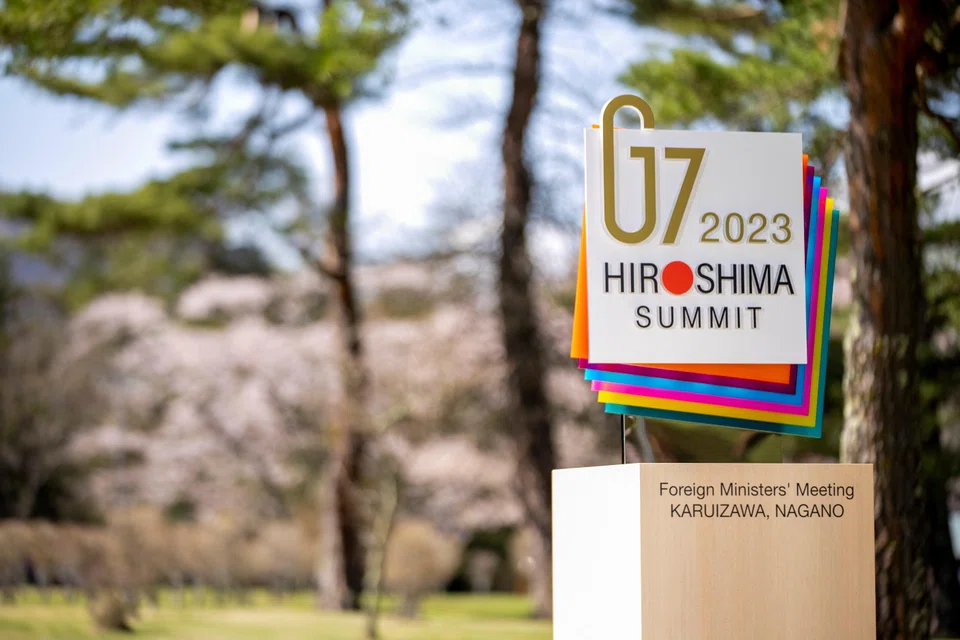
IN THE build-up to next week’s G7 leadership summit, a wide range of issues from climate change to the world economy have been discussed by Western ministers. However, the overriding issue to be discussed in Hiroshima from May 19 to 21 is Ukraine and its ongoing ramifications.
It is now some 440 days since Russia’s invasion, and there is no obvious sign that the conflict will be over soon. This was highlighted on Tuesday (May 9) by UN Secretary-General Antonio Guterres, who said: “I don’t think peace negotiations are possible… Both sides are convinced they can win… I don’t see Russia being willing to pull out of the territories it’s occupying at the moment and I think Ukraine is hoping to retake them.”
The outcome of the conflict therefore remains highly uncertain. Yet, what is much clearer is the galvanising impact it has had on the West, including the G7, in the last year and a half.
While Joe Biden is still widely criticised, it is his presidency that has helped rebuild and renew the transatlantic and wider Western alliance. Plus highlight the areas in which international cooperation is now most urgently needed.
The Western club’s revival as a political and economic force has surprised many, especially after the woes of Donald Trump’s presidency, and also the early successes of the G20 after it became a leadership forum following the 2007-2008 financial crisis. Indeed, for some time it was even speculated that the G7 might cease to exist.
Part of the reason for that is the G7’s declining share of the world economy. In the 1970s, the Western club accounted for some 80 per cent of world GDP, but that is now nearer to 30 per cent.
Turn the clock forward to 2023, however, and the unexpectedly unified Western response to Russia’s invasion has renewed G7 self-confidence. To be sure, that may yet unravel, including if there are big new “bumps in the road” from Ukraine.
One of those challenges could be the return of higher energy prices with, for instance, gas prices predicted by Goldman Sachs to nearly treble this coming winter across Europe. Goldman has forecast that prices could rise beyond 100 euros per megawatt hour in the second half of 2023, up from the present rate of around 36 euros.
Gas prices have fallen significantly in Europe and wider geographies such as Asia, after demand has been lower following a mild winter, strong inflows of natural gas, and stockpiling, while households have also been incentivised to use less energy. However, the combination of winter weather risk, and potentially declining conservation efforts by households, could quickly change this picture.
For now at least, there has been a reversal of the years from 2017 to 2021, when a dominant narrative was uncertainty about the enduring purpose of the West (what some termed “Westlessness”). It should be remembered too, that while the G7’s membership no longer includes all dominant global economies, as in the 1970s, it retains significant strength, and accounted for almost 15 per cent of global GDP growth in the period from 2012 to 2022.
Of course, key questions about the future of the West predate Trump’s election as US president. Moreover, it is not just Trump who highlighted problems with key Western alliances as shown by the UK’s vote in 2016 to leave the European Union (EU).
Yet, there is no question that Trump’s presidency intensified worry about the future of the West. Hence the reason why there has been such urgency for transatlantic partners since then to develop a strategy for a new, unfolding era of great power competition.
Even now, the revival of the West as the world’s leading political and economic force is far from complete. There is significantly more needed to accomplish Biden’s goal of seeing the Western community re-unify against what he perceives as common challenges from not just Russia, but also China.
One necessary move is for all key parties, including the EU, Canada and Japan, to acknowledge that it may not be possible for the old liberal order to be brought back in exactly the same form as before. Desirable as that may be for many, it is now clearer that going back to the full mosaic of the old rules-based international order may not be realistic.
For instance, significant portions of populaces in Western societies remain supportive of political disruptors such as Trump with their populist agendas. Indeed, it is increasingly plausible that the former president may win the Republican nomination next year, and just possibly the White House too.
The window offered by Biden’s presidency is therefore the right moment to try to address these issues. And it is also the time to explore what a new Western-led approach to global governance looks like.
A prerequisite for enabling these goals is concentrating on the big strategic questions facing the West. While Ukraine is top of the list, there are multiple more beyond this, and they won’t be resolved in Hiroshima next week.
One of these is the future of international trade, more than a quarter of a century after the creation of the World Trade Organization. This system is creaking, and may yet collapse, under the strain of recent sanctions imposed across the globe.
To help address this, and other key questions, there is a need for more of the West and its allies to agree that there is a range of economic, not just military, challenges that are better met together. What is now needed is a multi-year dialogue, with forums such as Nato and the G7, imperfect as they are, stepping up to the plate.
Nato, for instance, has much continuing relevance with a membership of countries with a collective population of around one billion. While much criticised, it remains one of the world’s most successful-ever military organisations, helping underpin the longest period of sustained peace in the West’s modern history.
Meanwhile, the G7 is another key forum to shape the new West. The club’s unique contribution, which is even clearer after Russia’s invasion, is that of an anchor of the liberal world order as a group of powerful, like-minded democracies with strong, shared values.
Some sceptics will say that nothing significant will change in the near future. Yet this may be too pessimistic.
At this latest moment of trauma post-Russia’s invasion of Ukraine, 2023 and 2024 might yet be decisive years to build the foundations of a revitalised West, a project which would be galvanised if Biden wins a second term from 2025.
The writer is an associate at LSE IDEAS at the London School of Economics.