Will FCT’s Causeway Point reel from the opening of the Johor Bahru-Singapore RTS Link?
Busy Singapore residents who value convenience will continue to support strong suburban malls here

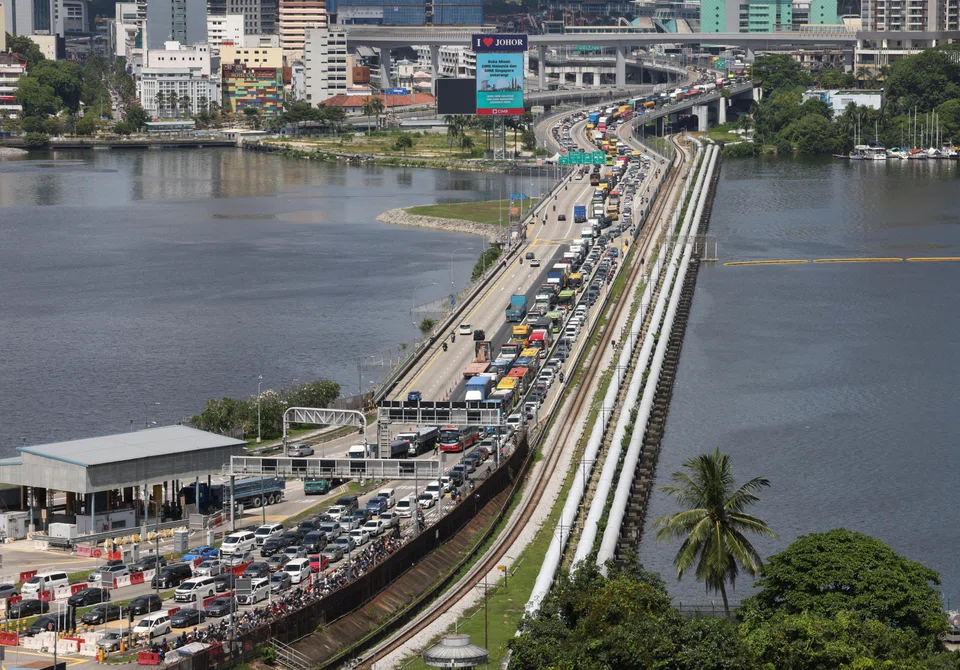
[SINGAPORE] Many Singapore residents cross the Causeway to shop and dine in Johor Bahru, Malaysia.
Despite the Malaysian ringgit strengthening against the Singapore dollar in recent months, many goods and services, such as meals, dental services, groceries and pharmaceutical products, are far cheaper there compared with the Republic.
Hence, Singapore residents who are concerned about affordability can stretch their dollar in Johor Bahru.
Crossing the Causeway for shopping and leisure will also get much easier when the Johor Bahru-Singapore Rapid Transit System (RTS) Link becomes operational later this year.
The RTS Link will connect Singapore’s Woodlands North MRT station with Bukit Chagar station in Johor Bahru. Journey time is expected to be five minutes, with a 3.6 minute peak hour frequency.
Each terminus will have co-located immigration facilities, allowing commuters to clear both Singapore and Malaysia authorities at the departure point.
In addition, connectivity will improve further with the redevelopment and extension of Woodlands Checkpoint.
Retail offerings
Today, residents here frequent malls in Johor Bahru such as JB City Square and KSL City Mall, as well as large-scale destination ones like The Mall, Mid Valley Southkey and Paradigm Mall.
Singapore residents also cross the Causeway for premium outlet shopping and dining in areas such as Mount Austin.
In addition, more retail space is being built in Johor Bahru such as the retail component of the integrated project that Malaysia’s Sunway Group and MRT Corporation are developing next to Bukit Chagar station.
Malaysia’s Coronade Properties has appointed Singapore’s CapitaLand Investment to help shape the retail vision for Coronation Square Mall, which will be linked to the Bukit Chagar station.
Might better Johor Bahru-Singapore connectivity and the increase in retail and leisure offerings across the Causeway lead to the city-state’s residents diverting more of their spending to Johor Bahru?
Perhaps rising leakage of retail spending by Singapore residents to Johor Bahru will affect the performance of suburban malls here, in particular Frasers Centrepoint Trust’s (FCT) Causeway Point, which is connected to Woodlands bus interchange and Woodlands MRT station – one stop away from Woodlands North MRT station.
Overblown fears
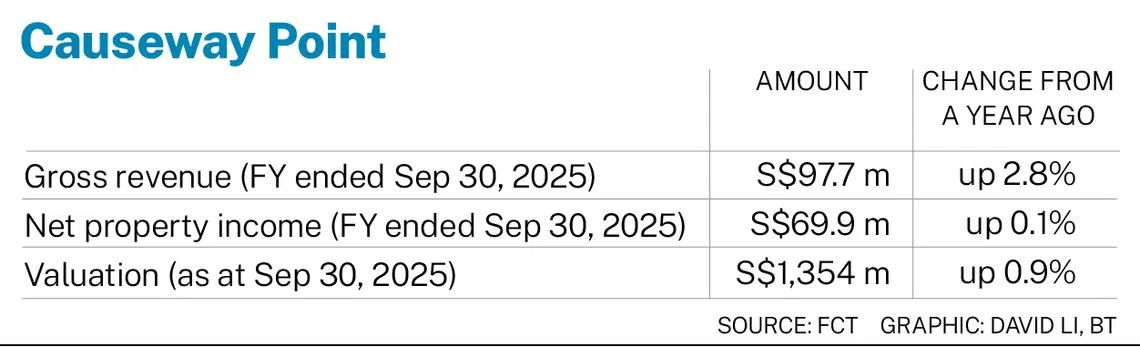
According to FCT’s latest annual report, Causeway Point, which has gross floor area of 629,167 square feet (sq ft) and net lettable area of 419,782 sq ft, was valued at S$1.354 billion as at Sep 30, 2025. The mall sits on leasehold land with a remaining tenure of over 68 years.
For the last financial year, Causeway Point’s top three trade categories – namely food and beverage, beauty and healthcare, and fashion and accessories – contributed over 60 per cent of its gross rental income. The mall’s rental reversion was a positive 8.9 per cent in the last financial year.
Will Causeway Point hollow out because residents in its catchment area ride on the RTS Link to shop and dine in Johor Bahru?
On reflection, I think fears over Causeway Point’s shopper traffic, tenants’ sales, occupancy level and rental rates plummeting once the RTS Link becomes operational are overblown.
Many residents here, such as working adults and students, lead busy lives. Many Woodlands residents may continue to shop and dine at Causeway Point regularly because of convenience while making ad-hoc trips to Johor Bahru.
In particular, shopping and dining very close to one’s home will appeal to local families with young children as well as the elderly.
Children with busy timetables may value attending enrichment classes at a mall near their home, while elderly persons might find commuting beyond their neighbourhood mall to shop and dine too problematic.
Indeed, if Causeway Point continues to curate an interesting tenant mix, offers a pleasant environment and acts as a focal point for the community, prospects for revenue growth and capital appreciation should be positive. This is especially as major efforts are underway to develop the Republic’s north region.
Growth plans
Singapore’s north region will see a host of infrastructural, residential and commercial developments which will substantially contribute growth to the region’s residential and working population.
The North-South Corridor – a 21.5 km integrated transport artery that will directly connect northern towns, including Woodlands, Sembawang and Yishun, to the city centre – is expected to open in phases from 2027 to 2029.
Over 50,000 new homes are expected to be completed in the next 10 to 15 years in the north region. New homes will be built in areas such as Chencharu, Sembawang, Woodlands North Coast and the former Kranji Turf City.
Thus, the north region’s population may grow by 25 per cent or more over the next 10 to 15 years.
Also, there are plans for Woodlands to become a major employment and commercial hub. For example, JTC is aiming to develop Woodlands North Coast as a vibrant, mixed-use economic hub and northern gateway.
Moreover, the growth of the Johor-Singapore Special Economic Zone could boost Woodlands’ development as a business hub.
In short, looking ahead for Causeway Point, population expansion, job creation and infrastructure improvements in the vicinity may outweigh potential rise in leakage of retail spending to Johor Bahru among Woodlands’ residents.
Moreover, the RTS Link might facilitate a rise in cross-border workers coming from Johor Bahru to Singapore.
This potential manpower influx can in turn help to address the persistent labour shortages facing the city-state’s retail as well as F&B operators, thus benefiting Causeway Point’s tenants.
Certainly, Johor Bahru’s retail, leisure, and F&B offerings pose a serious threat to suburban malls here. Mall developers, retail landlords and retailers in Johor Bahru understand Singapore consumers and will fight hard for a larger share of their consumer spending.
Still, even as more Singapore residents may cross the Causeway for shopping and leisure on the back of better Johor Bahru-Singapore connectivity, prospects for suburban malls here remain bright.
Strong neighbourhood malls can leverage population and household income growth by providing offerings which are relevant to local communities.
As a property asset class, the city-state’s suburban malls have generally done well. Doubtless, better Johor Bahru-Singapore connectivity poses a real challenge to these malls, especially Causeway Point.
Nonetheless, I think Causeway Point will continue to deliver sound operating performance and financial returns on the back of growth plans in Singapore’s north region and good asset as well as property management.
The writer owns units in FCT