HOCK LOCK SIEW

Will GIC and Temasek’s investments in blacklisted AI firm Anthropic backfire?

Not necessarily; corporate governance – not unconstrained profit – could be the new alpha generator

Summarise
Jude Chan
Published Thu, Mar 12, 2026 · 07:08 PM
    • Anthropic says it could lose “multiple billions of dollars” in revenue this year from its fallout with the US government.
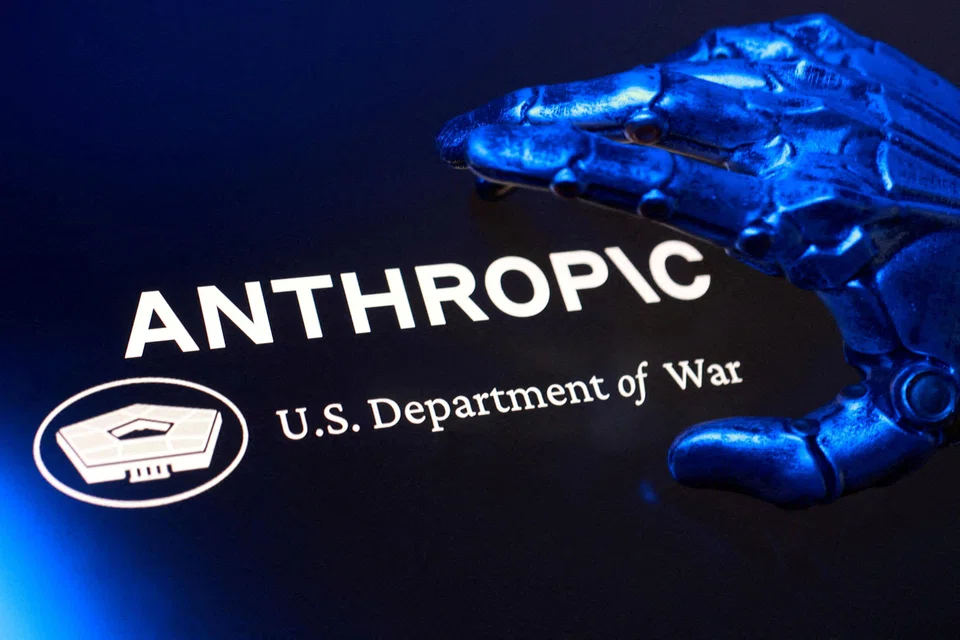
    • Anthropic says it could lose “multiple billions of dollars” in revenue this year from its fallout with the US government. PHOTO: REUTERS

    IT IS tempting for armchair critics to scoff at the latest artificial intelligence (AI) bets made by Singapore’s GIC and Temasek. But investors questioning if this move is a misstep are fundamentally misreading the room.

    GIC and Temasek recently sank billions into a funding round that valued Anthropic at a staggering US$380 billion – just weeks before the US Pentagon slapped the AI darling with a “supply chain risk” label.

    That designation is usually given to firms associated with foreign adversaries, and it impacts how Anthropic can do business with the US federal government. Specifically, Anthropic’s quarrel with the Pentagon stems from the fact that it refuses to allow its Claude models to be used for mass surveillance of American citizens and fully autonomous weapons systems.

    In a court filing, Anthropic said that its contracts with the US federal government are already being cancelled, and that current and future contracts with private parties are also in doubt.

    A company spokesperson noted that it could lose “multiple billions of dollars” in revenue this year.

    For sceptics, the punchline writes itself: Singapore’s sovereign wealth just bought into the one tech giant deemed too ethical to fight wars, effectively locking their investment out of the lucrative defence sector.

    Indeed, when a rising tech star loses a massive US military contract, the market usually punishes its valuation.

    But in this strange new world where unconstrained profit is increasingly seen as a high-risk liability in the capital market, saying “no” to the Pentagon might just be the ultimate flex.

    “Helpful, honest and harmless”

    Anthropic’s training framework for large language models is guided by a set of principles that align AI behaviour with positive human values: to be “helpful, honest and harmless”.

    For Anthropic investors such as GIC and Temasek, it is a calculated, multibillion-dollar hedge on the premise that corporate governance is the new moat. They are betting that the biggest enterprise spenders – banks, healthcare providers and legal firms – will demand the exact same ethical guard rails that the Pentagon found unpalatable.

    In the current market, a company without a governance soul is a ticking time bomb. A single bad autonomous decision could wipe out billions in market capitalisation overnight through regulatory whiplash.

    And this pivot from “growth at all costs” to a resilience-first model is actively rewriting the valuations of Singapore’s own national champions.

    Championing corporate governance

    Consider the Temasek portfolio company ST Engineering .

    While Anthropic lost a military contract by being “too ethical”, ST Engineering is doubling down on defence.

    But crucially, it is doing so through the lens of “sovereign AI” – helping Singapore to reduce dependency on foreign technologies to secure national security, data privacy and economic competitiveness.

    In a sense, this is the national-security equivalent of corporate governance.

    ST Engineering’s recent memorandum of understanding with US-based Shield AI to integrate the Hivemind autonomy software allows the group to develop indigenous mission sets.

    The group’s tech and digital chief Lee Shiang Long said that the collaboration “creates new opportunities to co-develop future-ready capabilities that can scale across (its) defence, public security and potentially commercial applications”.

    By building out its own systems that can operate even when GPS is jammed, ST Engineering is avoiding the trap of being a mere reseller of foreign tech.

    Instead of punishing ST Engineering for being a defence contractor, the market is rewarding the firm for being a predictable, state-backed partner with ownership over its intellectual property.

    ST Engineering shares have marched to a 32.9 per cent gain in the year to date, outgunning the 4.6 per cent rise of the benchmark Straits Times Index (STI) over the same period. It is by far the best performer on the blue-chip index.

    At the other end of the spectrum is the cautionary tale of Singtel’s Australian subsidiary, Optus.

    The tragedy of the September 2025 outage, which was linked to fatal consequences after emergency calls failed, highlights the risks of how profit-focused operations can affect a company’s valuation.

    While Singtel is powering ahead with its data centre transformation, the market is discounting its valuation.

    Shares of Singtel have climbed 10.1 per cent in the year to date – still ahead of the STI, but a distance from the premium that should be accorded to a company making headway into a high-growth sector.

    Perhaps a lean-running telco may be seen as higher-risk, now that investors realise the potential exposure arising from the underlying infrastructure that lacks the resilience and systemic governance required of a public utility.

    This emphasis on structural resilience and transparent communication is precisely what regulators are trying to engineer across the broader equities market. It forms the backbone of the Monetary Authority of Singapore’s and Singapore Exchange’s S$30 million Value Unlock programme.

    Far from being a mere administrative nudge, the initiative – which recently opened its Equip and Elevate grants – is effectively a strategic bootcamp for listed companies.

    The Equip grant covers 50 per cent of costs up to S$15,000 for training in strategy, investor relations and corporate governance; the Elevate grant supports deeper, professional consultancy for strategy refinement and market positioning.

    The goal is to help fundamentally strong but undervalued firms articulate their equity story, optimise capital and elevate investor relations.

    Regulators understand that in today’s market, intrinsic value is meaningless if a company lacks the governance framework and strategic clarity to communicate it to shareholders.

    This push for boardroom transparency is operating in tandem with the S$6.5 billion Equity Market Development Programme (EQDP).

    While the EQDP focuses on the supply side of capital – injecting liquidity and appointing fund managers to support high-growth companies – the Value Unlock programme tackles the demand side by making companies fundamentally more investable.

    Together, these initiatives signal a decisive shift: Authorities are no longer just hoping for better market valuations; they are also actively funding the capability-building required to achieve them.

    The armchair critics might still be sceptical of a premium paid for a company blacklisted by the Pentagon. But trust and structural resilience are now far more valuable currencies than a volatile government contract or quiet intrinsic value.

    Investors barging blindly into pure-profit growth counters would do well to ask if those companies have the governance framework to survive contact with operational and regulatory reality.

    When the next crisis hits, those who bought into governance won’t be the ones serving as the punchline.