
The world wants Chinese tech. China is determined to keep it

China’s rivals are learning how to get what Beijing won’t share
Published Tue, Apr 21, 2026 · 05:43 PM
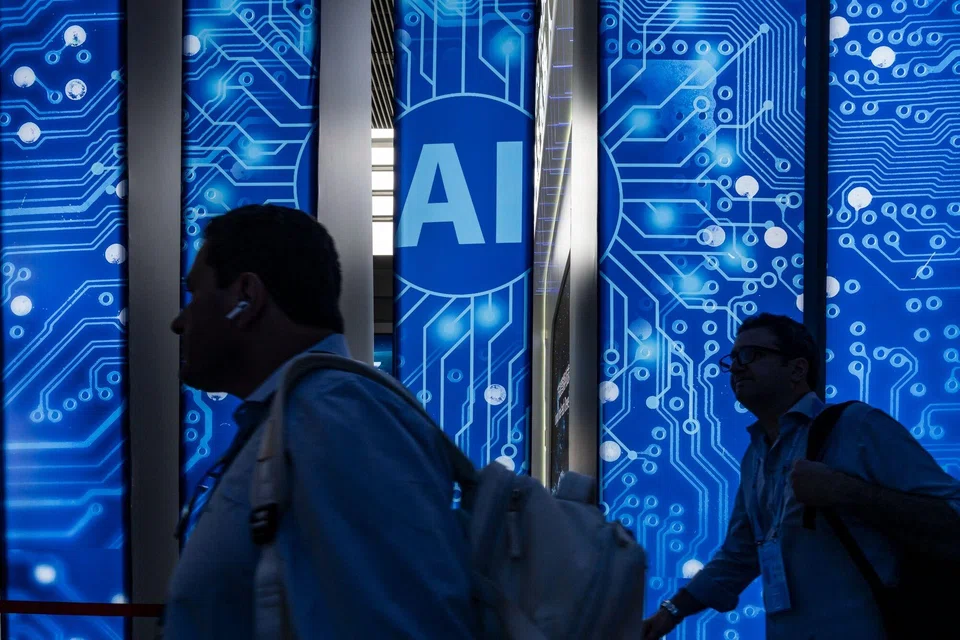
    • Attendees walk past AI signage at the Canton Fair trade event in Guangzhou.  Despite China’s manufacturing prowess, it is far from being a tech leader across the board, says the writer.
    • Attendees walk past AI signage at the Canton Fair trade event in Guangzhou. Despite China’s manufacturing prowess, it is far from being a tech leader across the board, says the writer. PHOTO: BLOOMBERG

    DeeperDive is a beta AI feature. Refer to full articles for the facts.

    THEY used to gripe about too much technology transfer in China. But in the past year or so, foreign business and political leaders have started to fret that too little is happening.

    No longer do they worry so much about Western tech landing in Chinese hands; rather, they fear that China is now too effective at preventing its best stuff from passing to foreigners.

    A former Chinese trade official reacted to the pivot with empathy rather than mockery. “It is a bit hypocritical, but it’s understandable,” he said.

    It might be tempting to craft a morality play out of this, as if countries outside China are getting their comeuppance. But at its heart, this is a practical problem – a question of whether China will be able to dig a moat around its world-leading technologies, from electric vehicles to artificial intelligence-powered robots.

    Chaguan, the Chinese politics and society column of The Economist, is inclined to take the other side of the bet – namely, that knowledge will flow as it normally does, from those who have it to those who want it. A reverse tech transfer will, over time, occur.

    In principle, the mechanism is straightforward. Countries can offer Chinese firms market access as long as they set up local manufacturing. In practice, none of this is automatic – and all of it is fraught.

    DECODING ASIA

    Navigate Asia in
    a new global order

    Get the insights delivered to your inbox.

    The European Union is now at the forefront, recently proposing procurement rules that would require things such as battery-storage systems for Europe to be made there.

    Chinese companies wanting to be let into European markets would have to invest in factories there. Developing countries also see promise.

    From Brazil to Vietnam, governments are opening their doors to Chinese EV companies and urging them to use local content. Yet, it is early days.

    China’s tech controls may also have the opposite of their intended effect. For young innovators in AI, the crackdown on Manus is chilling. 

    “We have been talking about tech transfer for just the past year, and it’s still not really clear how it will work,” said one diplomat with refreshing candour.

    One obstacle will be China itself. Over the past five years, it has built an export-control regime, mimicking America’s. The stated goal is to protect national security, but many controls are aimed at shoring up Chinese industry.

    Last year, for example, the commerce ministry said it would require companies to obtain licences before exporting technologies used in EV batteries.

    A Western trade official sees little prospect of Chinese officials letting out anything genuinely valuable. They have already reacted angrily to the made-in-Europe legislation, viewing it as a ploy to weaken Chinese industry.

    The saga of Manus, an AI startup, also highlights Chinese leaders’ paranoia.

    Founded in China, Manus shifted its business registration to Singapore last year, facilitating a sale to Meta, Facebook’s parent company. Chinese regulators are now attempting to unwind that deal and have barred Manus’ two co-founders from leaving the country.

    But China’s own record in attracting technology from other countries offers some guidance for the rest of the world. Persistence will be essential. China took the better part of three decades to hone its methods: incentives to attract foreign investment; requirements for local joint ventures; content rules; partnerships with foreign universities; and, yes, theft of intellectual property.

    One critical need is more attention to Chinese scientific research, much of which – at least in pre-commercial phases – is published in journals, said Cheung Tai Ming, a longtime analyst of Chinese tech policy. “It’s something that we didn’t think about that now we have to,” he added.

    Moreover, it is a mistake to think tech transfer involves discrete bits of technology, such as a blueprint for photovoltaic cells. Instead, what matters is the whole process, including workforce training – a lesson that India is slowly absorbing.

    Apple, whose investments helped build up China’s supply chains, now produces a quarter of its iPhones in India. Even if most components are sourced from China, many are made in Chinese factories owned by foreign companies, indicated analysis by Chris Miller and Vishnu Venugopalan for the American Enterprise Institute, a think tank.

    The implication is that the Chinese supply chain may ultimately prove more mobile than it currently seems.

    Transfer portal

    At the same time, the rest of the world will have to follow a different formula from China’s. Instead of relying on the government’s top-down strategy, other countries will have to depend on companies themselves.

    The auto sector offers an early indication. Almost all global carmakers –General Motors, Hyundai and Volkswagen, to name a few – are now developing EVs in China, learning from local companies.

    Many ideas are also seeping out through research-and-development partnerships. “The biggest companies are off-limits, but there are thousands of suppliers to work with,” said one Chinese executive with a foreign automaker.

    China’s tech controls may also have the opposite of their intended effect. For young innovators in AI, the crackdown on Manus is chilling.

    If they are unable to sell to foreigners, they will never get full value. That will only give them more incentive to take ideas abroad early on.

    The ultra-competitive Chinese business environment pushes in the same direction. The Chinese auto executive said many local suppliers are starved for profits, which makes foreign partnerships all the more tempting.

    Despite China’s manufacturing prowess, it is far from being a tech leader across the board. Nor can it ever be. It still wants what the West has to offer, notably in the semiconductor industry. In that sense, the current wrangling over tech transfers has an air of negotiation to it.

    As the former Chinese trade official put it, China will not fully benefit from its inventiveness unless it can export its own technology. The point, he said, is to extract a price from others, including access to their latest innovations.

    For now, that is not a winning proposition, especially given the determination of American officials to keep China away from cutting-edge chips. But it does point to a possible – perhaps even a likely – future in which tech flows both in and out across China’s borders. That may be unsettling for leaders in both Beijing and Washington. They will, however, struggle to stop it. ©2026 The Economist Newspaper Limited. All rights reserved

    Decoding Asia newsletter: your guide to navigating Asia in a new global order. Sign up here to get Decoding Asia newsletter. Delivered to your inbox. Free.

    Copyright SPH Media. All rights reserved.



