Xi finds five years has changed Europe
The undeniable chill in EU-Chinese relations in recent years reflect wide-ranging political and economic factors
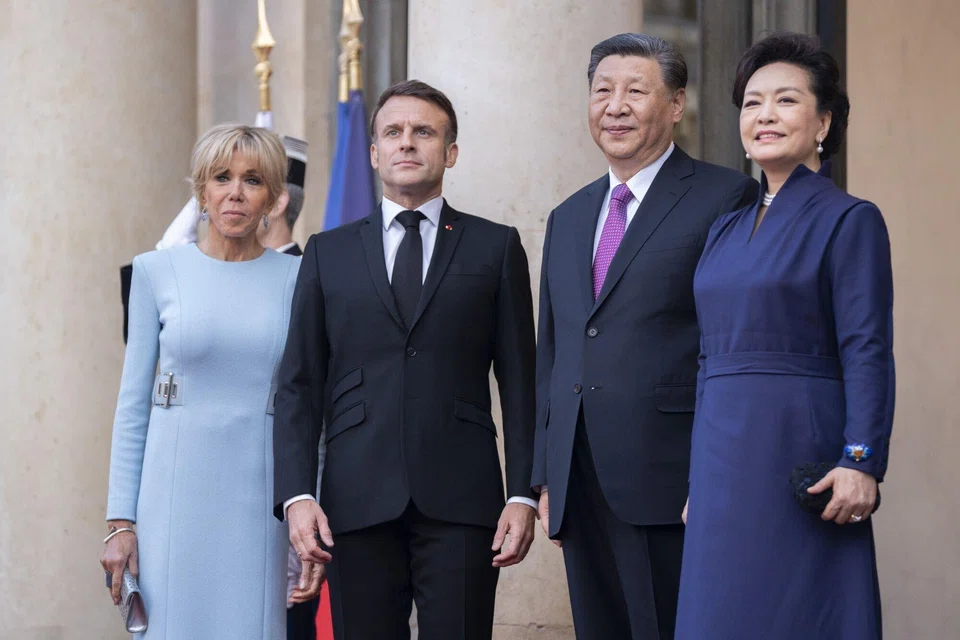
XI JINPING made his last high-profile visit to Europe in 2019, pre-pandemic, and was feted. Fast forward five years, however, and much of the continent is in a different political space towards Beijing.
To be sure, the Chinese president received a respectful, warm welcome in France on Monday (May 6) and Tuesday this week, the 60th anniversary of France-China diplomatic relations, where he met President Emmanuel Macron and also European Commission President Ursula von der Leyen. But the underlying political mood music is different from 2019.
Back then, what seems a “long” half decade ago, Xi was love-bombed by his then-Italian hosts who became the first G7 leaders to sign up for Beijing’s Belt and Road infrastructure scheme. Even then, this was a controversial decision within the West that infuriated the then-Trump administration, which called it “legitimacy for China’s infrastructure vanity project”, and was last year reversed by Prime Minister Giorgia Meloni’s administration currently in power in Rome.
Noting the change in mood in Europe, Xi has carefully chosen his three-leg itinerary this week. After France (with which China has what he calls a model bilateral relationship), he visits Hungary and non-EU nation Serbia, two of China’s supporters in the continent.
Beijing has described Serbia as an “iron-clad” friend, that has seen growing trade and investment ties with China. This includes a US$2 billion investment in wind and solar power plants and a hydrogen production facility.
Within the 27-member EU itself, however, Xi’s strongest ally may be longstanding Hungarian Prime Minister Viktor Orban. He favours deeper ties with not only China but also Russia, which makes him an outlier among the current cohort of 27 presidents and prime ministers.
These two states are outliers, however, in the course of contemporary European opinion on Beijing. More reflective of the stance, as at 2024, is the position of von der Leyen who has led the political charge in Brussels towards what she calls “de-risking” from Beijing.
This reflects the undeniable chill in EU-Chinese relations in recent years that reflect wide-ranging political and economic factors. These include perceived lack of transparency from Beijing over the origins of the Covid pandemic in 2020; European assertions of Chinese human rights abuses in Xinjiang province; and concerns that China is “dumping” key products such as electric vehicles, batteries, wind turbines and solar panels in the European market with use of extensive state subsidies.
Worse still, top EU officials have also become increasingly concerned in recent years about whether the nature of China’s external interventions in Europe represent a divide-and-rule strategy to undermine the continent’s collective interests. EU foreign affairs chief Josep Borrell even asserted that Beijing is a “systemic rival that seeks to promote an alternative model of governance” to that of Europe.
The background to this is that Europe is becoming an increasingly important foreign policy focal point for Beijing, including as an economic market. The rising superpower had, until recently at least, generally enjoyed growing influence across much of the continent.
Post-pandemic and Russia’s invasion of Ukraine in February 2022, Brussels has therefore sought to bring the bloc together around a stronger policy towards China. Von der Leyen and Borrell have led on this, even though the European Commission president’s role does not have a formal foreign policy mandate.
So the direction of travel for EU policy on China is clearly in a more hawkish direction. Even on issues where breakthroughs have been made with Beijing in recent years, such as the bilateral Comprehensive Agreement on Investment, the “long grass” of Brussels has prevented ratification in the European Parliament owing to EU concerns over China’s behaviour.
Yet, despite these greater attempts at more unity, Brussels is struggling to find common ground on Beijing across all 27 member states. It is this that has shaped Xi’s travel itinerary this week.
While Macron has become increasingly hawkish in Russia since its invasion of Ukraine, China has welcomed a string of his wider, recent comments. During a joint visit last year to Beijing with von der Leyen, the French president – remarkably – took a business delegation of around 50 people, and deployed the language of economic reciprocity rather than de-risking.
Macron also moved away from prior positions on Taiwan. So whereas von der Leyen asserted on the trip that “stability in the Taiwan Strait is of paramount importance” and that “threat of use of force to change the status quo is unacceptable”, Macron said Taiwan is a “crisis that is not ours” and that Europeans should not be “America’s followers”.
While the full motivation for Macron’s comments remain unclear, his position is out of sync with not just the EU stance, but also key G7 statements on Taiwan that France earlier signed up to. His remarks are premised on a highly questionable assumption that Europe can completely insulate itself from tensions between China, Taiwan and the United States. China has also acknowledged the role that France played in stymieing efforts to open a Nato liaison office in Tokyo.
The Franco-China discussions this week will be closely watched not just in Europe, but also the United States, around a month before President Joe Biden is expected to pay his own state visit to France. It is clear the position of the White House is closer to von der Leyen, than Macron, on many China issues.
Beijing will also seek to make political capital in the Serbia trip which coincides with the 25th anniversary of Nato’s bombing of the Chinese embassy in the nation’s capital, Belgrade, that killed three. The attack fuelled Beijing’s antipathy for the alliance, even though Nato said it was an accident.
In Hungary too, Xi is likely to welcome the fact that the nation has become a key production hub in Europe for Chinese automotive suppliers, including electric vehicle makers. This may help Chinese firms navigate EU tariffs in the future.
Perceptions of a divided Europe have also been publicly highlighted by several Chinese officials, including former EU ambassador Fu Cong, who has cast doubts whether all 27 member states are behind the agenda of Borrell and von der Leyen. Cong has said that “Europe has not formulated a coherent policy towards China” and that it felt like “people quarrelling with each other”.
Taken together, Xi hopes his visit will mark an important reset moment in ties, post-pandemic. However, while the visits to France, Serbia and Hungary will be very cordial, there is no disguising that broader Europe-China ties are chilled and could yet go from bad to worse in 2024.
The writer is an associate at LSE IDEAS at the London School of Economics