
The yuan ‘Plaza Accord’ would barely dent China’s edge

Structural reforms are what’s needed to blunt Beijing’s cost advantages in production, not currency tinkering
Summarise
    • Beijing has loosened its grip on the yuan, allowing it to gain 4.6% in inflation-adjusted terms in the past year. 
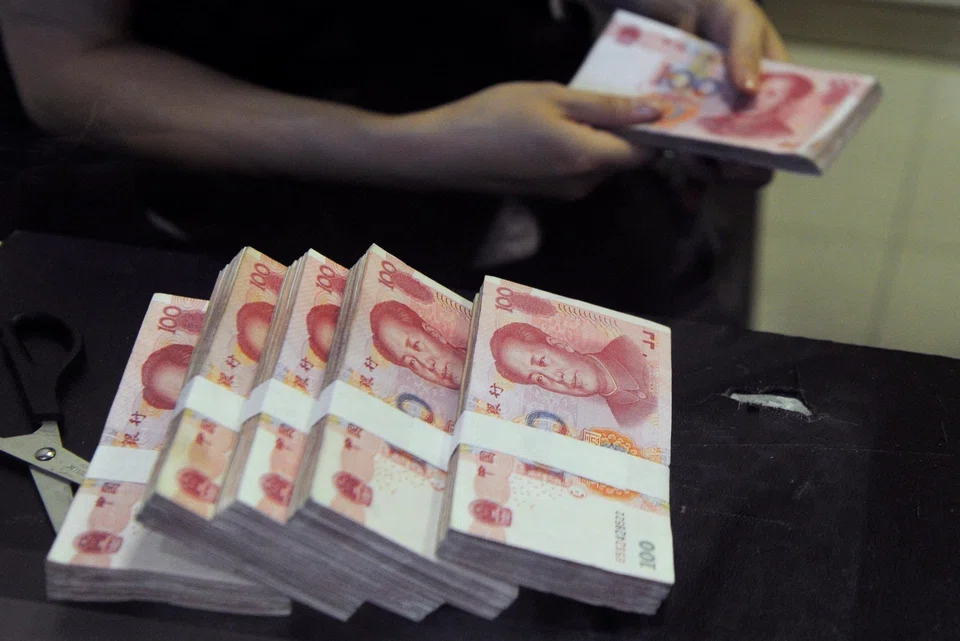
    • Beijing has loosened its grip on the yuan, allowing it to gain 4.6% in inflation-adjusted terms in the past year.  PHOTO: REUTERS
    Published Wed, Jul 1, 2026 · 07:38 PM

    [LONDON] Big problems invite simple fixes, and there is a risk that Western policymakers are starting to treat the yuan as a big problem.

    Force Beijing to revalue the currency, the thinking goes, and the hollowing out of global industries caused by cut-throat Chinese competition should begin to reverse.

    But China’s cost advantage is so vast that counteracting it is impossible without bold industrial policies and even some targeted protectionism.

    In June’s Group of Seven summit ​in France, German Chancellor Friedrich Merz blamed an “artificially low” yuan as a key driver of China’s large current account surplus, which hovers at around 3.8 per cent of gross domestic product.

    It marked a notable shift in his position towards American and French thinking.

    At the G7 summit in June, German Chancellor Friedrich Merz blamed China’s “artificially low” yuan as the key driver of its large currency account surplus. PHOTO: BLOOMBERG

    The business newspaper Handelsblatt cited an unnamed high-level official as having said that Merz was swayed by a research paper by economists Sander Tordoir and Brad Setser at the Council on Foreign Relations.

    Setser often cites the 1985 Plaza Accord, under which several countries coordinated their actions to weaken the US dollar, as a template to appreciate Asian export currencies.

    Beijing has already loosened its grip on the yuan, allowing it to gain 4.6 per cent in inflation-adjusted terms in the past year. But at that pace, it would take five years to be at a level that brings exports in line with imports.

    Still, the International Monetary Fund is sceptical of a new Plaza Accord, arguing that lasting rebalancing requires Chinese households ​to spend more, the US to cut its budget deficit and Europe to invest.

    Neither Beijing nor Washington will abandon growth models that have served them well.

    The same applies to the currency: Chinese officials will not change tack, not least ​because they believe Plaza set the stage for Japan’s financial crisis in the 1990s.

    Setser and fellow economist Shahin Vallee argue that coordinated US-European tariff threats could force China’s hand. But the currency is only a small part of the reason the West is becoming less competitive.

    Carmaker Volkswagen’s plans to cut 100,000 jobs underscore the urgency to close the overall gap; EU trade chief Maros Sefcovic, who met China’s commerce minister Wang Wentao in Brussels on Monday (Jun 29), wants trade talks to ​yield tangible results by October.

    Costs, not currency

    A McKinsey Global Institute report published on Tuesday underscores how vast this gap is.

    Researchers led by Chris Bradley and Anna Kortis analysed 10 major projects and calculated the average lifetime cost of production for each, including operating expenses and financing costs.

    The ​results are striking: In seven out of the 10 cases, China is the world’s cost leader, with the rest going to Asian or Gulf countries. On average across the eight sectors in which China is ahead of the West, its costs are only 58 per cent those of the closest competitor.

    In nuclear reactors, electric vehicles and fast-follower monoclonal antibodies, its costs are less than half those of the nearest Western rival.

    In solar power, battery assembly, pharmaceutical production and semiconductors, it is cheaper by at least a quarter.

    Only in polyethylene – the most widely used plastic in the world –- and steel making in electric arc furnaces does ​the US come out ahead, thanks to its abundant supply of natural gas.

    Yet even here, China undercuts Germany.

    For all the talk of China’s overcapacity, McKinsey’s numbers suggest that investment levels in the People’s Republic broadly track its cost advantages.

    Currency strength can ​only offset so much. A 25 per cent yuan revaluation would lift wages by a similar amount in dollar terms, but the gap would remain wide: Chinese workers still earn between a quarter and a half of their American counterparts.

    Local non-labour costs would also rise. China’s advantage in steel and batteries, for example, comes from vast investments in hydroelectric, coal and renewables clusters and from tightly integrated supply chains.

    Domestic steel production feeds through into lower construction costs for nuclear and solar plants. Overall, cheaper energy and materials account for about 30 per cent of the cost gap, McKinsey estimates.

    Even so, many inputs are traded internationally, so exchange rate changes only partially pass through.

    A back-of-the-envelope estimate by Breakingviews suggests a 25 per cent stronger yuan would raise China’s costs by 14 per cent on average across the 10 sectors, reducing by a quarter its leadership gap with the next Western follower.

    Counterintuitively, the impact would be large in some labour-intensive activities such as pharmaceuticals, where most inputs – such as active ingredients – are globally priced, leaving wages as the main differentiator.

    China’s edge goes further. The apparently higher productivity of Western industrial workers, which is estimated by the World Bank at about ​2.6 times the output per worker in the EU, may ​be a statistical artefact of lower prices in China.

    McKinsey’s data and other measures based on physical output suggest China’s workforce is ahead. Meanwhile, construction permits take an average of 42 days in China, compared with 62 in the US and 200 in Germany.

    In biopharma, faster time to market accounts for 40 per cent of firms’ edge, with drugs launched in about nine years, two earlier than in the West.

    Industrial policy another key lever

    Kortis and her colleagues argue that a concerted programme of structural ​reforms, including easier permitting, greater standardisation, active energy policies, automation and faster time to market, could enable the US and Europe to close more than a half the gap with China ​in many industries – much more than yuan revaluation would achieve.

    But even this likely understates the role of industrial policy. The Organisation for Economic Co-operation and Development estimates that Chinese firms received three to eight times more government support between 2005 and 2024 than those in rich economies.

    And while McKinsey’s figures account for subsidised land and cheap credit, they do not capture grants and tax breaks.

    The takeaway is not that the familiar cliche of focusing on self-improvement, long echoed in German policymakers’ calls to cut red tape and work longer hours.

    Rather, Western governments need to be far more ambitious, pulling whatever mix of levers brings lifetime production costs back ​to competitive levels in each key industry.

    That means trimming unnecessary regulation, but also narrowing the gap with China in the volume of funds channelled towards industrial ​policy, whether by expanding energy capacity or extending grants with clear technological goals.

    In some cases, it may require well-designed tariffs to cajole Chinese companies into joint ventures or to offset wage differentials that may never close.

    If China responds by appreciating the yuan to avoid losing key export markets, all the better. But Western officials ​should design their policies to stand on their own as a first line of defence.

    Since a new Plaza Accord would do little to end the trade war, it is the wrong hill to die on. REUTERS



