

EU’s global green leadership surges with Canada deal
SINCE the passage of the Inflation Reduction Act last year in Washington, there has been huge focus on the resurgence of US green leadership.
However, under the “global radar” also in North America, far less attention is – surprisingly – paid to Canada’s burgeoning credentials in this area.
While many miss Canada’s sustainability strengths, Europe is not one of them. Brussels sees in the vast North American country a huge partnership opportunity to help “futureproof” its global green leadership as it prepares for the possibility of a second presidency for Donald Trump from 2025 in the United States.
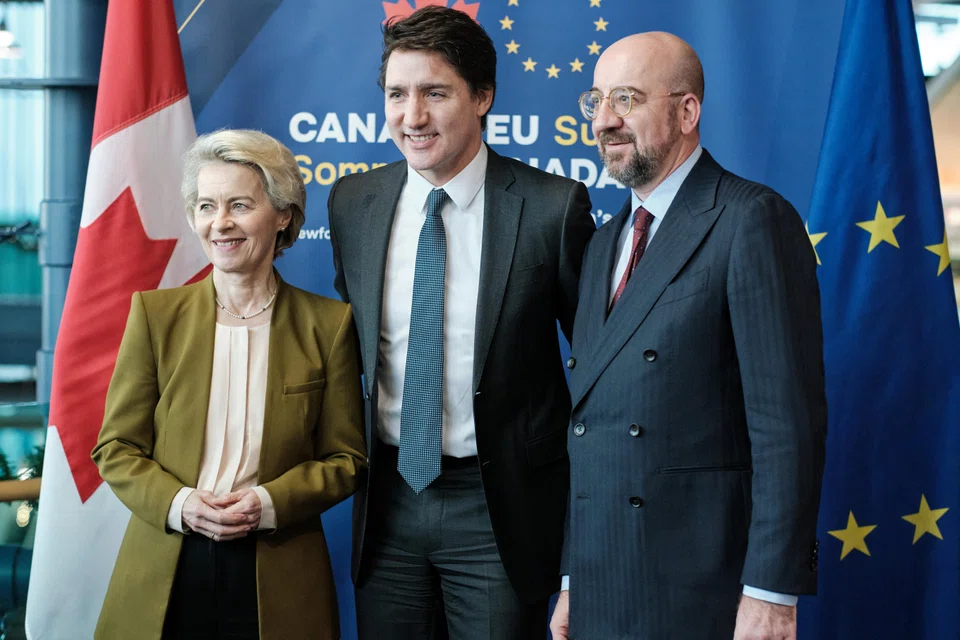
No surprise therefore that the powers announced a new “Green Alliance” at their annual bilateral summit last week (Nov 23 to Nov 24). It was also no coincidence that the summit was hosted in St John’s, the capital of the Canadian province of Newfoundland and Labrador.
The province has big plans to try to establish itself as a hydrogen-producing and exporting powerhouse in the near future, with an eye on European markets, especially Germany, which are key buyers of hydrogen. The provincial government is considering four bids for major wind-hydrogen projects.
These discussions build from a bilateral hydrogen deal that Canadian Prime Minister Justin Trudeau signed with German Chancellor Olaf Scholz last year in Newfoundland, the core of what could become a vibrant hydrogen energy partnership. Yet, Newfoundland and Labrador are only one of several areas in Atlantic Canada where companies are vying to build massive wind-powered hydrogen and ammonia plants. The goal for most of them is to transport hydrogen, in the form of ammonia, to Europe where there is a significant market for greener energy.
The ambitious green alliance pact reached with Canada, the most comprehensive form of bilateral engagement established under the European Green Deal, is based on a template that the European Union (EU) has pursued with other advanced, industrialised countries like Japan and Norway. It has also pushed similar initiatives with key emerging markets too, including India.
As COP28 approaches, the new EU-Canadian alliance will give a boost to the climate summit, and also European green leadership. Since the pandemic and the Ukraine war, the EU has doubled down on the green economy to meet global goals such as the 2015 Paris climate agreement.
This has built growing momentum behind the European Green Deal mega project. For instance, more than 50 major sustainability initiatives have been announced by Brussels since the signature policy agenda was launched by the European Commission.
This has helped the bloc refashion itself as a global green superpower which it hopes can secure a renewed political lease of life to boot. This after several difficult decades that saw the rise of challenges such as growing euro-scepticism and multiple financial crises.
However, meeting global green goals cannot be achieved simply by announcing endless, major new political initiatives from Brussels. Growing help from the private sector, and also international allies, is key in accomplishing this important agenda.
Hence the importance of the Canadian deal, which also helps with the wider European goal of diversifying from the Chinese economy. Canada is one of the key Western allies that the EU would like to build stronger green economy supply chains with, including critical raw materials, to help ensure a secure and sustainable supply of materials for Europe’s industry. And in so doing, significantly lower the dependency of the 27 member states on imports from nations such as China.
Beyond hydrogen, there are wider plans too for much greater “green cooperation” between the EU and Canada in areas such as carbon pricing and trading.
On carbon pricing, both Canada and the EU have a shared interest in rolling out carbon markets internationally. Europe was the first power in the world to introduce such a system – the EU Emissions Trading System – in 2005.
Moreover, Brussels has welcomed Canada’s carbon pricing system, and announced last Friday that it will become a partner of Trudeau’s Global Carbon Pricing Challenge. This seeks to increase explicit carbon pricing coverage of global emissions to 60 per cent by 2030 and creates a forum for dialogue, coordination and capacity-building on emissions trading.
To be sure, the EU and Canada are not fully aligned on all elements of the green agenda, including coal and fossil-fuel subsidies. Canada’s federal auditor recently highlighted that the nation is not on track to meet its climate targets due to delays in key measures, including methane regulations and an oil and gas emissions cap.
However, bilateral relations are fundamentally positive and cooperative. Mutual reliance could grow significantly further in the years ahead, especially if Trump wins a second term as US president. Canada-EU ties in the green economy build on a series of agreements since the 1970s and the joint membership of bodies such as the G7 and G20.
Underpinning this is the landmark EU-Canada bilateral trade pact, the Comprehensive Economic and Trade Agreement. This has driven an increase in two-way commerce, including a 15 per cent boost in EU exports to Canada in 2020 alone.
The writer is an associate at LSE IDEAS at the London School of Economics
TRENDING NOW
China recruited exec at Singapore data centre firm to spy on Nvidia CEO Jensen Huang: US intelligence

DBS, OCBC, UOB’s big sell-off: Was it their Q3 numbers or a broader market de-rating?

Could Japan trigger the next global financial crisis?

Philippines’ FDI slowdown exposes uneven investment prospects across S-E Asia

