

Averting the retail apocalypse: A Singapore survival kit
E-commerce might be a boon for customers but it doesn't have to be a bane for physical retailers. Applying both formats judiciously is key.
THE proliferation of e-commerce companies such as Qoo10, Lazada, Carousell and Redmart in Singapore has seen an emerging but alarming trend - the desertion of retail spaces. While Singapore is far from the retail apocalypse facing brick-and-mortar retailers such as Toys "R" Us in the United States, the stars are aligning in that ominous direction for retailers who fail to arm themselves ahead of the digital revolution.
For many retailers, the solution is simple: go digital. With the cost of setting up a website relatively low compared to rental cost, many retailers have gone down a slippery slope - investing in e-commerce and then realising that the world of e-commerce is highly competitive with low margins.
Consider the number of e-commerce-only retailers that go unnoticed because they exist on the second page of results from a search. With little differentiation across e-commerce retailers, not only do they have to incur logistical infrastructural costs but for online visibility, they have to invest heavily on marketing themselves through search engine optimisation.
So, what can retailers who choose to stay offline do to survive this retail apocalypse?
CONDUCIVE SPACES
Physical retailers must recognise their advantage over e-commerce retailers is in creating immersive experiences conducive for enabling customer's emotional attachment to the space. As digital platforms offer convenience, most e-commerce retailers focus on metrics such as the number of clicks to purchase or ease of navigating landing pages, the goal of which is to get the customer as quickly as possible to the finish line of the shopping cart.
Physical retailers, on the other hand, can create spaces that enhance the experience of shopping in person, allowing customers to easily immerse themselves in the retail space and potentially even wish to stay there for extended periods of time. Physical spaces offer opportunities to elevate the retail shop from just a place for purchase to a place of meaning and sentiment for customers. Take Lush, the chain selling personal care products. Its staff help customer walk through the sensory experience by engaging customers' senses through product samples. Washing sinks are located around the retail space for staff to apply body soaps and face masks on customers, based on their preferences or needs, while answering customer queries varying from the composition of the product, to its origins and its user benefits. Given the brand's high level of sustainability consciousness, its staff are also ready to tout the brand's adherence to the various standards of quality that sets it apart from its competitors.
CAPITALISE ON E-COMMERCE DEFICIENCIES
Smart devices give shoppers the autonomy to shop anywhere, any time. This can also be a constraint when it comes to products that are used over long periods of time, have a strong aesthetic value, vary in quality, or require a tactile experience that is important but difficult to convey via digital screens. The loss of this aspect can greatly devalue the purchase experience, reducing it to a function solely of convenience. Instead, allowing customers a multi-dimensional evaluation pre-purchase can mitigate perceived risks, reduce purchase anxiety and improve post-purchase satisfaction.
Retailers can observe the customer purchase journey and determine what crucial factors are considered in a purchase process. By doing so retailers are able to identify key elements that fall within the overlap of what is important to customers and what e-commerce cannot offer. Capitalising on these aspects can allow physical retailers to fill in that crucial gap and remain relevant. For instance, buying make-up online can be tricky. Thus, L'Oreal in China brought physical shopping a level higher by having augmented reality in its stores to help customers visualise better how the make-up looks on them before purchase.
Understanding the online shopping experience also allows retailers to appreciate customer pain points and the benefits digital shopping offers customers. However, there are solutions that e-commerce offers that are not exclusive only via online. Failure to understand this has led retailers into a false dichotomy of riding the digital bandwagon or facing poor financial performance. They begin to invest in overly complex and costly solutions.
Retailers should instead first examine the pain points of physical shopping and find innovative solutions to solve them, thereby preserving and enhancing the shopping experience rather than removing the physical experience altogether. Technology can be innovatively applied to physical retail, turning customer pain points into avenues to be differentiated from its competitors.
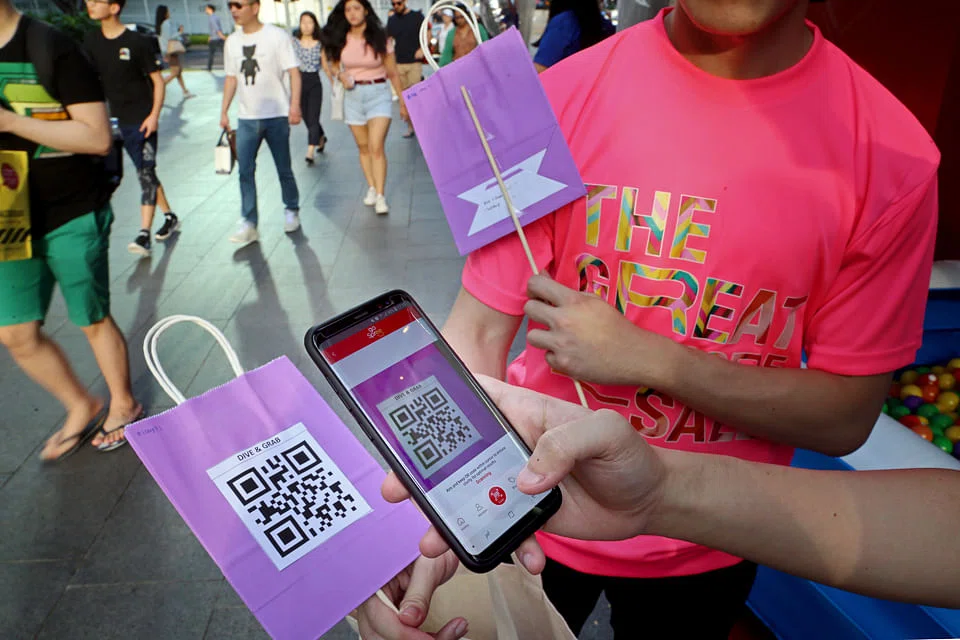
Honestbee's Habitat allows shoppers to buy groceries without the pain points of having to queue. From the moment customers arrive, they download a QR code into their smartphones. While browsing the place, customers simply use the app to scan their items themselves, which are then tallied and paid for through the app's digital wallet. The entire space is run without the hassle of cash. For larger purchases, customers are able to load their trolleys with the items and have them scanned and packed by pushing the trolley through an auto-checkout system that retrieves the trolley.
CUSTOMER CONSULTATION
E-commerce websites are seeking to provide customers as much of the experience they can find in physical stores. But not all experiences can be replicated. For example, the use of chatbots where customers post queries and receive answers in real time enhances the website's customer engagement. But these chatbots have not developed the sophistication that can match up to knowledgeable sales staff who are able to not just draw on personal expertise but also provide a human social element that can be appealing to the customer. These sales staff serve as critical touchpoints in allaying purchase anxiety and improving post-purchase satisfaction by reaffirming the customer's purchase or helping customers find the right product to satisfy their needs. They are also important in conveying what distinguishes their products from that of competitors. The Lush example mentioned earlier exemplifies this advantage.
E-commerce might be a boon for customers but it is by no means a bane for physical retailers. What has been an unproductive hassle for many retailers is the improper application of both or either formats. At the core, what is needed is an intimate understanding of the purchase journey and the different benefits that each format offers.
TRENDING NOW

Analysts cut DBS target price on lower 2027 earnings, but see buying opportunity after share price slide

Waymo founder predicts ‘landslide’ robotaxi adoption in Singapore, driven by high car costs

The limits of China’s trade concessions to Europe

Nvidia CEO Jensen Huang drops from world’s top 10 richest after chips sell-off

