

Beef up support so lifelong learning can yield payoffs
Sustained efforts at different career stages are needed to match changing needs and trends in the industry and education landscape.
AT the recently concluded Budget debate, Member of Parliament Ang Wei Neng made the controversial suggestion that local degrees should expire after only 5 years, thereby necessitating that university graduates attend upgrading courses to refresh their skills. His proposal triggered vociferous criticism and widespread derision, leading him to clarify that he had shared it as "food for thought".
The ensuing firestorm of debate online reflects the concerns and worries surrounding lifelong learning and skills upgrading. In the face of technological transformation and pandemic-induced upheaval, working adults are understandably anxious about the enduring value of their educational credentials and hard-earned working experience. Some fret about having to constantly pursue new credentials to remain competitive on the job market, or simply not to be dismissed or displaced.
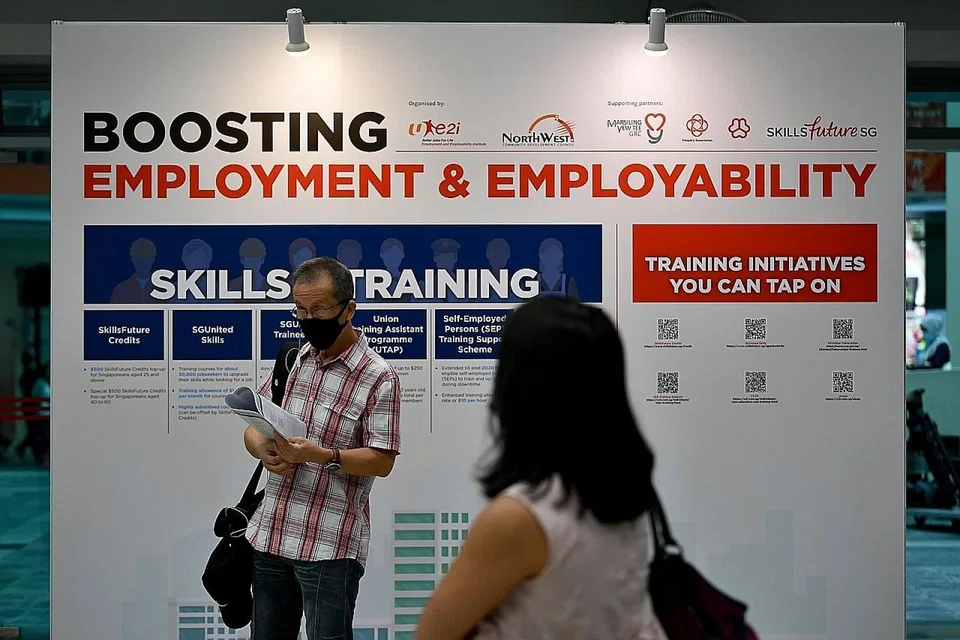
These concerns have not gone unnoticed or unsupported. In recent years, programmes in Singapore for skills upgrading have grown in size, scale and sophistication, with an expanded suite of courses offering training in emerging areas such as cybersecurity, data analytics and social media marketing. Such courses offer a clear value proposition, aligning with the country's fast growing infocomm sector. Trainees are necessarily drawn to them, enticed by the prospects that such market-relevant skills will be in great demand.
However, there remains a complex relationship between skills upgrading and enhanced career prospects. Training for reskilling or upskilling cannot be seen as a one-off activity with guaranteed results. For such schemes to translate into improved job outcomes and career pathways, sustained efforts at different career stages are needed to match changing needs and trends in the industry as well as the education landscape. In this regard, our interviews with trainees participating in SGUnited Skills (SGUS) programme as part of our ongoing research funded by a Social Science Research Council grant provide some insights.
SGUS was launched by SkillsFuture Singapore in 2020 under the SGUnited Jobs and Skills Package to cushion the economic fall-out of the pandemic by supporting citizens and permanent residents of Singapore to enrol in skills training courses. A formidable challenge with skills upgrading, however, is the plight of vulnerable workers. Whereas workers with formal degree qualifications can seek to leverage their credentials and social networks during career disruptions, vulnerable workers have very little to fall back on. Through our research, we identified characteristics of vulnerable workers who require special assistance in our lifelong learning and skills training ecosystem, and the particular challenges that they face.
In essence, mature, mid-life and mid-career learners who juggle multiple personal and professional responsibilities can benefit from greater support. A range of factors influence their enrolment in skills training such as course timing, duration, mode of teaching, peer support, location and credibility of the training provider, and availability of subsidies, among others. Such learners desire clarity on all these aspects and unforeseen difficulties can throw them off course.
Significant hurdles
Resource limitations on many fronts are a significant hurdle to skills training. For mature workers, time is a scarce resource; many find it difficult to fit training into their work schedules, or are unable to balance work, family and learning obligations. The absence of subsidies is noted to be another huge deterrent, leading them to deliberate at length on whether the training is worth the investment.
In a digitalising economy, workers who lack digital skills and devices with which to conveniently access online learning will also not derive the full benefits of skills training. Device loan programmes coupled with training will be a tremendous boon to such workers, who would otherwise fall behind in their skills acquisition. Notably too, older workers whose social networks do not comprise digitally literate friends and relatives find the absence of peer or family support a great hindrance to learning. In such circumstances, offering 'learning buddies' or helpdesks would serve to plug those gaps.
Workers who either lack or have 'inadequate' educational credentials also feel highly disadvantaged, given the premium that credentials command in our ecosystem. Some interviewees lamented that although there are workers who lack degrees but possess excellent work experience and passion for their work, they are not welcomed or rewarded by prevailing hiring practices. This situation is especially salient for mature workers considering pivoting to a new job profile or industry.
Too long a gap between skills training and subsequent employment also undermines the value of training because trainees lose the opportunity to apply their new skills in a timely manner. In this regard, skills training programmes should be even more closely aligned with job-placement programmes so that the utility of skills training is maximised for trainees and industry alike.
Besides these practical factors, the culture surrounding skills upgrading is also key. A positive and affirming environment is one where mature workers feel motivated and supported as they seek to augment their competencies. Yet mature learners often encounter ageism in training and job seeking. Some interviewees felt that larger organisations such as government agencies and multi-national corporations should take the lead and hire more mature workers so as to help set the tone for small and medium-sized enterprises to do likewise.
In the face of economic upheavals, programmes such as SGUS are commendable, and designed to cater to as wide a range of learners and job seekers as possible. Nevertheless, it is clear that some profiles of workers require more assistance and targeted support than others. Identifying their distinct difficulties in terms of resource constraints, skills and credential deficits, limited opportunities and even societal prejudices is an important step towards augmenting upskilling and reskilling programmes. Unless these difficulties are resolved through concrete scaffolding structures, skills upgrading efforts will not yield the desired return on investment for both the worker and the country.
Dr Lim Sun Sun is a professor of Communication and Technology and head of Humanities, Arts and Social Sciences at the Singapore University of Technology and Design (SUTD). Dr Sreeja Nair is an assistant professor at the Lee Kuan Yew School of Public Policy, National University of Singapore. Dr Gayathri Haridas is a research fellow at the Lee Kuan Yew Centre for Innovative Cities at SUTD.
TRENDING NOW

Once staunchly pro-China, Malaysian Chinese businesses are now distancing themselves from Beijing

Looking beyond looming CEO succession, should UOB potentially pursue a transformative merger?

Could stablecoins be the future of money?

Grab CEO’s wife Chloe Tong on life with Anthony Tan and finding her purpose

