

Biden faces balancing act in dealing with China
Balancing conflict and cooperation is tough enough, and it does look like Biden's administration will not easily find allies for a united international front as well.
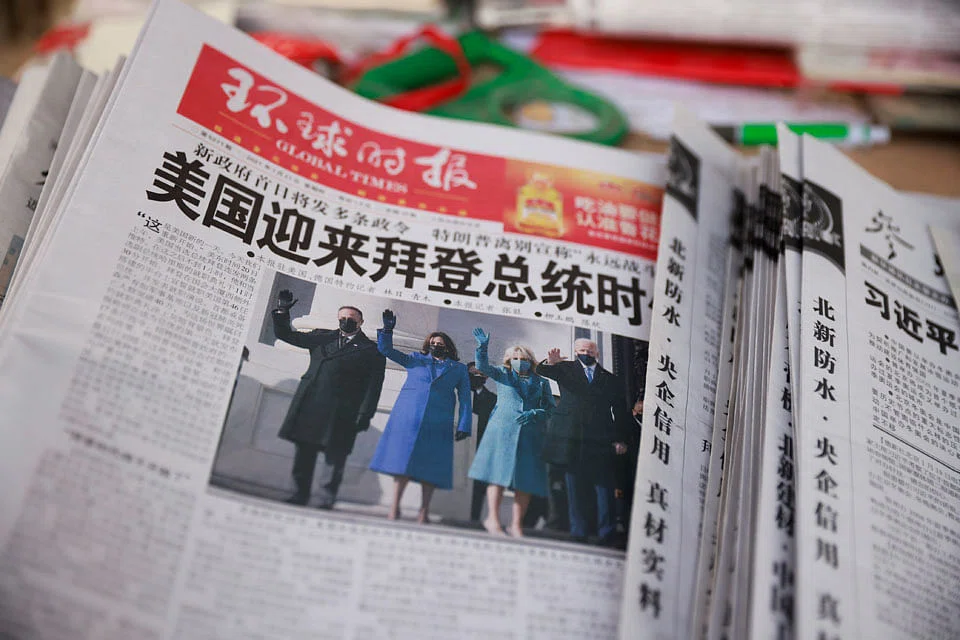
AS CHAIRMAN of the powerful Senate Foreign Relations Committee and later, as an influential vice-president in the administration of President Barack Obama, Joe Biden, one of Washington's leading foreign policy voices, tended to echo the bipartisan consensus that dominated US policy toward China since the opening to the communist regime following President Richard Nixon's historic 1972 visit to Beijing.
Like other members of Washington's foreign policy establishment then, the Democratic Senator Biden from Delaware had welcomed China's emergence as a great power, "because great powers adhere to international norms in the areas of non-proliferation, human rights and trade", as he put it after a visit to China in 2001.
He supported all the major US policy decisions that promoted the idea of engagement with China, including the move to allow the Chinese to join the World Trade Organization (WTO).
Twenty years later, Mr Biden - now the 46th US President - is facing a new reality on the Sino-American relationship: Beijing is being seen now not as a promise, but as a threat, and the talk about engaging China has been replaced with a new bipartisan consensus that regards Beijing as America's most dangerous global rival.
In fact, referring to Senator and VP Biden's rosy assessment of the relationship with China in the past and his role in an Obama administration that promoted engagement with China, it is notable that he was, during the 2020 presidential campaign, cast by his Republican opponents as an appeaser of China's aggression, and even worse, as someone who would serve as Beijing's stooge in the White House.
But the attacks on the engagement strategy vis-à-vis China have come not only from nationalist Republicans and military hawks; they have also been articulated by members of the Democratic Party's progressive wing, who have called for reassessing US free trade policies, as well as by human-rights activists who have denounced China's alleged mistreatment of the ethnic Uighurs and its repressive moves in Hong Kong.
Responding to the criticism, then-Presidential Candidate Biden made it clear that his views on China have since evolved; he now sees Chinese leader Xi Jinping as a "thug", and has stated in a Foreign Affairs magazine article that the United States "does need to get tough on China", which he and his top foreign policy advisors regard now as a major strategic challenge to US interests and values.
Kurt Campbell, a long-time Washington foreign-policy operator expected to join the White House as the National Security Council's Indo-Pacific coordinator had admitted in an article in Foreign Affairs he co-authored that "across the ideological spectrum, we in the US foreign policy community have remained deeply invested in expectations about China - about its approach to economics, domestic politics, security and global order, even as evidence against them has accumulated"; he added that the "policies built on such expectations have failed to change China in the ways we intended and hoped".
That admission reflected the transformation in the way he and many other Washington insiders - Democrats and Republicans - have gone through, regarding America's China policy.
Erstwhile China engagers have now become skeptics, reflecting similar changes in the American public's attitudes towards China that have become more hostile.
Mr Campbell had served as Assistant Secretary of State for East Asian and Pacific affairs during the Obama administration and was one of the architects of its "Pivot to Asia" strategy. Like his new boss, National Security Advisor Jake Sullivan, and the incoming Secretary of State Anthony Blinken, Mr Campbell is sometimes portrayed as a "hawk" on China. The three policymakers will attempt to take a tough stand in dealing with Beijing without promoting a new cold war with the Chinese, and regard China as a tough competitor, but not as a global threat.
Or as President Biden put it in an interview with The New York Times, the preferred policy of the new administration would be to have a "competitive relationship with China without it being a bellicose relationship". Gone will be President Obama's engagement strategy. Expect a resistance against adopting President Trump's belligerent - and, in many ways, incoherent and inconsistent - approach towards China, under which he hailed President Xi as a "friend" even as he set the US on a collision course with Beijing and blamed it for the spread of Covid-19.
From that perspective, one way of anticipating the Biden administration's policy towards China is to describe it as a work in progress or as an evolving China doctrine.
TRUMP'S TARIFFS
For example, it is not yet clear whether the new administration would dismantle the Trump administration's US$370 billion in tariffs on Chinese goods or retain some of them to employ as leverage in negotiating issues like climate change; it is also as a way to placate the anti-free trade progressive Democrats.
Concern over those progressive reactions may explain why President Biden is not rushing to rejoin the Trans-Pacific Partnership (TPP) trade deal, which the Obama administration helped create.
But at the same time, the TPP is the kind of multilateral arrangement that President Biden and his aides see as a more effective way to contain the rise of China and bind it to Western trading norms. Hence instead of "decoupling" the American and Chinese economies, let us create an environment in which the two would compete under agreed rules, while working together to deal with climate change and other common challenges.
But developing such a strategy faces major obstacles, including a Congress hostile about China playing a dominant role, and a bureaucracy and business community less supportive of engagement with the Chinese.
The intertwining of national security concerns and economic interests is central to the new American attitudes towards China, as demonstrated in a continuing pressure on the Biden administration to ensure that America keeps ahead of China in technology. This would mean battling a Chinese telecom giant like Huawei and supporting an ambitious industrial policy that includes providing government support for high-tech American companies. If pursued, this kind of high-tech wars between the two global powers would make it more difficult for the new administration to avoid the shift towards economic decoupling and confrontation.
In this context, it would be interesting to see whether the Biden Administration embraces its predecessor's move of delisting Chinese telecommunications companies in the New York Stock Exchange
There is very little doubt, however, that the Biden administration is going to take a tough stand towards aggressive Chinese military moves, and highlight its ties with military allies in Asia, including India, Japan and the Asean members.
But what is not clear is whether the new administration would continue to follow the Trump administration's attempts to strengthen diplomatic and military ties with Taiwan, even if that provokes China and makes it less likely to be able to cooperate with it in containing North Korea's nuclear threats.
President Biden is also likely to pursue a more activist US policy in dealing with alleged Chinese human rights violations. He has accused China of committing a "genocide" against Uighur Muslims and pledged to impose sanctions on Chinese officials and companies accused of being complicit in violating human rights.
But the main difficulty facing the new administration in its effort to fashion a new China policy would be in trying to create an international alliance to counter Beijing and bring multilateral pressure on it as opposed to the unilateral and go-it-alone approach of the Trump administration.
Indeed, during the election campaign, Candidate Trump called for forming "a unified front of friends and partners to challenge China's abusive behaviour".
But in a sign that even America's most staunch allies may not join it in creating a common China policy, the European Union (EU) under German leadership recently signed a Comprehensive Agreement on Investment (CAI) with China, a move that was harshly criticised by Washington. Some reports said that Mr Sullivan had advised the Europeans against signing the deal before the new US administration took office.
"The Biden-Harris administration would welcome early consultations with European partners on our common concerns about China's economic practices," he tweeted last Dec 21.
Yet, the EU decided to prioritise their economic interests over their ties with Washington, raising doubts about the viability of the new administration's multilateral approach.
TRENDING NOW

Once staunchly pro-China, Malaysian Chinese businesses are now distancing themselves from Beijing

Grab CEO’s wife Chloe Tong on life with Anthony Tan and finding her purpose

Could stablecoins be the future of money?
ST Engineering opens tech-focused aircraft maintenance facility in Changi; to create over 500 jobs

