Carbon scorecard: informing consumers so that they learn to do their bit
Introducing this will help people make more environment-friendly choices. BY SUMIT AGARWAL AND ALBERTO SALVO
THE Budget announcement that Singapore's carbon price will increase from the current S$5 to S$50-S$80 per tonne of emissions by 2030 is a welcome move. Such bold leadership contrasts with many countries that have been slow to realise that we need to stop treating our precious atmosphere as a "free" dumping ground.
The Singapore government has shown leadership in tackling challenges in the past. Realising that access to roads was not free, Singapore pioneered road pricing in the 1970s. In 2020, Singapore's regulators were again first to allow the sale of meat grown in bioreactors, a step the United States seems likely to follow this year.
To put the carbon price in perspective, S$80 per tonne would amount to S$400 for an average Singaporean whose consumption results in five tonnes of carbon a year emitted in 2030 - assuming of course broad incidence across all manner of goods and services, which is not the case.
Carbon pricing currently falls on some businesses - for example, electricity generators that use natural gas and emit carbon into the atmosphere.
Greenhouse gases, including carbon dioxide and methane, are produced by human activity such as the burning of fossil fuels and cattle ranching.
While pricing emissions by some firms makes implementation relatively simple, eventually all of society needs to engage in the transition from carbon-intensive products to a modern, sustainable economy.
In particular, consumers are the trigger to all supply chains and need to participate fully. For that, carbon literacy, or understanding the carbon impact of one's consumption choices, is key.
The three sectors in which households most influence carbon emissions - that is, have a large carbon footprint - are utilities such as electricity and water; transportation; and food, including plastic packaging that ends up incinerated.
We propose that Singapore develop a carbon score for individuals. Just as individuals have a credit or health score, they can have a carbon score.
What we propose is not easy. There are at least two challenges. First, a consumer's carbon footprint needs counting up. Building a scorecard that is relatively transparent and accurate requires the collaboration of statutory boards, research institutes at universities and more.
Next, such data needs dissemination to a regulatory authority, such as IRAS, besides of course the consumer.
As the adage "what you don't measure, you can't control" goes, consumers can learn about how their choices drive carbon emissions and adjust their behaviour in response. Changes by consumers will then drive innovation by the private sector, such as the development of new, greener food products. This is in line with Finance Minister Lawrence Wong's idea to have an entrepreneurial society.
Measuring our carbon footprint
We have to measure consumer activity as it relates to transportation, utilities, and food consumption choices.
Apps for ordering food, transport and electronic payments are proliferating. Our wallets are going digital. This means that most of our activities are being electronically recorded.
We know how much petrol we pump into the car, how many Grab rides we order, and how often we tap in and out on a public bus.
We know with sufficient accuracy the carbon embedded in each of these choices - for example, from extracting the oil in the Middle East to selling the petrol at our local pumping station. A 10 km car ride emits around 3 kg of carbon dioxide, well to wheels - about 10 times more than the amount released from shared public transit.
Electricity and water payments are recorded by utility providers or through Nets and bank statements. With some tweaks, we can also capture itemised food purchased at restaurants or through delivery apps.
The food transition
We will inevitably miss out some spending that is done with cash like food purchases at hawker stalls. But over time, we will capture more and more of such transactions as consumers switch to using electronic wallets like PayLah!
You may wonder: Is there a difference between the carbon footprints of the various foods we eat? Clearly, the answer is yes.
Few consumers realise that the "green" difference between eating beef and a diet rich in plant protein is about 25 times. While not as green as beans and lentils, even chicken and pork fare better than red meat farmed from ruminant livestock.
A Singapore-based study for Temasek found that "producing 30 per cent of Singapore's nutritional needs locally by 2030, adopting optimal health diet, and replacing 50 per cent of red meat with plant-based meat will significantly reduce greenhouse gas emissions by 26 per cent".
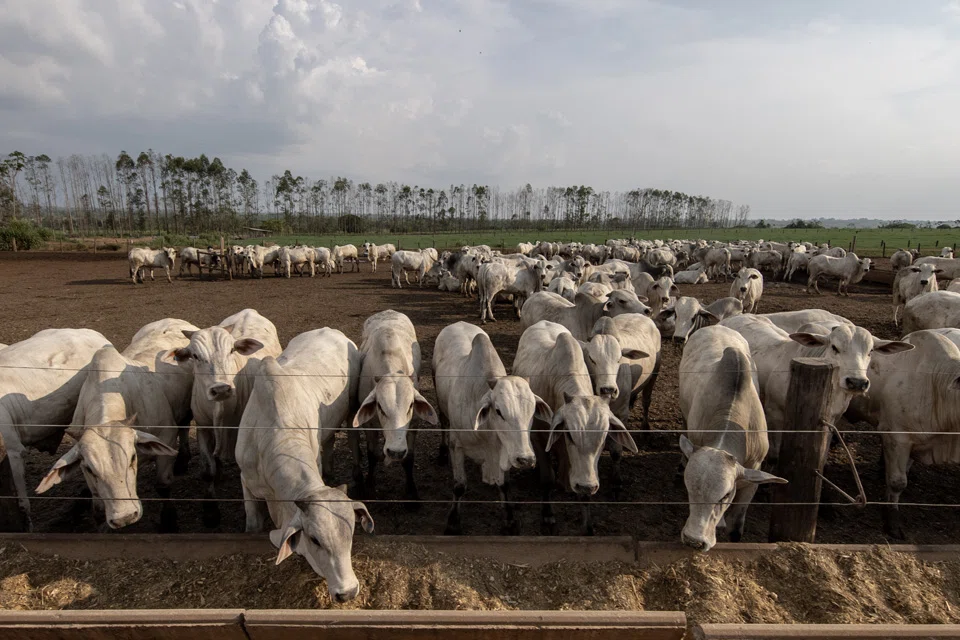
One kilogram of chilled beef from Brazil emits a staggering 38 kg of carbon from farm to table. This contrasts with 1 kg of fresh chicken from Malaysia or 1 kg of locally farmed eggs emitting 3 kg of carbon each.
Using the carbon footprint scorecard
Consumers can use the scorecard to learn about their carbon footprint. There will be important considerations to take into account, such as age, gender, or race.
There will be health and religious reasons why diets vary. But such accommodations can be debated once all the data are collected and can thus be analysed.
Data privacy and sensitivity concerns are paramount. Similar protocols will be in place as with credit and health scorecards, or digital mobility tracking in response to a crisis (the pandemic).
Should society choose this path, in future, we can tax households progressively according to their annual carbon footprint, similar to how authorities tax individual income. For instance, the carbon tax rate can be zero up to a threshold of 5 tonnes per year; S$5 per tonne for the next ton; S$10 per tonne for the next ton, and so on. Most individuals would fall in the first bracket and pay no annual carbon tax.
And because annual "carbon filing" is kept separate from product prices, such a measure is less likely to be inflationary than charging a carbon tax on each individual item on the supermarket shelf.
Carbon inequality
The wealthy account for most of the carbon that flows into the atmosphere (let alone the stock due to past flows). A recent article in Nature Sustainability finds that the average United States resident has a carbon footprint over 10 times larger than that of the average citizen in India. The top one-fifth of US emitters have a footprint 400 times that of the bottom one-fifth in sub-Saharan Africa.
What's more, a growing body of research shows that the poor will bear the brunt of climate damage, as they have the least means to protect themselves. In effect, without comprehensive carbon measurement and carbon pricing, the world's poor are subsidising the consumption of the rich.
Righting this wrong is likely what Finance Minister Wong had in mind when announcing Singapore's latest initiatives to advance its green transition.
Sumit Agarwal is the Low Tuck Kwong Distinguished Professor of Finance, Economics, and Real Estate at National University of Singapore (NUS) Business School and managing director of the Sustainable and Green Finance Institute (SGFIN) at NUS.
Alberto Salvo is associate professor of economics at NUS and a research affiliate at SGFIN.