Closing the funding gap for green urban infrastructure
Innovative forms of finance such as blended deals are one way to unlock progress - with NGOs, governments, the private sector and insurers working together.
THE clock is ticking on climate change. Temperatures are rising, sea levels are going up and we have more greenhouse gases in our atmosphere than at any time in human history.
In a rapidly urbanising world, where two out of every three people are forecast to live in cities by 2050, this is a formidable challenge. Unless we act fast, 800 million people living in low-lying coastal cities - particularly in Asia and the US coast - will be hit by sea level rises and coastal flooding by 2050 according to the UN. And according to the Urban Climate Change Research Network
(UCCRN) technical report, as many as 1.6 billion city-dwellers will suffer the effects of extreme heat and 650 million will find it more difficult to access fresh water.
There is no denying it - we need to start making our cities more sustainable and resilient now. But there is a big problem: a lack of funding to build the infrastructure needed to make cities greener and mitigate climate change risks.
Mind the funding gap
At present, there is simply not enough capital flowing to the countries where investing to achieve the United Nations' Sustainable Development Goals (SDGs) matters most. The UN has calculated a financing gap of at least US$2.5 trillion per year up till 2030 for emerging markets alone.
Looking more closely at infrastructure-focused SDGs reveals the scale of the problem - and the potential. Standard Chartered's Opportunity 2030 report reveals a US$10 trillion financing gap across 15 high-growth markets in Asia and Africa.
This presents a clear business case and investment opportunity for the private sector to contribute to three of the most tangible, infrastructure-focused goals - SDG 6: Clean Water and Sanitation; SDG 7: Affordable and Clean Energy; and SDG 9: Industry, Innovation and Infrastructure.
A surge in demand is coming for transport, housing, energy, digital connectivity and water. An enormous infrastructure buildout is needed. The challenge is to ensure that it happens sustainably and in a manner resilient to the changing climate.
None of this will be easy. Many governments may be financially constrained in the aftermath of the Covid-19 pandemic, having taken on more debt to shore up struggling economies. Investors too have been wary in the face of an uncertain outlook.
Reshaping financial services for sustainability
So how can we ensure that the work of financial organisations both promotes and entrenches sustainability, and attracts the new wave of investors looking for green returns?
1) Backing projects
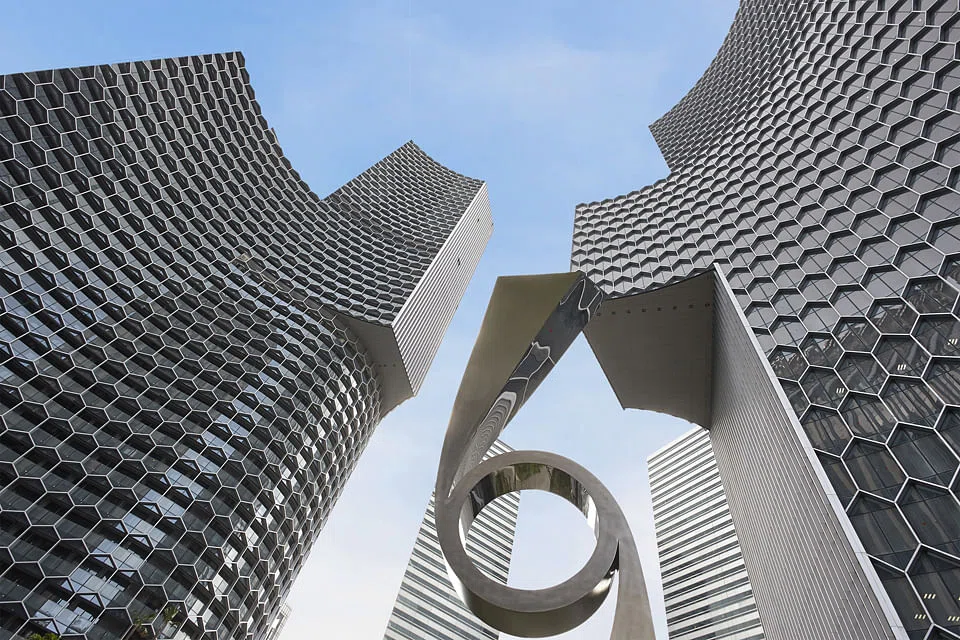
In 2019, Standard Chartered helped finance one of Singapore's largest-ever green loans for the acquisition of DUO Tower and DUO Galleria. Both buildings are renowned for their green credentials, including a rainwater harvesting system and a special glass exterior that keeps the building cool, reducing the need for air conditioning.
The Greater Bay Area in Hong Kong has also secured its first-ever green bond. The money raised will finance or refinance green assets to help create a low-carbon economy, including renewable energy, cleaner transport and wastewater management.
But finance for emerging markets has historically proved challenging. Truly transformative projects often cannot be funded by the public sector alone.
Innovative forms of finance such as blended deals are one way to unlock progress - with non-governmental organisations (NGOs), governments, the private sector and insurers working together to help the world's poorest cities transition to low-carbon economies.
Standard Chartered participated in one such deal in January 2020. Working alongside the Asian Development Bank, we provided long-term financing to develop and operate a 50MW photovoltaic solar power plant in Tay Ninh Province in Vietnam.
The private sector plays a pivotal role in helping emerging economies realise the SDGs. Standard Chartered has committed to providing US$40 billion of project financing services for infrastructure that promotes sustainable development by the end of 2024.
2) Measuring impact
Measure, manage and ultimately reduce - this is Standard Chartered's commitment to lessen our financing for activities that will accelerate climate change. To make good on our word, metrics are proving essential.
We have developed a Green and Sustainable Product Framework in collaboration with Sustainalytics, a leading provider of environmental, social, and corporate governance (ESG) and corporate governance research, so that funds can be directed to projects that will have a positive impact.
Unsurprisingly, data is also instrumental in the capital allocation process. Our Sustainable Finance Impact Report has shown that a dollar invested can have a significantly different outcome depending on where and how it is deployed. The greater the information at our fingertips, and the deeper our understanding of the issues we are working to solve, the better the decisions we can make to meet our sustainability goals.
3) Withdrawing services
Power generated by burning coal is a major cause of pollution, and must be actively avoided as cities grow their energy infrastructure to meet increased demand. At Standard Chartered, we are gradually withdrawing our services from clients who rely on coal for a large part of their income. From January 2025, we will only work with clients who are less than 60 per cent dependent on earnings from thermal coal, with this threshold dropping to 40 per cent in 2027, and then 10 per cent in 2030 (based on percentage of Ebita at group level).
The example of coal is relatively clear-cut. The difficulty comes in measuring the impact of more complex activities such as city infrastructure projects, which may have a negative impact on wetlands, forests or peatlands.
That is why everyone - banks, city planners and NGOs - needs an established methodology to measure carbon dioxide emissions from planned developments to help us all manage the climate impact.
The power of collaboration
No single organisation can plug the sustainable financing gap alone. We must all work together to share best practices and develop a common set of standards.
The Taskforce on Climate-related Financial Disclosures has developed a new way of reporting carbon dioxide emissions alongside financial results. The Taskforce for Scaling Voluntary Carbon Markets, which I chair, is bringing together the entire carbon value chain to create a blueprint to enable private sector companies to reach their net-zero goals and sustainability-related aspirations through a liquid, transparent and reliable carbon market.
Real progress requires multilateralism and partnerships at every step of the journey. We must continue to learn from one other and extend a helping hand to those who need it most, as we work for the greater good.
Creating a sustainable legacy
As cities grow and develop, sustainability must be built into every level of organisational decision-making. At Standard Chartered, our position on climate change not only informs all our decisions on project finance but also gives us a sense of purpose.
A sustainable city is a liveable city - one that has not just environmental benefits, but health and economic ones, too. By directing the flow of money to infrastructure projects that will leave a positive legacy, we want to play our part in creating a more sustainable and resilient world for generations to come.
- The writer is group chief executive of Standard Chartered. This is an edited version of an article published in the January 2021 issue of Urban Solutions magazine (www.go.gov.sg/urbsol18), a publication by the Centre for Liveable Cities (www.clc.gov.sg) under Singapore's Ministry of National Development.