Creating more 'Jewels' in Singapore
All parties in the development industry - including govt agencies, developers and contractors - need to pull their weight.
DEVELOPMENT projects in Singapore are never-ending. At this year's National Day Rally, Prime Minister Lee Hsien Loong spoke about the Greater Southern Waterfront, Tuas Port, Punggol Digital District, and a host of mega development projects in the pipeline, all with significant long-term impact to Singapore. For these massive projects to be successfully implemented, all parties - including government agencies, developers, consultants, architects, engineers and contractors - have to pull their weight in their respective responsibilities along the development value chain, be it government regulations, planning, design, engineering, construction or project management.
I have been involved in the development and construction industry for almost 50 years. I had been a government engineer building military camps, infrastructure and airports, a specialist engineering contractor, and a multi-sector real estate developer. I am now back in the development consultancy business, and am concurrently overseeing the largest development project in Singapore at Changi Airport. Today, I would like to discuss some issues and challenges faced by the various key players in the built environment industry.
GOVERNMENT REGULATORS AND POLICYMAKERS
Firstly, I am glad that regulators and policymakers like URA (the Urban Redevelopment Authority), BCA (the Building and Construction Authority) and MOM (the Ministry of Manpower) are aware of the challenges faced by participants in the built environment ecosystem, and are taking positive steps to support them.
They have been pragmatically reviewing regulations and policies affecting the industry, promoting innovation and productivity initiatives, and addressing environmental issues like climate change. Many of these challenges are complex and impactful, and close consultation industry-wide will be useful. It is not about relaxing current rules and regulations for the benefit of developers, consultants and contractors, but reviewing them to allow creative and pragmatic ideas to optimise land use and facilitate ease of construction. Frequent dialogues with various players in the industry will be very helpful.
PROCUREMENT PRACTICES BY DEVELOPERS AND OWNERS
To ensure industry sustainability, developers should review their current procurement approach for construction and consultancy services. Buyers of services - that is, the project sponsors, developers or owners - have to move away from an overemphasis on pricing to realise real value from such services.
From my past experiences, calling tenders in the open market and awarding the contract to the lowest bidder is not necessarily the best practice. I acknowledge that in public-funded projects, the calling of an open tender may be a strict official requirement. But should a tender be open to all contracting firms? And must it be necessarily be awarded to the lowest priced bidder?
In reality, choosing the lowest bidder is tantamount to the contractor or consultant in the open market choosing us. They could secure the project just by diving down their bid prices, even to the extent of making financial losses. This will eventually create a further negative spiral within the industry. With very limited price margins, contractors are unlikely to be financially able or motivated to upgrade themselves with technology or improve their productivity.
If the construction and engineering business continues to be perceived as backward and hence poorly valued in the capital markets, how then could construction become an attractive or healthy industry that appeals to investors and talents?
The good news is that we have started the practice of adopting more progressive procurement practices in both the private and public sectors. For instance, in CapitaLand under my watch, we did not require the architects, engineers or contractors to compete on fees or price alone. I believe that professionals in the development industry should be required by developers to compete on design, as well as other important and desirable attributes including innovation, functionality, sustainability, construction productivity, and of course cost-effectiveness. It is wasteful in land-scare Singapore for poorly designed and badly constructed urban projects by sub-par consultants and loss-making contractors to stay in situ for 30 to 50 years, until it becomes economical to demolish the structures for redevelopment.
The award of major construction and consultancy contracts in Changi Airport Group is not based on an open tender system. Under an open tender system, any of the 1,255 contractors with a BCA Class 1 General Builders Licence would be able to bid for our airport projects, and win a project by diving their bid price to the lowest, regardless of their profitability. This effectively means contractors can choose us to be their clients and not the other way round. Changi Airport as an international air hub cannot afford to take implementation risks by appointing the lowest-priced consultants and contractors in an open-tender system. Contractors and consultants have to be pre-qualified with the following considerations:
Tenderers are evaluated based on scores for both Quality and Price (or Fee for consultants). The Quality component can range from 40 per cent for contractors to 80 per cent for consultants. Specifically for construction contracts, Safety is also the first key factor to be considered. We call this the Safety/Quality/Price or SQP score. Evaluation is undertaken by a panel of technical/development experts, reviewed by an Executive Committee on Airport Development (ECAD), which consists of externally appointed experts from the development industry, and finally approved by the Group's board of directors. The final award is based on the highest SQP score (or Quality-Fee score in the case of consultants), and not the lowest price bidder.
CHALLENGES FOR PROFESSIONAL CONSULTANTS
Developers and project sponsors aside, professional consultants will also need to play their part in the transformation of the built environment industry. The building industry is a major contributor to environmental pollution. Consultants should be mindful of the need to reduce carbon footprint, energy consumption and other contaminants of the environment in their design. They would also need to weigh in climate change considerations in their planning and design endeavours, including making buildings more sustainable and energy-efficient.
Like what Prime Minister Lee mentioned at the National Day Rally this year, they should strive to understand, mitigate and adapt to climate change. At the same time, consultants must continuously upgrade themselves on the latest and fast-moving digital technology applications in the built environment, including AI, BIM, VR, drones and IoT, etc.
Another concern about the building industry in Singapore is the deficit of qualified building professionals, such as architects, engineers, quantity surveyors and project managers. Singapore is currently short of qualified engineers to manage mega projects like Changi Airport Terminal 5, LTA road and rail infrastructure, and Tuas Mega Port. The future Greater Southern Waterfront development mentioned by PM Lee will further increase the demand for building professionals exponentially.
However, young talents are not keen to be trained in engineering due to competition from other careers deemed to be more attractive and glamorous, such as those in banking and finance. We must address the matching of supply and demand of trained professionals in the construction industry, if we are to continue to build large urban and infrastructure projects in the country.
CHALLENGES FOR CONTRACTORS
Within the built environment industry, construction can be regarded as its main "production arm". An appointed contractor has to deliver a project on time, meet specified quality, adhere to contractual costs and ensure construction safety. Unfortunately, it is not uncommon for projects to fail in one or several of these critical requirements. Projects may be derailed, and some end up with costly and time-consuming legal disputes. The construction industry, as one of the oldest industries in the world, is still tenuously riddled with many such chronic issues.
Facing challenges in the construction industry is historical and universal. Every construction project is essentially unique in its features, and unlike the manufacturing industry, cannot be totally industrialised.
At the same time there is no business certainty on when contractors can secure the next project as the market becomes more and more competitive. Organising construction resources like manpower, machines, equipment, and material becomes a speculative game.
Due to the competitiveness of the bidding process, a contractor has to bid with razor-thin profit margins of between 3 per cent to 5 per cent, which is the present industry norm. At times, he has to even forgo profits to sustain overhead costs. For large and complicated projects, such thin margins can be wiped off quite ruthlessly. Unlike manufacturing, estimates and control of cost and time in the construction industry may not as sophisticated or precise.
Similarly, architects and engineers are also engaged in a "race to the bottom" for their consultancy charges to keep their practices alive.
In a very small market like Singapore's, the "suppliers" in the construction industry - that is, construction and consultancy firms - have to be tightly managed to remain profitable. Maintaining the business is tough going and growth is a gamble. Few local contractors can comfortably handle contracts much larger than S$300 million.
This inherent problem is the main cause why not many local construction firms are able to grow to a larger scale to undertake multi-billion contracts locally, let alone go overseas. Given the financial constraints, it becomes a challenge for contractors to invest in technology, upgrade the skills of the workforce, and attract managerial talents to improve their performance for the long term.
STAKEHOLDERS' VS SHAREHOLDERS' INTERESTS
My proposition is that the various participants in the development industry ecosystem - namely the developers (including government sponsors), development consultants and contractors - need to adopt a paradigm shift in mindset. We should not only be concerned about shareholders' interests, but also stakeholders' interests including those of the community, the employees and the supporting industry participants such as contractors and the development consultants.
Developers should not be overly obsessed with short-term profit maximisation, and willingly accept poor design and construction quality.
In turn, professional consultants should be fully conscious of their responsibility to deliver the most cost-effective design for developers, and to be mindful of the greater needs of the community and environment in the planning process. Contractors should also never attempt to cut corners or cheat to generate higher profit margins.
Government agencies should be open to the industry to consider the latest suggestions and feedback on bold and innovative ideas. Indeed, if all participants in the development industry can take an all-hands approach, we can certainly make the necessary improvements in the industry.
Many businesses in other industries have now realised their responsibilities to stakeholders. I note that recently in the Business Roundtable (an association of CEOs of America's largest companies) the purpose of business has been reframed as stakeholders' value and not solely shareholders' value. They now proclaim that customer values, taking care of employees, fair and ethical supplier relationships, and care for the community and environment are also the purpose and responsibilities of a business.
I hope that we, as participants of the built environment, can also adopt such open-minded and robust thinking for the long-term benefit of all stakeholders in our ecosystem.
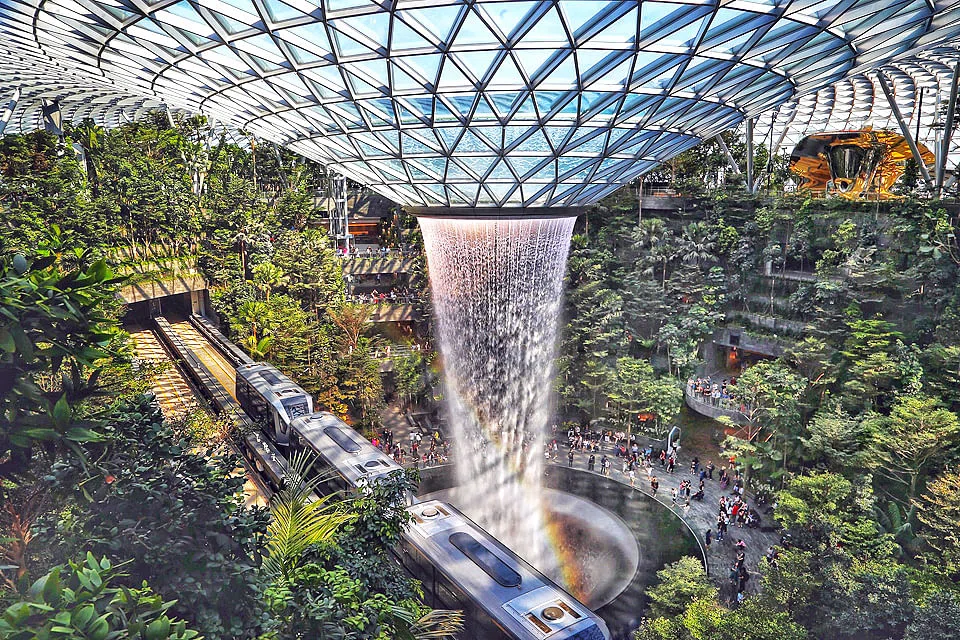
I would like to refer to the recently opened Jewel Changi Airport as an example. It has been much acclaimed as the "jewel" in the aviation and development industry. We have turned and enriched a former open-air car park with 850 parking spaces into a three-hectare mixed-use development comprising 2,500 parking spaces, a gleaming shopping mall, indoor forest, attractive playscapes and leisure amenities for travelling passengers and the Singaporean public alike.
The completed structure with all its features and facilities did not happen by chance. Every aspect had been thoroughly thought through, and the end product was what we had set out to do, having fully taken into consideration all stakeholders' interests. We certainly did not settle for the cheapest consultants and contractors! It is an excellent example of the close collaborative work by all project participants including the government agencies, Chang Airport Group, CapitaLand, the architects, engineers, landscape designers, rain vortex specialists, project managers, contractors, sub-contractors and material suppliers to produce this extraordinary development masterpiece.
The project was not a walk in the park, but we did it on time, within cost, met quality specifications, and without legal disputes or fatal accidents. Now that the project has been completed, can you imagine a situation where the wrong concept or a bland and ordinary multi-storey car park was constructed at the site? What a waste of land would that be?
Turning a former car park charging hourly fees into Jewel Changi Airport, a billion-dollar asset, seems like a transformative, ingenious real-estate play. In fact, many "Jewels" have already been created in land-scarce Singapore in the past. Prominent among them are Raffles City, ION Orchard, Marina Bay Sands, Gardens by the Bay, The Esplanade, the four terminals of Changi Airport, Port of Singapore, Jurong Rock Caverns, and many more splendid commercial buildings.
All these projects could not have happened if not for the bold and creative thinking and close collaboration among the players in the built environment and the government agencies.
As a participant who has gone through the complete value chain in the built environment ecosystem, I am convinced that we have the capability and opportunity to transform more land in Singapore into "Jewels".
We cannot afford for the Greater Southern Waterfront development to become a missed opportunity. If we all play our part, we can help ensure that the landscape of Singapore stays sparkling and liveable!