

Democrats' stance on trade angers Obama
He takes a swipe at MSNBC, whose progressive hosts have been attacking his trade policies, and says his entire presidency has been about helping working families
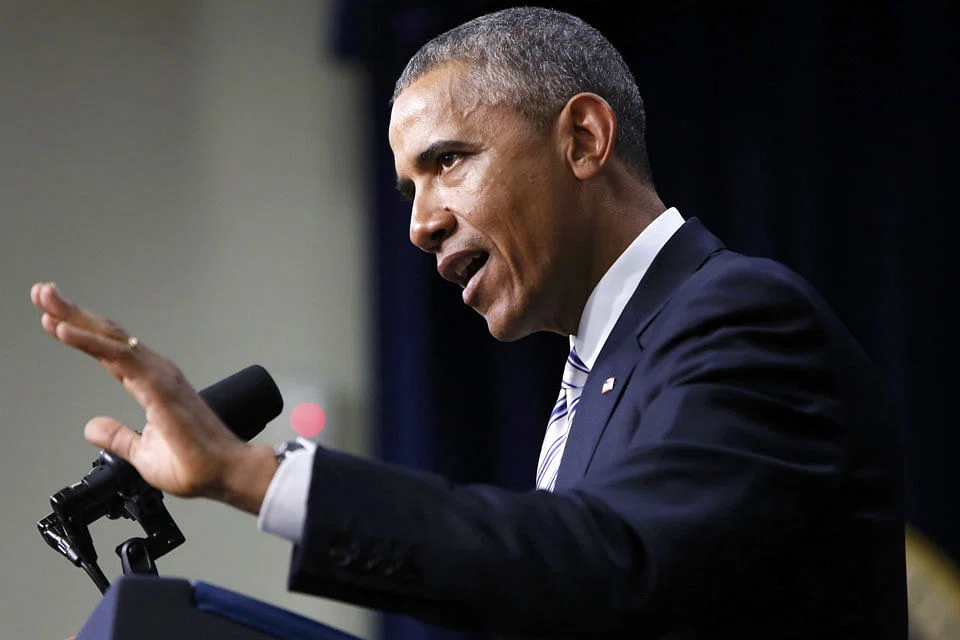
PRESIDENT Barack Obama, who has prided himself for projecting to the world a cool No-Drama Obama veneer, recalls in his biography how his (white) grandmother had warned him that white folks were scared of angry black men and that he should always try to wear his winning smile.
So in his appearance at last Saturday's annual White House Correspondents' Dinner in Washington, Mr Obama employed self-deprecating humour to demonstrate that contrary to prevailing cliche, he does have, well, anger issues simmering beneath his unruffled surface.
In a joint appearance with "Luther, my anger translator" (Keegan-Michael Key from Key & Peele, a Comedy Central cable show), Mr Obama and his sidekick tried to show how Mr Obama would have looked and sounded if he hadn't listened to his grandmother's advice.
"I often joke about tension between me and the press, but honestly, what they say doesn't bother me. I'm a mellow sort of guy. And that's why I invited Luther, my anger translator, to join me," the Real Obama explained.
And then this is what "Luther" had to say: "I MEAN REALLY, WHAT IS THIS DINNER AND WHY AM I REQUIRED TO COME TO IT?!"
Real Obama: "Because despite our differences, we count on the press to shed light."
"Luther": "AND WE CAN COUNT ON FOX NEWS TO TERRIFY ALL WHITE PEOPLE WITH SOME NONSENSE."
That was all very funny and made everyone in the room laugh out loud. But the really funny thing was that earlier in the week the television camera did get a glimpse of the Real President in quite an angry mood. Not as angry as "Luther". But still . . .
That Tuesday, the president travelled to the Fairfax Chamber of Commerce in Northern Virginia for a televised roundtable debate on trade with local business executives and Democratic Party activists, which was moderated by liberal MSNBC talk-show host Chris Mathews.
The topic of the debate was the White House's global trade policies and, in particular, the proposed Trans-Pacific Partnership (TPP) accord which would link the 12 economies of the region with America, creating a free-trade system that would account for 40 per cent of the world's gross domestic product and one-third of global trade.
But before Mr Obama showed up to the televised discussion, his trade policies had already ignited enormous political fury among leading members of his party. The opposition by the pro-labour progressive wing of the party was expected.
And, indeed, a top progressive Democratic figure, Senator Elizabeth Warren of Massachusetts, and Senator Bernie Sanders from Vermont (an Independent who votes with the Democrats) who have been mentioned as potential Democratic presidential candidates next year, attacked Mr Obama's trade agenda for allegedly favouring Big Business over American workers.
But then, even Democrats who were considered to be more centrist and even pro-business in their positions - such as Democratic Senator Chuck Schumer of New York, a traditional ally of Wall Street, and former governor of business-friendly Maryland, Martin O'Malley (who is also considering a run for the presidency in 2016) - criticised the proposed TPP and vowed to campaign against it.
Even more surprising was the response from Senate Minority Leader Harry Reid, a Democrat from Nevada, when he was asked by reporters whether he would vote for granting Mr Obama the trade promotion authority (TPA), aka "fast track", that he needed in order to get the TPP and other trade pacts passed through Congress. "The answer is not only no but hell no," he said.
Indeed, Senators Warren and Reid, and the majority of congressional Democrats are expected to vote against a "fast track" bill introduced in the Senate and a similar one being drafted in the House of Representatives. Less than 50 Democratic lawmakers in the House would probably vote for the TPA.
So perhaps it was not surprising that Mr Obama was visibly angry when he was asked to respond to the criticism by Ms Warren and other Democrats. Ms Warren and other Democratic opponents of the TPP are "wrong on this", he said, adding that "some of the information that has been getting thrown out there plays into legitimate fears that Democratic voters have, and progressives have, it's simply not true". It's simply not the fact, the president added. "Luther" would probably have called Ms Warren, Mr Reid and other Democratic critics "just plain liars".
Perhaps they were not lying, but many of the concerns that have been raised by the Democrats about the TPP are misleading, and their proposals to "fix" the accord by, among other things, conditioning its passage on pledges by the White House to deal with the issue of so-called "currency manipulation" practices - as proposed by Senator Schumer - are unrealistic.
The Obama administration and the Republicans who support the TPP have never argued that the passage of the treaty would usher a new age of American and global economic prosperity. In fact, under the best-case scenario, the accord would probably raise American incomes by less than one per cent. And while there is no doubt that they would help raise the purchasing power of American consumers, foreign imports may have also had some downward effect on American employment and wages.
But Democrats and other critics are demagoguing when they contend that trade agreements, such as the 1993 North American Free Trade Agreement (Nafta), have been responsible for the loss of American manufacturing jobs.
These losses were a result of the effects of the combined forces of globalisation and automation. And if anything, Nafta and other trade agreements helped smooth the process through various schemes, such as the trade adjustment assistance programmes that aid workers who may have lost their jobs as a consequence of foreign imports - and which would expand under the TPP.
Moreover, reflecting the pressure from the political left, the TPP would include provisions that would secure the rights of workers in foreign countries. And the proposed TPA would provide Congress more authority to monitor the implementation of the TPP and would allow it to revoke "fast track" if the administration violates its commitments under the accord.
But what really angers Mr Obama and his aides is the continuing effort by Democrats (and a few Republicans) to press for the introduction of enforceable currency provisions in the TPP and other trade accords that would ensure that other countries would not manipulate the value of their currencies in order to boost their exports.
The irony is that the country that has been the main target for criticism by US lawmakers for its currency policies, China, is not going to be a member of the TPP. In fact, the Obama administration has marketed the accord as part of a strategy to reinforce US alliances with South-east Asian countries and Japan in response to China's rise as an economic and military power.
And, in any case, none of the governments that are negotiating the TPP, including the United States, would agree to outside intervention in determining monetary policies that are usually set by their central banks.
Which is why the TPP debate between the Angry Obama and his critics may be getting a bit nasty. Talking with a group of supporters, Mr Obama took a swipe at MSNBC, the cable news network whose progressive hosts have been attacking his trade policies.
"And if you were watching MSNBC and all of this stuff thinking, 'oh, man, I love Obama, but what's going on here?'," Mr Obama said.
"When people say that this trade deal is bad for working people, they don't know what they are talking about," he stressed, adding: "I take it personally. My entire presidency has been about helping working families. The Chamber of Commerce didn't elect me twice; working people did."
Ed Schultz, an MSNBC host, responded to Mr Obama's attack on the news network. "I supported you big time. I was the first liberal talker to support you. I've carried your water big time when it comes to healthcare, I've carried your water on the economy and defending your move on the automobile industry, but Mr President, you can take shots at this network, but I guarantee you, you are wrong on this and you cannot prove to the American people," he said, accusing him of "now turning your back on these people trying to convince them that they have to do this phony trade deal that's going to ship jobs overseas".
"I'd love to talk to you face to face, Mr President," Mr Schultz declared. No response yet from Mr Obama or from his "anger translator".
TRENDING NOW
World’s largest offshore wind platform by Seatrium consortium on track to be completed by 2028
Is stamp collecting enjoying an analogue revival or are its best days over?

GovTech retrenches another 38 staff in second round of layoffs
MBS adjusted property Ebitda falls 20.6% in Q3 with fewer high-roller visits, weaker hold

