EU an avid supporter of rules-based global system
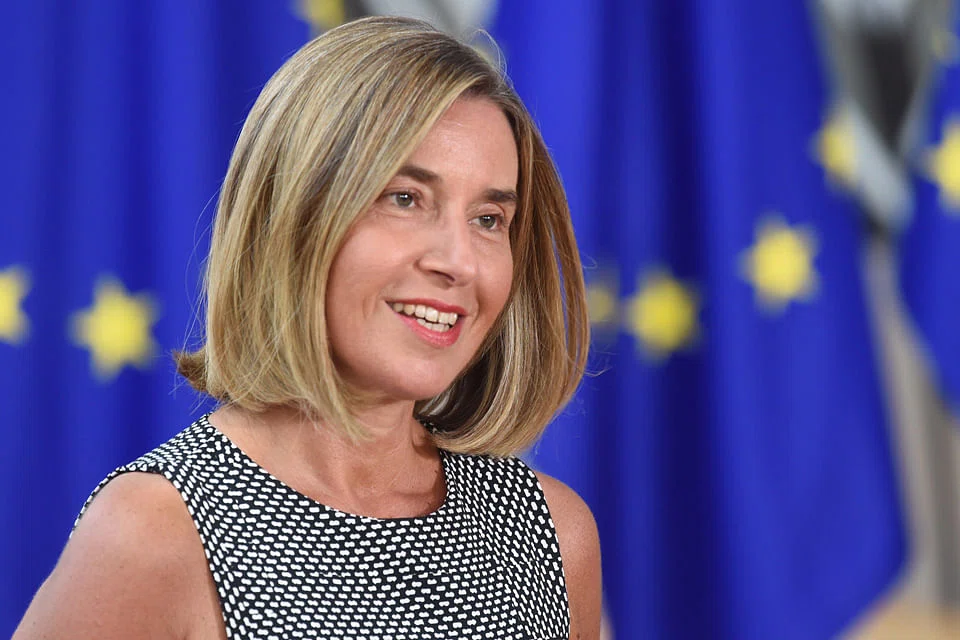
THE European Union's High Representative for Foreign Affairs and Security Policy, Federica Mogherini, will be in Singapore for the Asean Regional Forum Ministerial Meeting this week. In an exclusive written interview ahead of her trip, she tells ANNA TEO that the EU's commitment to Asia will not waiver.
What is the EU's main message at the Asean Regional Forum Ministerial Meeting?
My main message will be that Asia can continue to count on the European Union as a reliable and constructive partner. Our commitment will not waiver.
Because geographical distance certainly does not reflect the proximity of our shared interests and values. The European Union is looking to increase our role as a security provider; we will remain the first and most fervent supporter of a rules-based international system, with effective multilateralism at its core; and continue to push for open and fair trade across the world.
The Regional Forum will be a key opportunity for me to discuss with our Asian partners the work we are doing on various regional and international issues. Two issues, both nuclear-related but different in many respects, will I am sure feature heavily on the agenda. Firstly, the ongoing efforts to denuclearise the Korean Peninsula and bring long-lasting peace to its people, which as the European Union, we fully support.
And secondly, the work we are doing, together with many others - China and Russia, but also Japan, New Zealand and India, for example - to continue to fully and effectively implement the Joint Comprehensive Plan of Action with Iran, which constitutes a key element of the global nuclear non-proliferation architecture. Other topics will, of course, be discussed - in particular, I am looking forward to discussions on further increasing sustainable connectivity between Europe and Asia.
In developing a strategic partnership between EU and Asean, what is the biggest priority and focus? What is needed to bring the partnership to the next level?
The EU and ASEAN celebrated 40 years of cooperation last year. Our partnership has come a long way in that time, reflecting that we are two major global actors whose strength comes directly from regional cooperation, a common stand for multilateralism, against rising - and worrying - temptations of isolationism and protectionism. These values and interests must be the foundation for our upcoming Strategic Partnership.
In Asia, the EU has recently held a major summit with China, and signed a landmark trade deal with Japan, amid a global backdrop of tariff threats and protectionist policies. Is there similar cooperation, between EU and Asean, on the security front?
It is true that there have been a number of very positive developments in our relations with many Asian partners recently. You mentioned the summit with China, where we agreed, for example, to step up our work to implement the 2015 Paris climate agreement; Japan, with whom we signed the biggest trade deal in the EU's history, cutting tariffs and other barriers to trade.
We want to add to those successes with Free Trade Agreements that we are pursuing with many Asean members and the exploration of a possible region-to-region agreement in due course.
Another important step forward was the recent decision of EU Foreign Ministers to enhance the EU's security engagement in and with Asia.
Our partners in Asia increasingly look to the EU to be present and engaged in the region, thanks to our experience with cooperative security, regional approaches to crisis management, and tackling modern hybrid threats, but also because the EU has taken important strides recently to establish a true European Union of defence.
The face and indeed the capacity of the European Union as a global actor is evolving; we are not only a reliable trade partner, not only a pillar of multilateralism: the EU is a security actor in its own right.
Security cooperation is actually one of the primary success stories of EU-Asean relations in recent years. The EU has become one of the main contributors to the work of the Asean Regional Forum, organising initiatives on maritime security, cybersecurity, counter-terrorism, trafficking in persons, radicalisation, preventive diplomacy and mediation, to mention just the main sectors.
There is always room to do more with Asean, and to do it more effectively. In addition to the Asean Regional Forum, we want to have the possibility of making a contribution to other fora, such as the East Asia Summit and the Asean Defence Ministers' Meeting - Plus.
What is the significance of the Trump-Kim Singapore summit towards the ultimate goal of denuclearisation of the Korean peninsula?
We have ourselves, as Europeans, learnt over time that truly peaceful, long-lasting solutions can only be achieved through diplomacy and negotiation.
What we have seen on the Korean Peninsula since the turn of the year is that pursuing this diplomatic track is often challenging, but it is always rewarding. The Singapore Summit was for sure an important step on the path to what we all want to see on the Korean Peninsula: denuclearisation, peace and security.
The European Union itself has long-pursued a policy of critical engagement with the DPRK, combining pressure - applying not only UN Security Council sanctions but also stringent additional autonomous EU sanctions - with open channels of communication intended to persuade the DPRK that it will have a brighter future through full adherence to international law, denuclearisation and engagement with the international community.
We will continue to follow this path - in full coordination with President Moon Jae-in as well as our other international partners - and do our utmost to support international efforts for peace and reconciliation.
I hosted (US) Secretary (of State Mike) Pompeo in Brussels only a few weeks ago, where we had the opportunity to discuss together the state of play. He, and also Foreign Minister Kang (Kyung-wha) and other partners in Asia, know that the European Union has a longstanding experience in peace-building, reconciliation and specifically in successful negotiations for denuclearisation.
Look at the Balkans, in Aceh/Indonesia, ongoing efforts in Afghanistan, Myanmar and the Philippines, and of course, the Iran nuclear deal, to name just a few.
We are ready to put this expertise and the tools that we have towards supporting our shared objective of peace and security on a denuclearised Korean Peninsula. This would be a major success not only for Koreans, but for the region and the world.
On Nato: While Donald Trump has demanded that the alliance's European members increase their defence budget, some say that what Nato needs is not so much more money but "new thinking" - that its mission needs to be reconfigured for the 21st century, to reflect the new geostrategic threats and power transitions today. What do you say?
While many EU Member States are Nato members, the EU as such is not. So I will not enter into a debate that we have no formal role in. But I will say one thing: we have a great deal more to gain from strengthening our international rules-based organisations that currently operate, than from destroying them.
This is what we as the European Union are doing, with Nato, with the United Nations, the World Trade Organisation, and others.
It's been over two years since UK's Brexit referendum, and there still has been limited progress between London and Brussels over the Brexit terms. What is the EU's stance in the Brexit negotiations?
The European Union has a united position when it comes to all of the issues on the table in the negotiations. I am in touch with (Chief EU negotiator) Michel Barnier on a very regular basis in particular on the future relationship that the EU will have with the UK. Because for our work on foreign policy, on security and defence, the European Union and the United Kingdom will continue to need each other. In today's world, you need partners and friends.
We have shared responsibilities; we are also so interconnected that even if we didn't share the same objectives around the world - which I believe we do and will still do - it would be impossible to avoid working together; and finally, the challenges of today require joined-up, common solutions. Isolation does not work, and neither does unilateralism. So, we are preparing for the UK to leave the EU - and yes, I wish that this wasn't the case - but for the work that we do together and the positive impact we have to be maintained as much as possible.
Where does Brexit rank in the list of major challenges facing the EU?
You know, three years ago, there were some who predicted that the flow of migrants and refugees coming to Europe would be the demise of our European Union. Two years ago, it was the referendum in the UK that would apparently cause the EU to disintegrate. Today, it is the rise of populist sentiments, or something else. Well, let me say: our European Union is more resilient than that. It is worth fighting for, worth defending, worth improving.
Rather than any kind of disintegration of our Union, on the contrary, we have over the past years seen a relaunching of common projects, a recommitment to European unity, and clear steps to determine the future of the European project, such as the huge strides we have taken in security and defence and creating new opportunities for EU companies through more and better free trade agreements than ever before. Let me also say that, even though the European Union will lose one of our Members, there are many countries doing everything they can to join our community. Just look at the Western Balkans.
The European Union's ability to inspire positive change, to accompany democratic reform and to support the aspirations of people in our European neighbourhood for me clearly demonstrates that, as a foreign and security actor, the EU can be an even stronger actor in the future than we are now.
European Council President Donald Tusk last year said that the challenges confronting the EU were perhaps "more dangerous than ever", citing among other things the geopolitical climate and an "aggressive" Russia. Others have talked about the "existential threats" facing the Union. How do you see the EU's longer-term political and economic character in the face of multiple challenges?
The world without the European Union would certainly be a less stable, less secure place than it is now; the work that the European Union does for global peace, security, sustainable human and economic development, and prosperity, is undeniably positive. So, you ask about how I see our future character. My answer would be that we need to show as much resilience to threats to our Union as we have done in the past, that we need to keep believing in the work that we do, and that we must continue to act in a principled, united way. Not only for our own futures, but for those around us too.
And not least, how do you see your role, as EU High Representative for Foreign Affairs and Security Policy, in the context of today's global uncertainties?
I see more than ever a need for a strong European Union in the world. Everywhere I go, with whomever I meet - in Brussels and elsewhere - I not only receive support and thanks for the work that we are collectively doing, but also a request for us to do more. We live in a world where the challenges we are faced with do not know, do not respect borders.
Climate change, terrorism, cybercrime, migration... We cannot expect to effectively tackle and find solutions to these challenges, and others, if we also do not think beyond borders. Europe has a painful history showing that acting alone, in confrontation, leads only to destruction. The European Union, which was born out of this lesson, is a natural partner for those who also view cooperation as key, multilateralism as essential, and win-win solutions where others see a zero-sum game.
What do you like most, and least, about your work?
There are many things to love about my job. I am very lucky, very honoured to do the work that I do. Seeing in person the positive impact of the European Union around the world is probably the most rewarding thing. I also love to meet and discuss with young people: they're never afraid to tell you how it really is, and they give great ideas. There are times when the job is tough but the important thing is to maintain the drive and the vision.