Insurance par policy primer: What smoothing and cross subsidy mean for you
Mechanisms provide stable returns but non-investment factors may affect bonuses

MOST policyholders of traditional participating life plans can breathe a sigh of relief that they will not suffer any bonus cut this year.
But a relatively small proportion of policies from three firms - AIA, AXA and Tokio Marine Life Insurance - will suffer some reductions in bonus and dividend payouts.
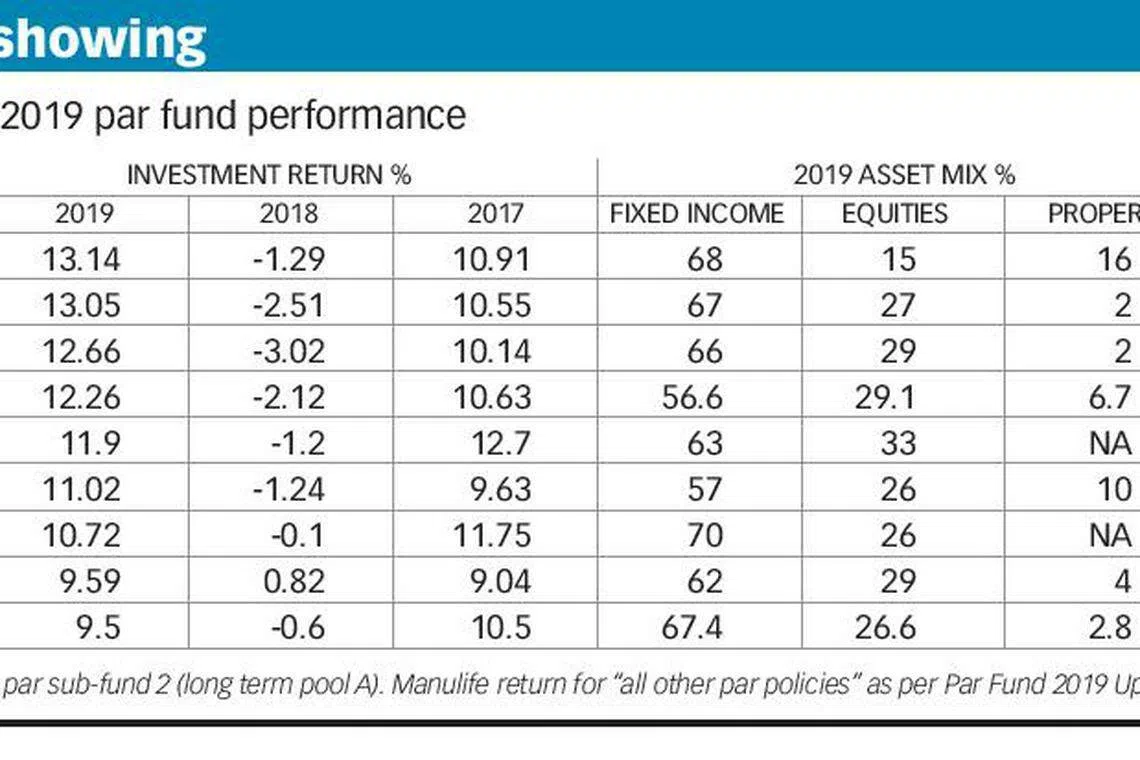
Why the bonus cuts, you might ask, since investment returns of life funds in 2019 were strong? Based on our compilation of the returns of eight insurers - HSBC Insurance's returns were not available as at press time - most life funds delivered double-digit returns.
In 2018, however, returns of most life funds were negative.
Now is as good a time as any to revisit the principles that underpin traditional life plans, which remain an immensely popular mode of saving and investment. In the first quarter, the Life Insurance Association data showed a 10 per cent year-on-year increase in new weighted business premiums. Annual premium business grew by a steady 3 per cent.
Here are some things to note about par policies and how insurers invest their life funds. Par policies share in the investment experience of the life fund, and returns comprise guaranteed and non-guaranteed components.
Smoothing of returns
Perusal of your par fund statement will show that the par fund, as with any investment fund, is exposed to market volatility. Policyholders, however, are shielded from this by the mechanism of smoothing. This means that in a poor year, an insurer may choose to continue to pay its promised bonus rate. In a good year, the firm may withhold some of the return in reserve to distribute when the investment experience is poor.
This mechanism is evident today, as a minority of policyholders will experience some bonus reduction, even though par fund returns in 2019 were mostly in double digits. Bonuses are non-guaranteed, but once paid, they form part of a policy's guaranteed benefits.
In traditional par policies, you will also have to accept a degree of cross subsidy among different generations of policies. Quite a few insurers, such as Prudential, create sub-funds to distinguish between types of policies ranging from short term endowments to long term whole life plans. Insurers disclose the performance of various sub-funds, and you should receive the annual statement of the relevant sub-fund that your policy sits in.
As the Life Insurance Association (LIA) explains, smoothing and risk pooling are essential for the par fund to provide a stable return. This is in contrast to investment-linked policies (ILPs) where policyholders hold units of a fund and the net asset value will rise and fall along with the market.
LIA says the practice in Singapore is to create cohorts or different generations of policyholders. An insurer's appointed actuary will group more homogenous products into a cohort. Insurers may also set up separate sub-funds with a specific investment policy within the par fund, "to ensure better equity within the par fund".
Says LIA: "Some degree of cross subsidisation is inherent in par (sub) fund since investments (and other risks) are pooled together. Based on the professional standards, all assets will need to be attributed to the cohorts as part of the bonus declaration process. This means that life insurers in Singapore have to pay out the entire asset share eventually and cannot build an estate within the par fund."
The short of this is that insurers will need to have and maintain a good internal par governance policy. "Overall in Singapore, multiple safeguards are in place to protect the interests of par policyholders. LIA recognises this needs to be and indeed is being regularly reviewed and updated to ensure that consumer interests continue to be safeguarded," says LIA.
In its par fund statement, AIA said its aim is for the "long term cost of smoothing to be broadly neutral across generations of policyholders".
In addition to the practice of smoothing, other non-investment factors may affect bonuses such as claims and lapse rates.
Illustrated rates of return
The benefits that accrue to all par policies will be illustrated based on two theoretical assumed rates of return - 3.25 and 4.75 per cent. These are found in benefit illustrations which the adviser furnishes. The actual net return achieved may be significantly lower after expenses are deducted and if the long term investment experience is poor.
The bulk of life funds is invested in fixed income assets. While these are stable, particularly as insurers tend to buy and hold bonds, the reinvestment risk is significant in today's lower-for-longer interest rate environment. To be sure, insurers have grappled with a low-rate environment for well over a decade. But the reinvestment risk - which arises when bonds mature and the monies have to be reinvested in lower-yielding assets - grows more acute for a number of reasons. One is that there is a dearth of longer dated bond instruments that will enable insurers to better match their assets to long term liabilities. Two, the appetite for good quality and higher yielding bonds has risen significantly, thanks to risk aversion and an ageing population hungry for lower risk income assets.
Insurers have the flexibility to invest in higher-yielding credits, and manage the risk through diversification and a long investment horizon. LIA reviews the illustration rates annually to ascertain if they remain relevant in the long term.
Par fund expense ratio
LIA said there is an "agreed approach'' to the calculation of the par fund total expense ratio (TER). "The vast differences (in TERs) could reflect the economies of scale and efficiency of each company. There is also a possibility that it is due to confusion resulting from changes in disclosure requirements in 2018.''
Previously only the investment expense ratio was required for disclosure, which referred to expenses arising from investment activities. In 2018, the TER included all expenses such as operational and distribution expenses.
The variation in TERs range from as high as 2.92 per cent for Prudential to as low as 0.15 per cent for Tokio Marine. The TER is a factor in the net rate of return that your policy actually earns.
Annual vs terminal bonus
A traditional policy is quoted with an annual (or reversionary) non-guaranteed indicative bonus rate. There may also be a terminal bonus (TB), an additional amount that may be paid upon death, surrender or maturity. For its regular premium life sub-fund, Prudential said it would raise the TB rate for the financial year 2019.
Insurer financial strength and product repricing
A financial strength rating may be a factor in your choice of insurer, although some insurers' credit ratings are not based on their Singapore operations. Virtually all insurers satisfy the regulatory solvency requirements.
It is prudent for an insurer to regularly reprice its products in the market, in line with achievable returns in the long run. An aggressively quoted benefit illustration may win business in the short term, but it ultimately risks investor disappointment if projected returns cannot be met.
READ MORE: Some insurers cut bonuses on par policies despite strong 2019 return