Insurers keeping annual bonus rates unchanged
Life funds post poor 2018 returns but smoothing mechanism keeps bonus rates intact


POLICYHOLDERS of traditional life insurance plans can heave a sigh of relief.
Despite a relatively poor showing among life funds in 2018, insurers are maintaining their annual bonus rates, reflecting the benefits of the "smoothing" mechanism that applies to participating policies.
Two insurers - Prudential and Aviva - are adjusting terminal bonuses (TBs) on some products. The terminal bonus is a one-time bonus paid when policies mature. Aviva is raising TB rates on some products but cutting on others. Prudential is cutting TB rates for some products.
Performance of seven life insurers' life funds was sharply lower in 2018, as almost all asset classes were dragged down by an uncertain macro economic backdrop and monetary tightening among central banks, in addition to trade tensions between the US and China. Results of an eighth insurer Manulife were unavailable as at press time.
The poor showing was a sharp contrast to 2017 when life funds registered double digit gains, bouyed by a Goldilocks macro environment, which has since dissipated.
Six insurers reported a negative return in 2018 of between minus 0.1 per cent and minus 3.79 per cent. Just one insurer, Income, was in the black, with a return of 0.82 per cent.
Participating or par policies are those where premiums are pooled together and invested collectively by the insurer. Policyholders share in the experiences of the fund. There are typically two components of return - guaranteed and non-guaranteed. The non-guaranteed portion typically comprises an annual bonus (also called reversionary) and a terminal bonus. Once declared, bonuses become part of a policy's guaranteed return.
Smoothing means that in a poor year insurers will likely continue to pay bonuses from a life fund's accumulated surpluses. In a strong year, however, not all surplus for that year will be distributed as bonus. Policyholders are thus shielded from market volatility and benefit from a regular return that also helps to encourage them to maintain their policies for the long term.
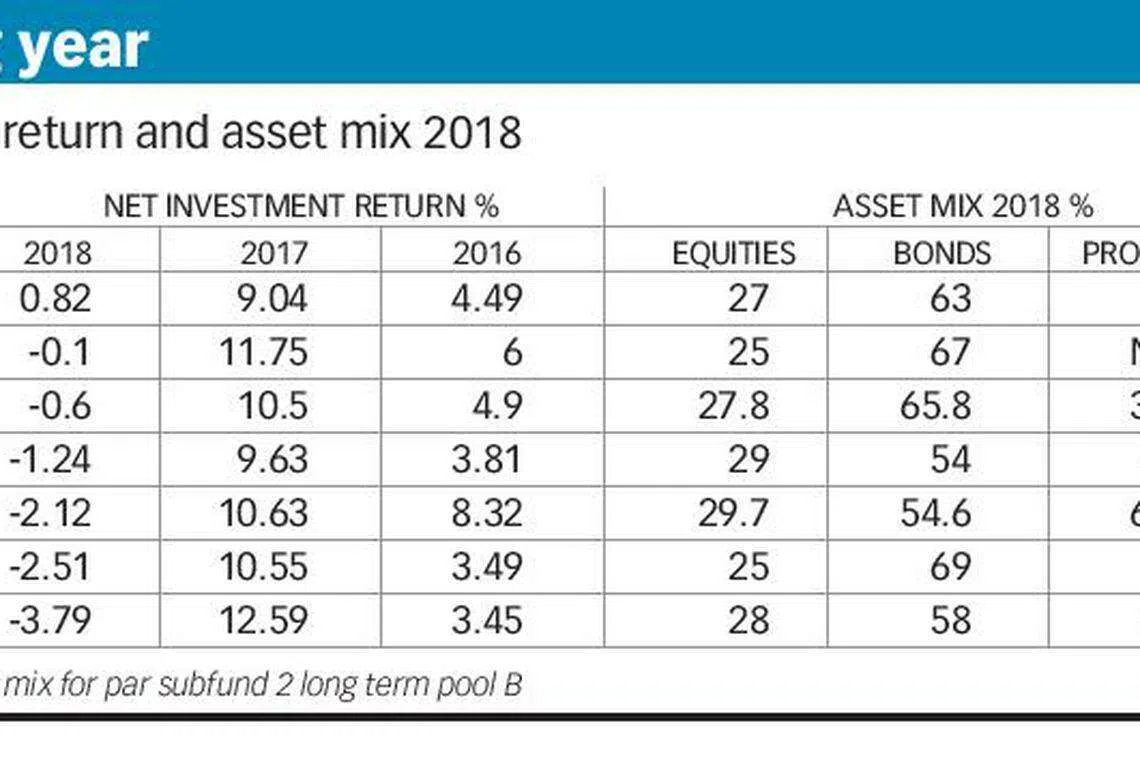
This column focuses on Singapore dollar policies. Insurers may maintain a number of sub-funds to reflect various types of policies, ranging from short term endowments to long term whole life policies. Short term policies are likely invested very conservatively, mainly in fixed income instruments, and the asset allocation will differ from that for long term whole life policies.
There are two things to keep in mind about par policies.
First, while the smoothing mechanism shields policyholders from volatility, the life fund itself is subject to market swings. Apart from volatility's impact on marked-to-market valuations, there is also reinvestment risk, particularly for fixed income assets. This risk is particularly salient for life funds as the bulk of assets - between 54 and nearly 70 per cent based on 2018 par funds' allocations - are invested in fixed income instruments. Today, bond yields are heading south yet again, which suggests that assets are being reinvested in ever-lower yields.
While a bonus cut is a possibility, particularly in a prolonged downturn, it has been done very sparingly. This is because insurers seek to encourage commitment to long term par products. Frequent bonus cuts by an insurer have negative connotations, such as poor investment skills or risk management on the part of the insurer, or that the products were too aggressively illustrated when they were sold. It could also reflect poor underwriting of a poor claims experience - none of which inspire confidence.
Second, policyholders should revisit and re-examine their objectives in holding par products, particularly, when their circumstances change. A whole-of-life policy, particularly with critical illness benefit, should not be surrendered prematurely. Typically it may take as long as two decades to break even on premiums. But the larger issue is that if your health has deteriorated you may be subject to premium loading or worse, rejected for new health-related cover.
The following are some highlights of insurers' par fund updates for 2018:
Aviva
Aviva stated in its par fund update that while it has kept annual bonus rates unchanged, it is adjusting the TB for some products. It is raising TB rates for nine products, resulting in an increase of 0.2 and 0.3 per cent in the projected yield, due to "better than expected claims experience''. For three products, however, the TB is being adjusted downwards and the projected yield will decrease by 0.6 and 0.8 per cent due to 2018's weaker investment performance.
Income
Income said that for the current bonus cycle - April 1, 2019 to March 31, 2020 - it is declaring higher than projected special bonuses on selected regular premium par policies incepted post-2008 financial crisis that mature during this cycle, as they experienced better-than-projected returns.
It is maintaining the special bonus rates of all other policies that mature in the bonus cycle ending March 31, 2020. It also continues to raise the payout of selected annuities for the year ending 2018, "but at a more conservative rate to reflect longer life expectancies and the current volatile investment climate''.
Prudential
Prudential said some customers will have reduced TB rates this year. It has maintained projected reversionary bonus rates for more than a decade, "... despite 2018 being a challenging year across global financial markets'', Prudential's appointed actuary Harry Lee said. "We will maintain a disciplined investment approach that focuses on delivering stable returns for our policyholders over the long term.''
AIA
AIA expects to pay out S$527 million in par fund bonuses and dividends for 2019. It is maintaining the bonus and dividend rates for all policies at the same scale as the previous year. Its statement on 2019 outlook noted that corporate credit spreads tightened significantly in the first quarter of 2019, making it increasingly challenging to find yields in the low-rate environment.
A significant rebound in equities brought valuations "well above historical mean levels'', even though corporate fundamentals are yet to show signs of a turnaround. "In the absence of a sustained improvement in earnings revisions, equities are likely to be trapped in a tug of war between slowing growth and policy stimulus.''
Great Eastern
For 2019, GE said there are concerns that the sharp rebound in risk assets has already reflected a recovery in global growth later in the year. "Weak economic data and earnings challenge the thesis that growth is picking up, or new trade disputes could derail the recovery. Nevertheless, it would be premature to turn overly bearish as economic and corporate earnings growth are still expected to remain positive and the broader risks to global economy looks contained.'' It has declared bonuses of S$403 million.
AXA
Sean Goh, AXA Insurance managing director, said the firm's par fund "continued to perform steadily, enabling us to maintain bonus rates''. The firm said the par fund has outperformed the industry average since 2016, thanks to a strategy focusing on diversification and risk control. It said the fund also "structurally increased'' investments into alternative assets such as private equity and real estate, and also "maintained a fair balance between public securities and private assets''.
Tokio Marine
TM said its long term investment view remains generally positive, "barring a downturn in major macro indicators for the worst.
"We continue to invest for the long term in order to maintain our current attractive bonus rates in the future.''