

Once-hot Singapore banks are turning cold
Russia-Ukraine war, macroeconomic headwinds and excessive valuations are weighing down these seemingly ideal post-pandemic recovery plays

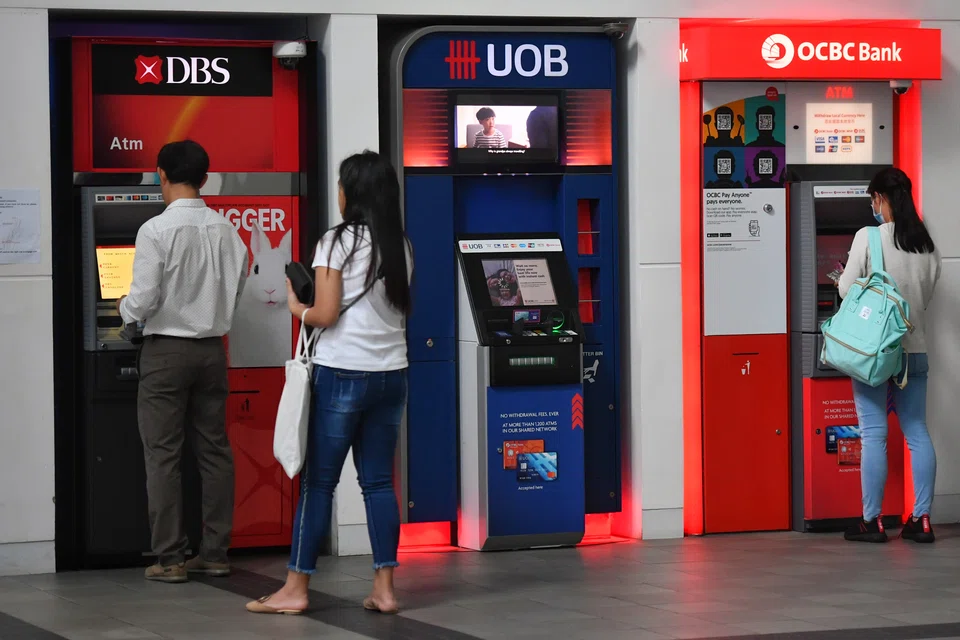
THIS week – on Friday, June 10 – readers of The Business Times will have the opportunity to join me as I chat with OCBC chief executive Helen Wong about the outlook for the financial institution.
This is a particularly interesting moment to have this conversation.
Last year, it seemed that OCBC and its local peers DBS and UOB were ideally positioned to ride the post-pandemic recovery. Profitability was swinging up on falling provisions and strong fee income. Rising interest rates were also expected to boost their net interest margins.
As 2022 dawned, the local banks appeared to be the key driving force behind the Straits Times Index.
On Feb 17, the STI hit a closing high for the month of 3,441.57. That was the same day OCBC and UOB closed at their 2022 highs – of S$13.41 and S$32.86, respectively. DBS hit its closing high for 2022 of S$37.25 a few days earlier, on Feb 11.
While the 3 banks – which account for about 45 per cent of the STI – have since rolled back, the local benchmark index has gone on to breach its February closing high. The STI closed at 3,442.81 on Mar 30, and at 3,445.01 on Apr 5.
At this point, the performance of the 3 banks in 2022 could be characterised as mixed. DBS has fallen 5.08 per cent since the beginning of the year, trailing the STI’s gain of 3.47 per cent. Only 6 STI component stocks have performed worse than DBS, all of them real estate investment trusts.
UOB and OCBC have managed to beat the STI – with year-to-date gains of 4.04 per cent and 7.51 per cent, respectively.
But their performance was nothing compared to the STI’s leading component stocks – such as Jardine Cycle & Carriage (up 45.15 per cent), Yangzijiang Shipbuilding (up 40.07 per cent), Sembcorp Industries (up 39.5 per cent), Keppel Corp (up 33.59 per cent) and City Developments (up 23.83 per cent).
What’s weighing down the banks? Could this be a buying opportunity for investors?
Macro headwinds
The most significant dampener for the market this year has arguably been Russia’s assault on Ukraine, which began on Feb 24.
That event has not only heightened geopolitical tensions, but also created concerns about the global supply of commodities just as the post-pandemic recovery was stoking inflation.
For the 12 months to April, the US consumer price index increased 8.3 per cent. Even excluding food and energy, the index was up 6.2 per cent during the 12 months.
Not surprisingly, the US has quickened the pace of its monetary policy tightening.
The US Federal Open Market Committee last month raised the target rate for the federal funds rates by 50 basis points to 0.75-1 per cent, and indicated that further hikes of 50 basis points “should be on the table at the next couple of meetings”.
The Fed is now also reversing its quantitative easing policy. From Jun 1, the Fed began allowing principal payments of its securities holdings to roll off its balance sheet subject to monthly caps.
For Treasury securities, the cap will be US$30 billion per month for 3 months before being increased to US$60 billion per month. For agency mortgage-backed securities, the cap will be US$17.5 billion for 3 months and US$35 billion per month thereafter.
While banks may benefit from wider net interest margins as interest rates rise, their overall profitability is susceptible to weaker economic growth.
JP Morgan chief executive Jamie Dimon – the banker with perhaps the loudest voice in the world – was widely quoted this past week saying his bank is bracing itself for an economic “hurricane” on the horizon.
Apart from these macroeconomic headwinds, a possible longer-term concern for the banks is competition from fintechs.
In particular, after encouraging banks to merge in the wake of the Asian financial crisis in the late 1990s, new licences for so-called “digital banks” have recently been handed out. This past week, Green Link Digital Bank (GLDB) became the first Singapore-licensed digital bank to begin operations.
GLDB holds 1 of 2 digital wholesale bank licences in Singapore. The other is held by a unit of Ant Group. Singapore has also awarded 2 digital full bank licences – one to a consortium comprising Grab and Singtel, and the other to a unit of Sea.
Valuations and returns
The recent lacklustre performance of the Singapore banks is a reminder that valuations matter.
While big technology stocks were widely viewed to be beneficiaries of the pandemic, economically-sensitive bank stocks seemed obvious beneficiaries of the recovery. And, with ample liquidity in the market, they all attracted strong investor interest.
With tightening global monetary policy now, many richly priced technology stocks have come back down to earth. The S&P 500 and Nasdaq 100 have fallen 13.8 per cent and 23.1 per cent, respectively, this year, underperforming the cyclically oriented STI.
Among the 3 Singapore banks, investors may have chased up DBS too aggressively. Even after slipping more than 5 per cent this year, DBS is trading at 1.47 times its net asset value (NAV) of S$21.02 per share as at Mar 31.
By contrast, UOB is trading at 1.19 times its NAV of S$24.23 per share and OCBC is trading at just 1.03 times its NAV of S$11.55 per share.
No doubt, DBS has a track record of generating superior return on equity (ROE) versus its peers. But its 5-year average ROE of 11.32 per cent is not all that much higher than UOB’s 10.14 per cent or OCBC’s 10.18 per cent.
For the record, DBS ended Q1 2022 with a common equity tier-1 (CET1) capital adequacy ratio of 14 per cent. UOB and OCBC had CET1 ratios of 13.1 per cent and 15.2 per cent, respectively.
Rising interest rates and heightened geopolitical tension could continue to erode excessive hope placed on shares of some of the most profitable and fastest growing companies. Meanwhile, market attention could shift to stocks with better risk-return characteristics.
Whether that means OCBC will outshine its peers in the months ahead will depend on how well it navigates the macroeconomic risks ahead and seizes new growth opportunities.
If you want to hear what OCBC’s Helen Wong has to say about all this, you can sign up for our subscriber-only event – see the details below – and send us questions you would like to have answered.
Mark to Market ‘Live’ is a new subscriber-only webinar series. Registration has been extended to 12pm on Jun 8. Sign up for a subscription at http://bt.sg/M2Msubscribe then drop us an email at btleaders@sph.com.sg to indicate your interest to attend.
TRENDING NOW
8 public officers referred to police over property buys near unannounced MRT stations: Chan Chun Sing
Retrenched PMETs who return on lower pay see median 25% wage cut

Grab CEO’s wife Chloe Tong on life with Anthony Tan and finding her purpose

Vietnam’s northern provinces, not Hanoi or Ho Chi Minh City, are powering near 10% GDP growth

