

Russia asserts in Asia as geopolitical gambit
With continuing uncertainty over his relationship with the West, Putin is now placing greater emphasis on Asia-Pacific, as shown in his hosting of the Eastern Economic Forum this week
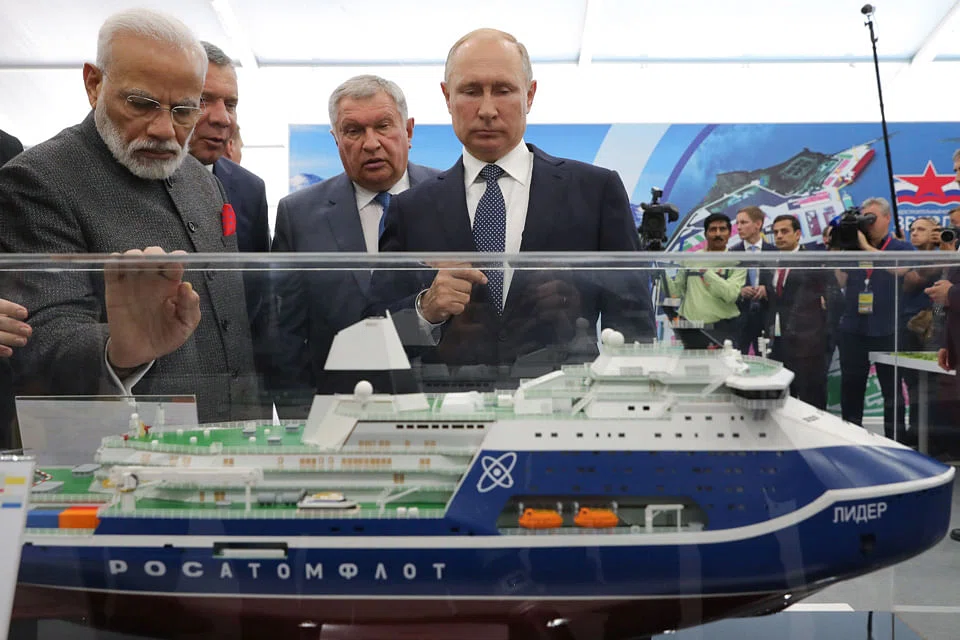
VLADIMIR Putin is hosting this week the Eastern Economic Forum in Vladivostock, the latest Russian attempt to increase influence in its Far East. Yet, this region is far from the only focus of Mr Putin's grand strategy to restore Russia's geopolitical prominence from the Asia-Pacific to the Americas, including Venezuela.
Some two decades after first assuming power, this approach has included gambits such as the annexation of Crimea in Europe, and the Syria intervention in the Middle East. And this has generally (so far) played well domestically for him, helping him in 2018 win a new six-year presidential term of office.
This week's Eastern Economic Forum - which has lined up thousands of political and business attendees - will see Russia double down on re-energising relationships with four countries, in particular. These are India, China, Japan and Mongolia with leaders from all four nations in attendance, including Prime Minister Narendra Modi, China State Council Vice-Premier Hu Chunhua, and Prime Minister Shinzo Abe.
Mr Modi is being billed as the guest of honour this week, and he and Mr Putin's broad-ranging dialogue, which will unnerve Washington, sees a number of economic and political deals inked. These include pacts in areas including defence, trade, investments, industrial cooperation, energy and connectivity.
Another notable guest is Mr Abe given the bilateral dialogue with Mr Putin over their Eastern interests. Both leaders have agreed to foster joint economic activities in the disputed islands off Japan's northernmost main island of Hokkaido which were seized by the former Soviet Union at the end of the Second World War.
These islands are now controlled by Moscow, but claimed by Tokyo. While the details remain complex, both appear to want to see progress towards a peace treaty settlement on this issue and accelerate economic cooperation.
Yet, it is perhaps China that enjoys the strongest ties with Russia right now. Perhaps the most cited area of these warmer ties is on the political and security front. However, China and Russia also enjoy an extensive economic dialogue which has deepened since Moscow's annexation of Crimea.
Russia has previously announced plans for numerous cooperation projects with China including a new method of inter-bank transfers. There's also a joint credit agency that seeks to create a shared financial and economic infrastructure that will allow them to function independently of Western-dominated financial institutions.
The two powers are also among the countries involved in creating alternative fora to the World Bank and International Monetary Fund, including the New Development Bank. This will finance infrastructure and other projects in the BRICS nations, and a related US$100 billion special currency reserve fund.
Moreover, in the energy sector, the two states have signed a US$400 billion natural gas supply deal which will see a gas pipeline of about 3,200km from eastern Siberia to northeast China. And they have agreed to construct a second major gas pipeline from western Siberia to China's Xinjiang province.
Moscow has also opened parts of its upstream oil and gas sector to direct investment from Beijing. Moreover, Chinese firms have also stepped in to provide Russian counterparts with technology, and Chinese banks have become an important source of loans for Russian businesses in the wake of Western sanctions.
The boost to the bilateral cooperation agenda has also helped enable work towards stronger, common positions on key regional and global issues too. This includes North Korea which both Russia and China have land borders with and were its allies in the Korean conflict in the early 1950s.
Within the space of just a few days, the Russian president will therefore have met with three leaders from the top world economies in Vladivostock. This underlines his continuing political energy which extraordinarily, by the mid-2020s, could see him having been in office for a longer period at the top than all the Soviet Union's supreme leaders, except Joseph Stalin.
And, despite current protests in Moscow, his foreign policy has generally fuelled his domestic popularity, at least to date, in much of Russia. Yet, this has been mirrored by frostier ties with leaders in multiple key countries, especially in the West.
And a key question - now that Mr Putin may be in power till at least 2024 - is how much he wants to put on rebuilding these relationships with key powers from the United States, to France, Germany, and the United Kingdom.
The question of rebuilding Russian's foreign relations is especially pressing with Europe after years of sanctions over Ukraine and Crimea; concerns over Moscow's alleged extensive meddling in a suite of Western elections; plus the attempted murders in England of former Russian spy Sergei Skripal and his daughter which have been widely blamed, internationally, on Moscow. The mood music between Russia and Europe is still tense, as shown at last month's G7 meeting where a few countries - particularly Britain and Germany - were sceptical about Donald Trump's ideas to re-admit Moscow back into the club which it had previously joined since the turn of the millennium as the G8.
This highlights that, while Mr Trump remains president, perhaps the biggest area of continuing Russian foreign policy uncertainty is over US relations. Mr Putin and Mr Trump had hoped for a rapprochement. However, developments in 2017 and 2018 - including the pressure the White House was under over the congressional and FBI investigations into alleged collusion with Moscow during the 2016 US presidential campaign - froze that potential window of opportunity.
However, it is not only the domestic US pressures that are complicating ties. There have also been tensions between Moscow and Washington in the Middle East during the Trump presidency, including after US missile strikes targeted at Syria over alleged poison gas attacks committed by the Damascus regime which is propped up by Mr Putin.
Indeed, previous US defence secretary James Mattis and then-secretary of state Rex Tillerson were especially forceful in their criticism of Moscow at the time, with the latter saying that "either Russia has been complicit or simply incompetent" in Syria. And the spike in Washington-Moscow tensions then even saw Russian Prime Minister Dmitry Medvedev saying the two countries were "one step away from war" and had "totally ruined" relations.
Taken overall, this week's summit is only Russia's latest attempt to assert itself internationally. With continuing uncertainty over the direction of the relationship with the West, Mr Putin is placing ever greater emphasis on the Asia-Pacific, including Japan, China and India.
TRENDING NOW
Simba admits exceeding spectrum limits amid failed M1 deal; full-year profits surge 277%
Temasek’s Wan Chee Foong to helm PIL, Lars Kastrup to be board adviser

He built the Vingroup empire. Now South-east Asia’s richest man is handing some key roles to his sons
One-third of Singapore-listed firms at risk in severe AI downturn: MAS

