The US and Europe should share info and track Chinese investment flows
China, the source of largesse especially to eastern and southern European countries, is playing one region off against the other.
TALK about a trade war between the United States and China may have overshadowed another major debate about the impact of Chinese investment, taking place on both sides of the Atlantic.
While the US Congress considers reforming the Committee on Foreign Investment of the US - CFIUS, an inter-agency committee tasked with reviewing in-bound investments for national security concerns - the European Union (EU) may move forward with a pan-European screening mechanism.
No doubt, an irked Beijing will have questions during the EU-China summit to take place in the Chinese capital on July 12-13. As China moves towards a more technology-oriented economy through its "Made in China 2025" strategy, some economists argue that the real debate should be about investment. China has set goals in sectors such as artificial intelligence (AI), robotics, alternative-energy vehicles, biopharmaceuticals, medical devices and aviation. If it cannot achieve innovation, its alternative would be to acquire foreign innovative firms.
US Congress considers expanding CFIUS, which reviews any application in anticipation of a merger, acquisition or takeover by or with any non-US entity which could result in non-US control of any US company. The US Treasury Secretary chairs CFIUS with members of other government departments such as Commerce, Energy, State, Transportation, Defence and Homeland Security.
After review, the president can decide to suspend or prohibit a deal if concerns remain unaddressed. For example, in September 2017, CFIUS rejected acquisition for a US$1.3 billion share of chipmaker Lattice by Canyon Bridge, a semiconductor investment fund sponsored by a Chinese state-owned asset manager. The proposed Foreign Investment Risk Review Modernization Act could expand the scope to examine the cumulative effect of investments.
THE GROUND SHIFTED
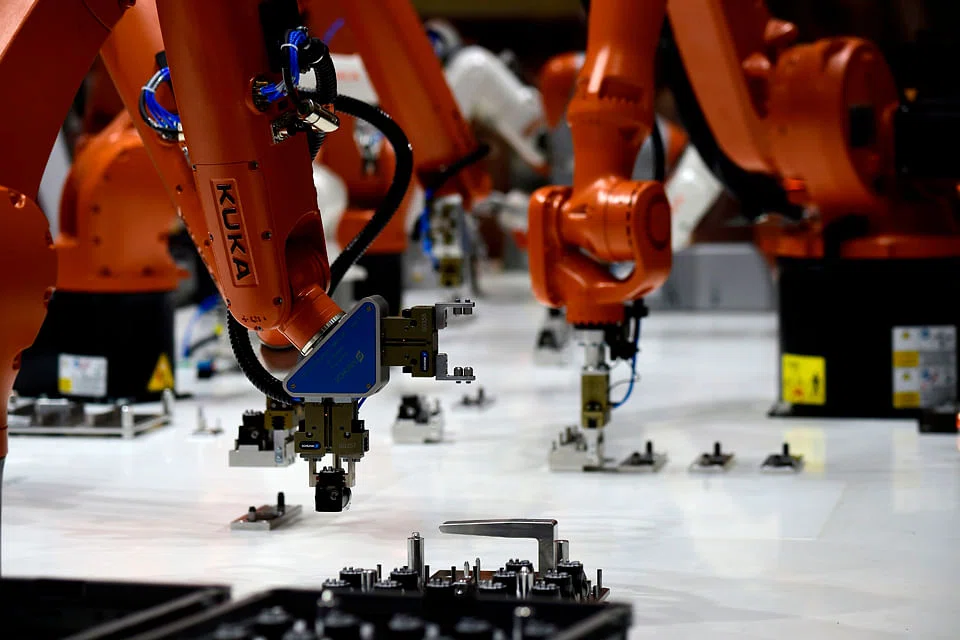
Meanwhile, in European decision-making circles, the ground shifted after Midea, a Chinese appliance-manufacturer, acquired Germany's top robotics company Kuka for US$5.3 billion in 2016. Germany and the US blocked the next acquisition attempt by a Chinese investor of semiconductor maker Aixtron for US$723 million, as Aixtron also operated in America. The French Finance Ministry has also acknowledged concern, having rejected "many deals".
Following a joint statement by the governments of Germany, France and Italy, President Jean-Claude Juncker of the European Commission declared last September that it was high time member states agreed on a common approach toward foreign direct investment (FDI): "If a foreign state-owned company wants to purchase a European harbour, part of our energy infrastructure or a defence technology firm, this should only happen with transparency." The planned framework would allow members to share details of proposed acquisitions on the grounds of security or public order, including those related to research, transport, energy or space.
Since early 2018, EU officials have frantically communicated on this issue, trying to find a solution acceptable to the 28 members; less than half of EU countries have legislation in place to review FDI proposals, mainly when transactions affect each country's defence or security interests.
The commission's proposal is a non-binding cooperation system that "can be activated when a specific foreign investment in one or several member states may affect the security or public order of another", saidMr Juncker.
The proposal faces resistence from eastern and southern European countries who receive Chinese largesse. Chinese investment in Europe hit 35 billion euros (S$55.7 billion) last year, while European investment in China declined to eight billion euros during the same period.
Besides national security concerns in areas like AI, robotics or nanotechnologies, reciprocity is a key issue: The Beijing-based European Chamber of Commerce in China reports year after year that European companies find it more challenging to compete in China against local players. In many sectors including fisheries, communications, financial services, transport, electricity and construction, China remains heavily restrictive when it comes to foreigners investing in its economy. Since the start of China's "open-door policy" by Deng Xiaoping in 1978, foreign companies in China have operated under a separate set of rules from domestic companies, and are forced to set up joint-ventures with Chinese partners.
On June 13, EU ambassadors agreed with the council's stance on the proposed regulation for screening investments from third countries in strategic sectors and creating a cooperation mechanism among member states and the European Commission, with regard to investments likely to affect security and public order. Interestingly, the ambassadors decided the EU should start talks with the European Parliament "as soon as possible"; the Parliament has debated the topic for the past year.
Between the Trump administration's "America first" stance, labelling China a "strategic competitor" in its new National Security Strategy, and a mainstream Europe actively looking to improve the EU's toolbox for screening foreign investments, China is carrying on its old practice of "divide and rule" among states while also trying to play Europeans against Americans, thanks to the current "trade war". Negotiations on much-needed bilateral investment treaties between China and the US on one hand, and China and the EU on the other, are stalled.
China is moving quickly with its ambitious Belt and Road Initiative (BRI), but investments have been relatively minor compared to Chinese investments in large developed economies. Still, central and eastern European countries are part of the BRI. Many, also members of the so-called "16+1" group set up by China in 2011 in parallel to the EU, have signed memoranda of understanding with China on supporting the initiative aiming at increased connectivity through infrastructure networks. Most signatories, having received substantial Chinese government loans or projects in exchange for open-door policies, therefore express mixed feelings about Brussels' plan. There have even been some foreign policy consequences: Greece and Hungary, in 2016, opposed a strong statement by the EU's high representative for external affairs following a ruling by the Permanent Court of Arbitration in The Hague overwhelmingly in favour of the Philippines over China's claims to the South China Sea. Bulgaria, which holds the current rotating EU presidency, has nevertheless managed to rally more voices behind the commission's proposals, and chances are good they will move ahead.
ISSUE OF RECIPROCITY
Meanwhile, both the US Senate and House of Representatives debate the issue intensely at committee levels. Both the US and Europe need outside investors in the years to come, and China will remain an appealing source of funds for many EU members and US individual states, which tend to take a friendlier approach than the federal government in Washington. But as Beijing moves in as a major global investor, there is a risk that "perception of China as a free rider undermines popular support for economic cooperation with China and for an open, liberal economic order in Western democracies", as suggested in a paper by the Rhodium Group and the Mercator Institute for Chinese Studies.
The issue of reciprocity should continue to be duly addressed separately on both sides of the Atlantic, but could be tackled through trans-Atlantic cooperation, in a process with other Organisation for Economic Cooperation and Development members including Japan or Canada. The US National Security Strategy calls for dialogue with European allies to "contest China's unfair trade and economic practices and restrict its acquisition of sensitive technologies", but it is not clear whether the Trump administration advocates a joint approach.
The US and the EU should ensure regular information-sharing and joint monitoring of Chinese investments and economic activities. Although the US and the EU do not always speak with one voice, they should coordinate and present a united front as Chinese capital continues to flow. A likely consequence of a possible tightening of US foreign investment screening and a general worsening of US-China relations: Chinese capital originally destined for the US switches to the European continent, making trans-Atlantic collaboration even more essential. YALEGLOBAL ONLINE