Trump insurrection undermines US international interests
Concerns are growing that some US foes may seek to take advantage, geopolitically, of what has become a chaotic transition.
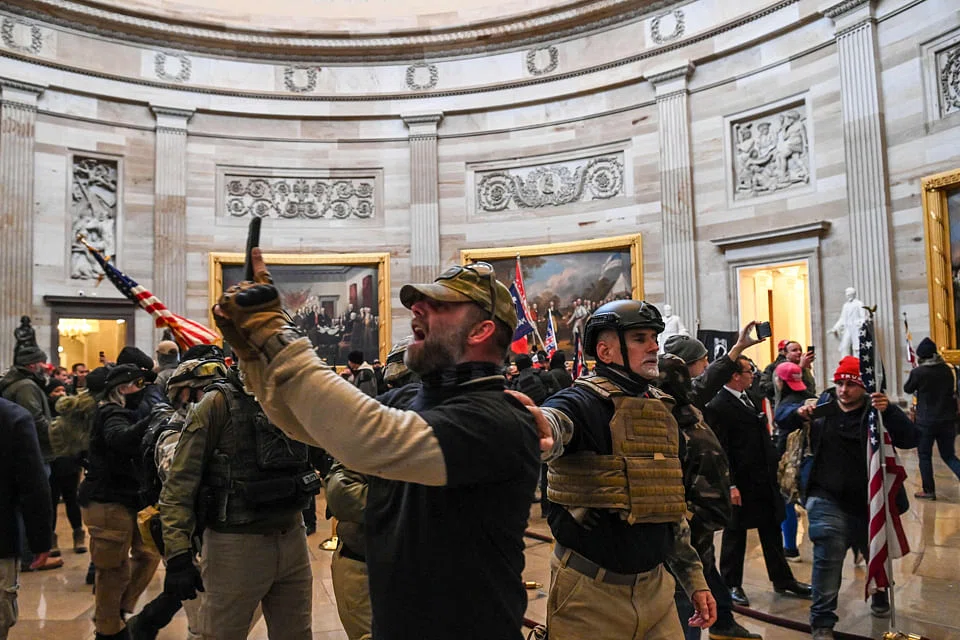
SUPPORTERS of US President Donald Trump stormed the US Congress on Wednesday, seeking to overturn November's presidential election result. While the insurrection is - rightly - a cause of grave concern within Washington, the international implications could be profoundly important too for President-elect Joe Biden's foreign agenda.
The scenes in Washington, broadcast endlessly around the world, have been witnessed by US allies and adversaries alike. It is US allies that have, so far, expressed most public concern at Wednesday's debacle and the wider antics of Mr Trump.
UK Prime Minister Boris Johnson has condemned the "disgraceful scenes in US Congress". The United States stands for democracy around the world, he noted, "and it is now vital that there should be a peaceful and orderly transfer of power" from Mr Trump to Mr Biden, he said.
Meanwhile, North Atlantic Treaty Organisation (Nato) secretary-general Jens Stoltenberg expressed alarm at the "shocking scenes in Washington DC," saying: "The outcome of this democratic election must be respected."
Mostly silent so far are many of the US' foes across the world from Venezuela to Iran and Russia to China. However, some of them will relish the disorder in the citadel of US democracy.
Take the example of Russia's Deputy United Nations Ambassador Dmitry Polyanskiy who tweeted that "quite Maidan-style pictures are coming from DC", referring to protests in Ukraine, that Russia believes were orchestrated by the United States, that toppled the then Moscow-backed president of Ukraine Viktor Yanukovich in 2014. "Some of my friends ask whether someone will distribute crackers to the protesters to echo Victoria Nuland's stunt," he went on, citing a 2013 visit to Ukraine when Ms Nuland, then-US assistant secretary of state, offered food to protesters.
Moreover, with around two weeks left before Mr Biden takes office, concerns are growing that some US foes may seek to take advantage, geopolitically, of the remaining two weeks of what has become a chaotic Trump-Biden transition. Take the example of Iran here which only this week announced its move to step up its uranium enrichment to 20 per cent purity which could be used for its nuclear weapons programme. That is the biggest break yet from its commitments under a 2015 nuclear deal struck with world powers, including the United States and Europe.
For it is not just Wednesday's events, alarming as they are, that have been highly irregular about the period since November. Almost without precedent in US presidential election history, Mr Trump has refused for weeks to concede to Mr Biden, and continues to dispute the result, despite providing no evidence to support this that stands up in court. Moreover, it now seems unlikely that he will attend Mr Biden's inauguration on Jan 20, further disrupting US democratic traditions.
On Wednesday, Mr Trump expressed his "love" for the "very special" people who stormed Congress by calling them "American patriots". In his extraordinary statement after the violence in the Capitol, he told the insurrectionists: "I know your pain, I know your hurt. We had an election that was stolen from us. It was a landslide election, and everyone knows it, especially the other side."
One of the specific areas where Wednesday's events will undermine the United States overseas, at least in the short term, is the democracy promotion agenda. This is important as Mr Biden has prioritised restoring a commitment to democracy as the core of his foreign affairs agenda, post-Trump, with a pledge to return the United States to its role as the "leader of the democratic world". This includes potentially convening a widely trailed "Summit of Democracies".
Take the example of Europe's national-populists in Eastern Europe, including the US' Nato allies Poland and Hungary, who are now less likely to feel the pressure of US-style calls for respect for the rule of law and democratic norms. During his period as US vice-president from 2009-17, Mr Biden had an active role in visiting these countries and speaking against corruption and in favour of the consolidation of democratic institutions, with an emphasis on the independence of the judiciary.
However, applying such pressure now is not likely to have similarly strong effects. This is, in part, because of Wednesday's chaotic scenes and the much wider erosion of US democratic traditions during the Trump era, combined with the advances made by governments in capitals such as Warsaw and Budapest in recent years in formalising a disequilibrium in the rule of law and post-Cold War democratic norms.
Perceptions in some developing countries in Africa, the Americas and Asia, especially where popular anti-US sentiment is already a significant political force, could also be important. Damagingly, an abiding memory and political discourse here could centre on recent US political disorder and the allegation that US democracy involves an element of chaos and indeed sham.
In this context, there will be some Republicans, and possibly centrist Democrats too, who will prefer Mr Biden not to over-emphasise democracy-based political rhetoric that characterised some previous Democratic administrations. They argue, for instance, that ideas like the "Summit of Democracies" - with a sometimes simple, binary distinction between "good" and "bad" - can sit awkwardly in a fast-changing, complex world of ambiguity and uncertainty where there is frequent need to work with states lacking democratic traditions, including China. Moreover, bad governance, policy mismanagement and personal scandals have also dented the moral standing of a significant number of democracies too in recent decades.
Critics favour instead an international approach based more on classic, quantifiable national interests. From this perspective, other states, especially developing ones, might be more likely to aspire to emulate the United States because of its material prosperity, rather than appeals based on the country's democratic virtues. One policy implication of this is stressing the virtues of pressing economic reform packages in Africa, Asia and the Americas on the basis that economic modernisation and liberalism will of itself be an impulse towards future democratic reform.
Taken together, this underlines why the international impact of Washington's political disorder could be so significant. While Mr Biden is still likely to press his democratic promotion agenda in coming years, Wednesday's events will encourage some domestic and international critics of it to voice their criticisms more loudly.
- The writer is an associate at LSE IDEAS at the London School of Economics
READ MORE: