

What can Indonesia do about the haze?
Jakarta could do a cost-benefit analysis on supporting industries linked to the problem, to see whether the returns from them are worth the costs suffered.
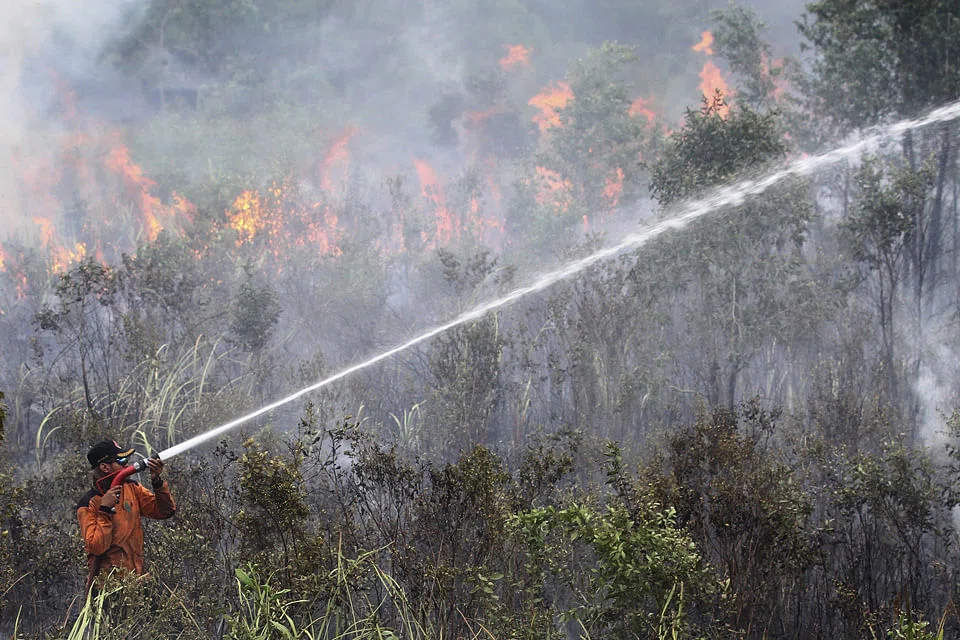
IF there is any solution to the relentless haze problem, it lies in Indonesia.
President Joko Widodo's administration has undoubtedly shown renewed resolve and increased efforts in tackling the Indonesian forest fires, but his three-year target to greatly reduce the fire episodes seems more of a political timeframe than a realistic one.
We have no wish to be right about this, but there are good reasons to believe it is so.
The Indonesian authorities have begun arresting executives from firms accused of being responsible for the fires. The penalties for those found guilty are heavy, but convicting the culprits is easier said than done. The perpetrators first have to be accurately identified, which is already a daunting task, and they may include small farmers instead of just big corporations.
The lack of land ownership information adds to the challenge, not to mention the local and central government's vested interests in protecting the industries (worth an estimated US$18 billion); corruption and coordination and enforcement failures also figure in the mix.
In addition, the time required to secure a hearing in court and thereafter, convicting the culprits, will likely be long. Hard evidence proving the sources of fires, required for litigation, would be difficult to collect.
As it appears, the punishment is severe - but neither swift nor certain.
DRAWING THE LINE
Within Indonesia, which has a large consumer market (unlike Singapore), banning products from alleged culprit plantations would still be futile for the same reason - that it is tedious to track down culprits and accord responsibilities.
Moreover, palm oil and paper are intermediate goods, meaning they are inputs to the production of other goods and services. Should consumers then boycott other products that use materials from pollutive plantations, thus penalising firms not directly complicit with the act? Will this information even be available? Where should we draw the line down the supply chain?
We must also remember that the forest fires are both a man-made and nature-caused problem.
Since the intense El Niño had already been expected early on, Indonesia could perhaps have informed Asean of the impending haze problem, the steps it planned to undertake and raised a request for regional support.
On the local front, more resources and logistical support could have been diverted to empower the local communities for proactive fire prevention, or at least for a faster reactive response to fires.
Small fires are easier to contain. Responses should be prompt and coordinated with standard operating procedures, focused objectives, and non-overlapping responsibilities across institutions.
President Joko's idea of creating water canals might also work in reducing the dryness of peatland, and thus the chances of nature-caused fires, but this will not work where peatlands have been intentionally drained to make way for plantations.
However, with most of these fires being man-made, solutions can largely be successfully implemented only in the longer run.
There should be more stringent requirements and greater scrutiny in granting and renewing concessions for plantations and for managing peatland use.
New technologies are often the solution to most problems, including the haze. For instance, water-bombing aircraft and land-clearing machinery would be made more efficient in years to come.
Lessons from economics would suggest the use of incentives and disincentives.
Since it is almost impossible to accurately determine which plantations started the fires, Indonesia should implement the law of strict liability. Instead of allocating blame to fire-starters, plantations should be held liable for any fire (above a certain scale) occurring on their land, regardless who started it.
This will create strong incentives for fire prevention and disincentives for clearing land with fire. Errant plantations should be fined or made to forfeit a liability deposit that they previously paid.
The magnitude of this penalty has to be carefully set as a determent, and fires must be accurately pinpointed with remote sensing and satellite technologies.
Land-owners should also be given grants, loans, training and logistical assistance to prevent or fight fires. If land-owners are unable to fight the fires themselves, they must be able to notify the local government for help before the fire gets out of control.
Gifts in kind - in the form of better roads, infrastructure, food vouchers and subsidies, or special funding for villages - could also be provided as incentives, if it can be shown that no fires above a prescribed size have occurred in a given area over a period of time.
Costs for the alternative methods of land clearing ought to be made known, so that Indonesia can negotiate and seek support from Asean and other countries in providing subsidies for firms and farmers who abstain from slash-and-burn practices. Alternative cost-efficient land-clearing practices could also be developed with increased investments in research and development.
Finally, this haze problem stemming from forest fires requires the involvement of multiple stakeholders, which include both culprits and victims. And since the daily greenhouse gas emissions from Indonesia's raging fires have reportedly exceeded the US' daily emission levels from all sources, the whole world is a collectively affected victim.
Indonesia could learn from transboundary pollution experiences in other regions, and seek support and guidance from international agencies such as the United Nations, World Health Organisation, World Wildlife Foundation and the Roundtable for Sustainable Palm Oil. The international community should also be concerned about the Indonesian fires, as this has obvious implications for global warming.
THIS WILL TAKE TIME
We do not doubt that the haze problem will eventually be resolved, but it will take longer than three years for a discernable policy impact, especially when weather also plays a part.
Besides, Indonesian laws and the system of governance are complex and will require time to change. Resources in terms of manpower and funds have to be budgeted. As a large and spatially distributed country - 34 provinces subdivided into regencies, cities, districts and administrative villages, each with its own set of laws and regulations - we should not expect results soon, even with sustained political will.
Given that there are many suggested solutions, ultimately, the test is whether there will still be fires of such magnitude in the future. In the meantime, just as in the case for Singapore, it is important for Indonesia to estimate the aggregate and sectorial damages of the haze and fires, to itself and to the other affected countries.
With this information, the country can then determine whether the returns from such pollutive industries are substantially greater than the damages suffered, and better plan the allocation of land concessions. If the damage costs more than the amount of economic benefits reaped, a rethink is required in the further growth of these industries; perhaps Indonesia could then consider diversifying its exports away from goods closely related to the fires.
In the interim, we can be optimistic about a solution, provided there is improved coordination among government institutions, weeding out of corruption, regional and international cooperation, technological advancements and, most importantly, a continued search for pragmatic solutions.






