Singapore Students Develop AI-Powered Climate Solutions in Nationally Supported Programme
Ninety Singaporean tertiary students joined 600 peers from India and Indonesia for a 9-month AI-powered climate innovation programme, culminating in a Global Summit in Singapore from 27 to 29 March 2026
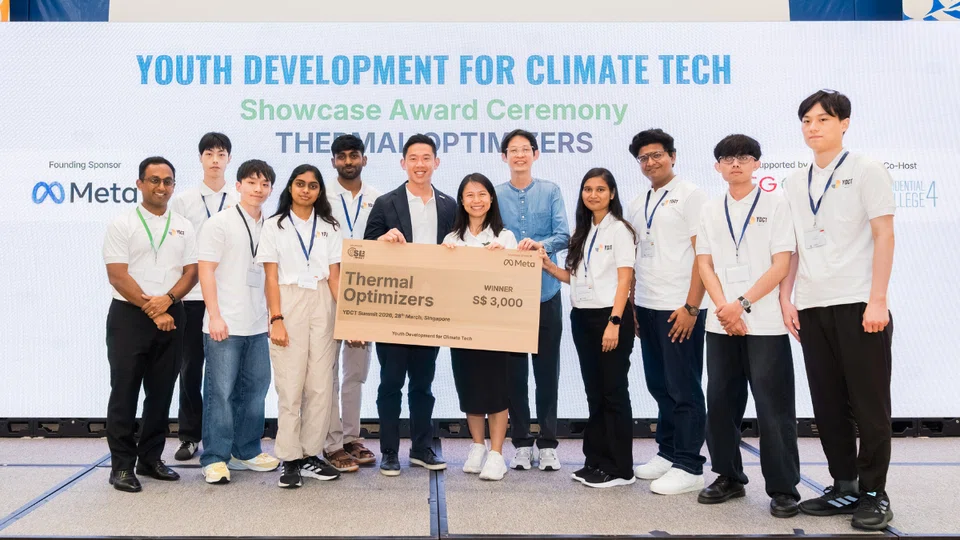
Organised by SL2 Impact (Sustainable Living Lab Group) with founding sponsor Meta Platforms, Inc. and SG Eco Fund support, the Youth Development for Climate Tech (YDCT) Global Summit was co-hosted by Residential College 4, NUS, and attended by Senior Parliamentary Secretary for Sustainability and the Environment, Ms Goh Hanyan. The top nine cross-border teams showcased prototypes, presented solutions, and engaged stakeholders on sustainability. This programme, equipped the students with practical digital and sustainability skills to tackle real-world environmental challenges. Consequently, students developed actionable solutions to address air pollution, extreme heat, flooding, and renewable energy, demonstrating practical impacts on these key resilience concerns for Singapore and the region. Throughout the programme, participants gained hands-on experience using AI, data analytics, and IoT to address environmental challenges. They analysed environmental data, built predictive tools to assess heat and flood risks, and designed digital platforms that turn climate data into actionable insights for communities. The programme emphasised on responsible AI, focusing on data ethics, governance, and practical implementation. This ensured innovations were feasible and valuable to the public. Participants leveraged Meta’s open-source AI tools for the programme’s applied AI component. Meta technology such as Llama large language models and the WhatsApp API enabled teams to prototype seamlessly. These tools were integrated into student-built solutions for predictive modelling, multilingual communication, and real-time community alerts, translating AI capabilities into practical, deployment-oriented applications. Several prototypes are now under review for potential pilot deployment. For example, CoolRide, a web-based application that helps cyclists choose shadier routes while displaying heat-risk indicators alongside the fastest route options. Cyclists receive AI-generated cooling recommendations powered by Meta’s Llama model. The solution demonstrates how AI can support everyday climate adaptation in dense urban environments. The programme aligns closely with Singapore’s national AI strategy and emphasises building a strong pipeline of AI-ready talent. By embedding AI into climate problem-solving, YDCT contributes to national efforts in strengthening digital workforce capabilities while advancing environmental priorities. YDCT’s work, particularly in addressing heat and flood resilience, also aligns with the climate resilience priorities outlined in the Ministry of Sustainability and the Environment’s recent Committee of Supply (COS) debate in March, where Minister Grace Fu designated 2026 as the “Year of Climate Adaptation.” In her address at the Global Summit, Ms Goh Hanyan emphasised the role of youth-led initiatives in driving climate action. “Ground-up initiatives like the Youth Development for Climate Tech Summit play an important role in inspiring individuals and galvanising action. These projects demonstrate that technology can be a powerful enabler for creating impactful environmental solutions that contribute to the wider community,” said Ms Goh Hanyan. Participants echoed this sentiment, highlighting the value of cross-border collaboration and real-world application of skills. “I enjoyed collaborating across cultures with like-minded teammates from different countries, all working towards a shared goal,” noted Bong Sharlert, a participant from NUS in Singapore. Anirudh Mohan, a participant from IIM Indore, India, said “YDCT made me feel that I can get into tech and climate and make a real impact, even as a management student.” Beyond technical competencies, participants developed cross-border collaboration and communication skills by working with peers from India and Indonesia. These experiences reflect the importance of regional cooperation in addressing climate challenges that transcend national boundaries. SL2 Impact plans to expand the initiative in future cycles, inviting additional organisations to contribute problem statements, mentorship, and pilot opportunities. The organisation aims to continue strengthening the link between youth capability-building, climate resilience, and digital transformation. For collaboration enquiries, please contact: [ydct@sustainablelivinglab.org] [https://sustainablelivinglab.org]
This press release was published as it was received from our partner, without any editing from The Business Times (BT) team.
You can publish your own paid press release on BT. Simply fill in this form, and our team will respond by the next business day.
Share with us your feedback on BT's products and services