

With 5G towers, progress is quite tall
 Add BT as a preferred source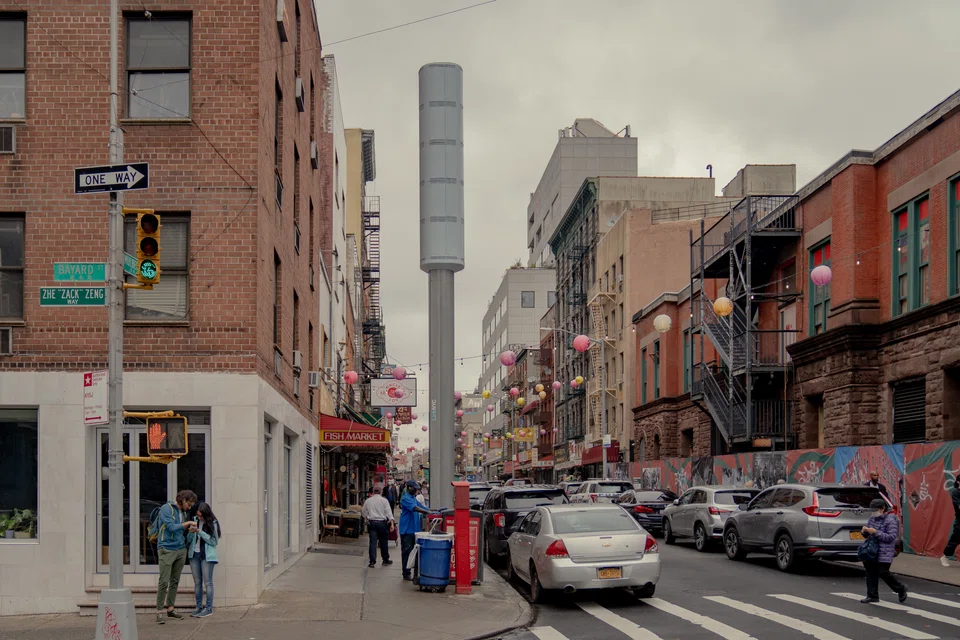
A CURIOUSLY futuristic tower recently appeared on the corner of Putnam and Bedford avenues in the Bedford-Stuyvesant neighbourhood of Brooklyn. A gray column topped by a perforated casing, at a whopping 32 feet tall (9.8m), it reaches higher than the three-storey brick building behind it.
Sixty-year-old Marion Little, who owns Stripper Stain & Supplies, a hardware store that has operated on that corner for 17 years, said he and his neighbours had received no warning. One day there were workers outside; then the tower materialised.
“We were shocked because we had no idea what it was,” Little said. Since it’s right outside his store, people keep asking him about it. “They’ve been emailing me, calling me weekends, Facebooking me, like, ‘Yo, what’s that?’ and I’m sitting there like, ‘I have no clue’.”
The object in question is a new 5G antenna tower erected by LinkNYC, the latest hardware in New York’s sweeping technological upgrade.
New York City has an agreement with CityBridge, the team behind LinkNYC, that involves installing 2,000 5G towers over the next several years, an effort to help eliminate the city’s “internet deserts”. Ninety per cent will be in underserved areas of the city – neighbourhoods in the Bronx, Brooklyn, Queens, Staten Island and above 96th Street in Manhattan.
Once the towers are activated, residents will have access to free digital calling and free high-speed Wi-Fi as well as 5G service. Many of the locations were previously home to pay phones.
According to officials in the city’s Office of Technology and Innovation, 40 per cent of New York City households lack the combination of home and mobile broadband, including 18 per cent of residents – more than 1.5 million people – who lack both.
The 5G towers, as well as fibre cables underground, will make up an infrastructure that carriers including AT&T and Verizon can use to provide better service to customers. Most of the towers, including the one on Little’s corner, have not yet been activated.
But as is often the case when something new appears on the New York City streetscape, people seem startled by the large structures – and some have expressed unfounded fears about 5G. They’re concerned about the towers’ sheer size and, in some cases, the wrecked views from third-floor windows. Little also questioned the practicality of placing the tower on his corner at the B26 bus stop: “The buses turn here,” he said. “It’s going to be easy to miscalculate and hit the thing.”
Another 5G tower popped up in Fort Greene, on the corner of Vanderbilt and Myrtle avenues, by, again, a bus stop – the B69. It looms alongside a three-storey residential building with a ground-level liquor store.
Mark Malecki, 26, who moved to New York City in mid-October from Richmond, Virginia, has an intimate view framed by his third-floor bedroom window. “I wasn’t even quite sure what it was,” he said.
The towers are not the only 5G antennas being installed in New York City. Others are going up on city property, including traffic lights and streetlamps.
At the end of September, jackhammering could be heard outside the six-storey brick building on the Upper East Side where Chelsea Formica, 32, lives with her husband, Joe, and their infant son.
Formica was in New Jersey visiting her mother when her husband called. “He was like, ‘Hey, you know, they put something up outside of our window. I’m just laying here on the couch and it’s pretty big.’” Then Formica got home. “I was like, ‘Oh, my God,’ freaking out. It’s huge. It’s so big.”
Workers for telecommunications company ExteNet had installed a cylindrical object roughly the size of a human: a 5G antenna that is 63 inches tall and 21 inches in diameter, according to the company. It is accompanied by a box that is 38 inches high, 16 inches wide and 14 inches deep – about the size of a filing cabinet or a nightstand.
The imposing antenna is mounted on top of a slender pole, three stories high – more than 30 feet in the air – and right in front of Formica’s living-room window. It’s also just steps away from where their 5-month-old baby sleeps, which makes Formica uncomfortable.
“People say that it is safe; the FCC (Federal Communications Commission) says it’s safe and everything,” she said. “We’re just worried that it’s so close to my son’s bedroom.”
Alex Wyglinski, associate dean of graduate studies and a professor of electrical and computer engineering at Worcester Polytechnic Institute, said residents need not worry. He noted that 5G is non-ionising radiation, on the opposite end of the spectrum from ionising rays that people need protection from, such as UV rays and X-rays.
In addition, Wyglinski said, the tower “cannot just blast energy everywhere. It’s going to be hyperfocused points of energy going directly to your cellphone”. NYTIMES
Decoding Asia newsletter: your guide to navigating Asia in a new global order. Sign up here to get Decoding Asia newsletter. Delivered to your inbox. Free.
Share with us your feedback on BT's products and services
TRENDING NOW

Singapore developer in limbo after Timor-Leste scraps major township project

From hawker stall to Enterprise Award winner: How Han Keen Juan scaled the Old Chang Kee empire

‘I feel so stupid’: How young Indonesians get stuck on the debt treadmill

Hanoi orders 20% surge in IP enforcement cases in May after US warning

