

AI investment wave driving money into data centre deals in Asia-Pacific
Japan is top market for investors, with Malaysia fast gaining more interest

A FRESH wave of AI-directed investments is driving money into data centre real estate in the Asia-Pacific, with most markets seeing record levels of construction activity and strong deal flow.
In the first quarter of 2024, acquisitions of Asia-Pacific data centre assets totalled more than US$1.6 billion, surpassing investment volumes recorded in both the first and second halves of 2023, according to MSCI’s Asia Pacific Capital Trends report.
“There was a mix of both individual property sales and platform-level deals, with assets across six different markets changing hands,” the MSCI report said.
Japan is top of mind among investors for its development pipeline, low borrowing costs and robust connectivity, say analysts. But Malaysia is fast emerging as a strong contender, especially next to Singapore, where limited land and strict requirements for sustainable power have hampered data centre development.
“More recently, we see the rise of artificial intelligence (AI), especially generative AI, as a significant factor driving interest in the sector,” said Celina Chua, JLL’s director for data centre client solutions.
Tech giants Google, Amazon, Microsoft and Bytedance are pumping billions in investments into AI, and will need to expand their data centre footprints in the region, said Catherine He, Colliers Singapore’s head of research.
Investments in the Asia-Pacific bounced off lows of roughly US$1 billion recorded in H2 2022 and in H1 2023, MSCI’s data shows, and rose to just under US$1.5 billion in H2 2023.
While investor interest is strong, there is a lack of stock for sale, said CBRE in a Q1 report issued in April. Still-high interest rates are weighing on deals, it said. According to CBRE’s tally, which excludes China investments, full-year investment volume fell 26 per cent to US$1.1 billion in 2023.
For 2024, total transaction value (excluding China) is expected to grow “modestly” by US$1.8 billion, driven by major deals in Japan, while sales activity elsewhere will be limited, said CBRE’s head of data centre solutions, Dedi Iskandar.
The biggest deal so far in 2024 was the sale of a stake in Beijing-headquartered GDS’s data centre business – with assets in Singapore, Hong Kong, Malaysia and Indonesia – to a consortium of institutional investors. The deal implied an enterprise value of US$2.3 billion, according to MSCI.
Some US$7.9 billion in Australian assets are in play, from the ongoing sale of Air Trunk, put on the market by Macquarie Asset Management and PSP Investments four years after they invested in 2020.
“This will be the largest data centre M&A deal in Apac on what is widely regarded as the most well-respected hyperscale data centre operator in the Apac region,” said Knight Frank’s data centre lead for Asia-Pacific (Apac), Fred Fitzalan Howard.
While deal flow has been sustained, returns vary across countries.
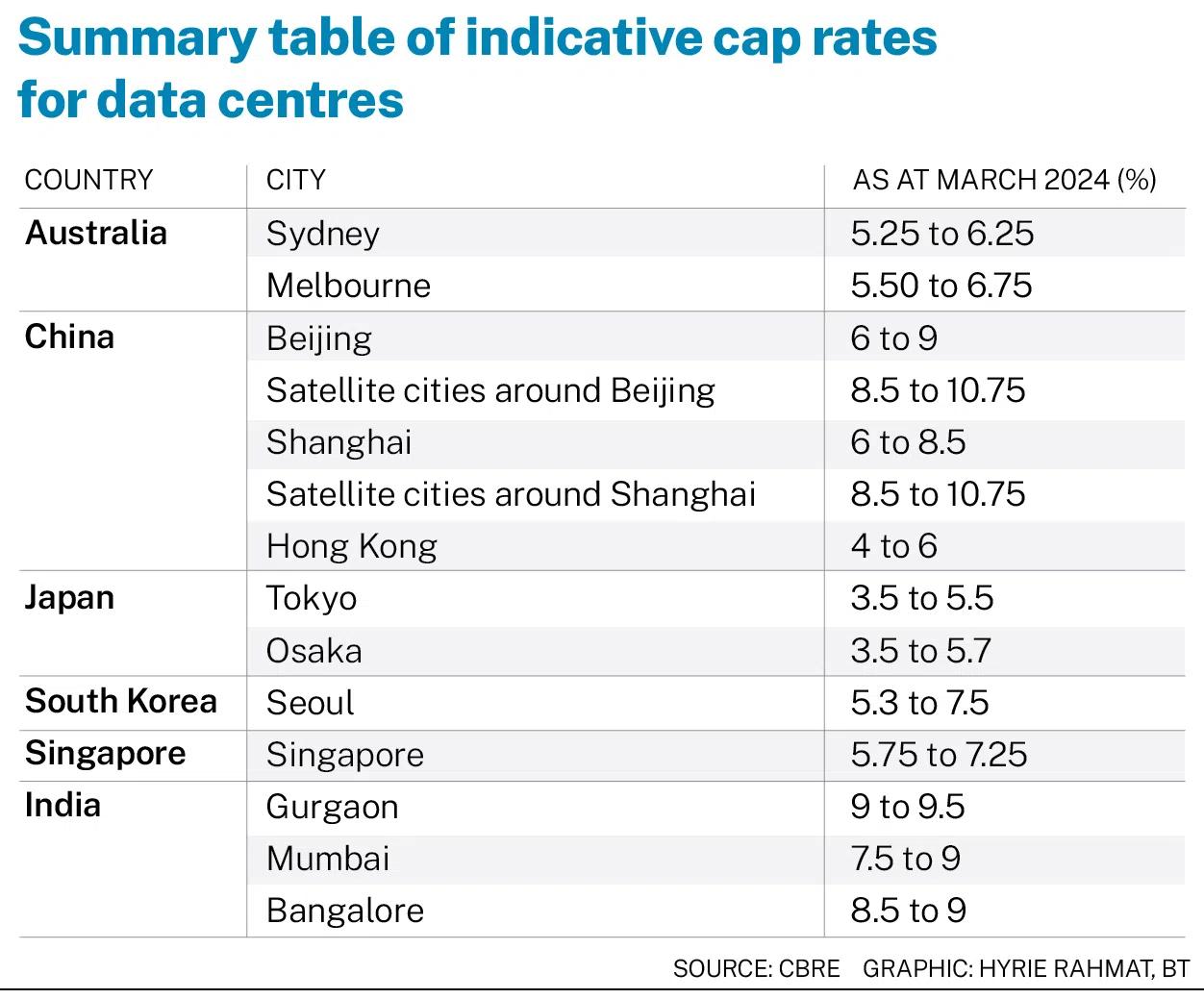
For Tier 1 markets such as Japan and Singapore, indicative capitalisation rate – a measure of yield – hovers between 3.5 and 6.5 per cent, according to CBRE. Higher transaction premiums reflected the assets’ higher occupancy, power availability, strong connectivity and regulatory environment.
Tier 2 markets such as those in India and China are showing cap rates at between 6 and 9.5 per cent, reflecting higher risks.
Japan currently has the most active development pipeline and is drawing the most investor interest, said CBRE.
Investors are bullish on the Japanese market due to the low borrowing cost, cheaper exchange rate and robust fibre connectivity between the US and Asia, said Lynus Pook, executive director of industrial services at Colliers Singapore.
However, the lack of sufficient power in Japan may cause delays in expansion plans, he cautioned.
Among emerging markets, Malaysia is the fastest growing, with strong interest in Kuala Lumpur and Johor. Indonesia and Thailand have also seen investors looking to buy land and form joint ventures for development, said CBRE.
Data centre construction activity in the Asia-Pacific saw a third consecutive year of double-digit growth in 2023, MSCI noted. Construction of over 2.5 gigawatts (GW) of data centre capacity was recorded in 2023, boosted by “a handful of emerging markets”, it said.
“We are witnessing record levels of data centre construction in most markets,” said Vivek Dahiya, head of data centre advisory for Cushman & Wakefield, adding: “Some previously ‘emerging’ markets like Mumbai are now becoming market leaders, and newer markets like Johor are emerging.”
More than 50 per cent of data centre development activity in the region is concentrated in China, Japan and India, said Colliers’ Pook.
In Singapore, construction has been capped since 2019 when the government enforced a moratorium on new data centre developments. This was implemented as land scarce Singapore had 60 data centres with a capacity of 357 megawatts (MW) at that time.
The moratorium was partially relaxed in July 2022, with a scheme introduced where new facilities will need to meet higher energy efficiency and sustainability requirements. Four companies were awarded a total of 80 MW of capacity to develop new facilities by 2026-2027, but have yet to begin construction.
“The moratorium has caused significant impact on any development plans by data centre investors and operators in Singapore, as there is no certainty in terms of data centre power delivery,” said CBRE’s Iskandar.
This has driven the growth of data centres to other markets such as Johor and Batam, which have become the main beneficiaries of spillover from Singapore, he said.
Knight Frank’s Howard noted that the impact of Singapore’s moratorium has pushed Johor going from having minimal data centre capacity in 2021 to having 1.5 GW of future planned capacity, taking in both overspill capacity from Singapore and plans for a regional hub for AI-based deployments.
The overall outlook is robust, with an estimated compound annual growth rate of between 10 and 15 per cent from 2024 to 2029 for Asia-Pacific markets, said Iskandar.
Singapore’s prospects, however, look less sanguine. “With no certainty on more power capacity, it is challenging for data centre investors and operators to continue their investment or perform any sort of planning for new data centre facilities in Singapore,” he added.






