The Albanian island at the centre of anger over Kushner’s resort plans
1.4b-euro project could turn Sazan from a former army outpost with decaying buildings and military relics into a centre of privilege for a select wealthy few
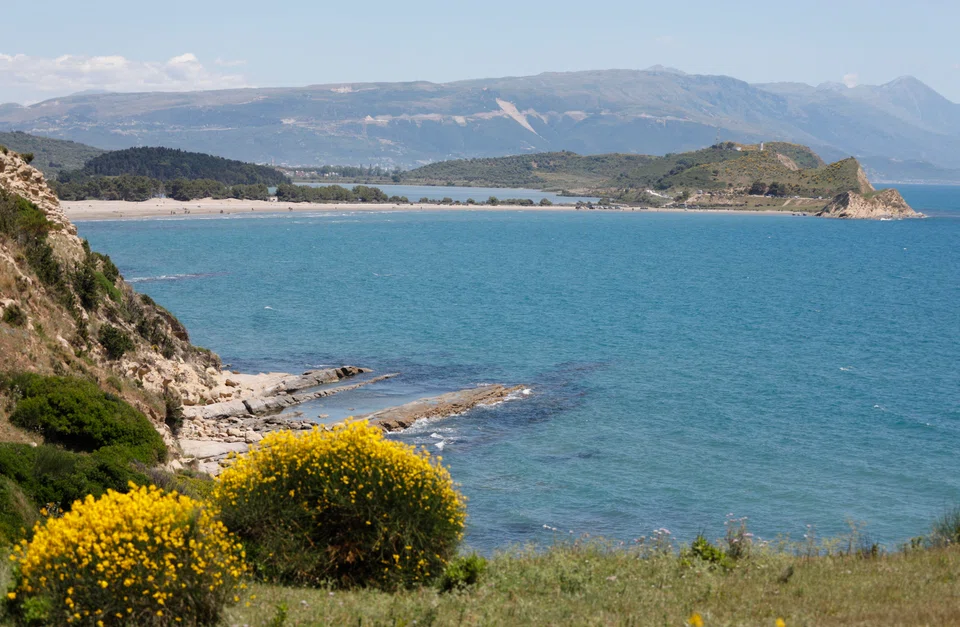
[PRISTINA, Kosovo] The ride from the Albanian mainland to the island of Sazan takes just 20 minutes in a speedboat.
From a small harbour, a worn-out road lined by disused streetlights and electricity poles, concrete bunkers and trenches overgrown with greenery leads up a hill to an abandoned military base. Inside, an old schoolhouse is strewn with shattered windowpanes, broken chairs and discarded mattresses. A former hospital has been stripped of its sinks and toilets. In what was once a cafeteria rusty metal grates are full of mostly broken wine bottles.
The complex began as a small army outpost during Fascist Italy’s four-year occupation of the country, before expanding under Albania’s communists into a fortified, closed community, where around 4,000 soldiers and their families were largely self-sufficient. They had workshops, tailors, and shoemakers. Ensembles and artistic groups visited each month. Football matches were held regularly. And films screened each weekend in a cinema. It was a lifestyle altogether out of reach for most of the population under dictator Enver Hoxha.
Families gradually left during the political and economic turmoil that followed the collapse of his regime, and visitors have been exploring the decaying buildings and military relics they left behind for a decade.
While dozens of people arrive daily from May to October – the warmer months of the year when the island is open to sightseers – it has no public toilets, cafes, or shops. The only sanctioned walk takes just two hours and wandering off is risky, with signs warning that mines are still buried in the hills. After the tour, guests may lounge on the beach, or return to the city of Vlore.
Sazan’s next incarnation could see it return to its earlier role as a centre of privilege for a select few. But this time around, it is wealth, not devotion to communism, that will secure access.
Jared Kushner’s 1.4 billion euro (S$2 million) development plans include a marina for private boats and yachts, high-end hotel style villas, along with a spa and wellness centre. In an interview with the Founders Podcast, released on May 31, his wife, Ivanka Trump, framed the project as an opportunity to transform a largely untouched setting into an “exclusive destination”, shaped by her own ideas about travel, architecture and community.
When the proposal was announced two years ago, environmental campaigners cried foul, pointing out that the island forms part of Albania’s only marine national park. Its coastal caves, coral and rocky reefs are home to around 70 species of endangered wildlife, including Mediterranean monk seals and sea turtles. Warning that increased ship traffic, noise and light pollution would harm that ecosystem, they organised protests.
But it was the government’s handling of demonstrations recently against Kushner’s plans for a 4 billion euro resort on the mainland in Zvernec, another environmentally sensitive coastal area, that fuelled wider public ire.
On May 30, after fencing went up at the site and preparatory work began, a protester was injured as he was dragged through a local park near the site by several private security guards. Videos shared widely on social networks of the incident were picked up by local news outlets which described the incident as a case of alleged abuse and unlawful detention.
“That was,” said Mentor Kikia, an independent Albanian political analyst, “what made the glass overflow or the spark that ignited the powder keg.”
Since then, demonstrations that drew hundreds of people in coastal areas have spread to Tirana, capital of the nation of 2.4 million people, tapping into longstanding concerns over corruption and cronyism that critics say have characterised Prime Minister Edi Rama’s near 13 years in power. They argue that the government lacked transparency in approving the Kushner projects, which they say are emblematic of an Albania being reshaped for investors at the expense of national assets, like land and coastline.
Rama has faced earlier waves of protests, including over alleged electoral fraud in 2019, when demonstrators clashed with police who used water cannons and tear gas to try to disperse the massive crowds. Now, like then, he brushed off concerns and decided to ride out the unrest.
He says the projects will go ahead as long as he is premier and accused protesters of trying to undermine Albania’s economic progress. Rama has pushed the repurposing of abandoned military sites as a way to attract visitors for around a decade. Tourism is now a major contributor of growth to the country’s US$33 billion economy, accounting for more than a fifth of gross domestic product last year and a much larger share when indirect effects, such as jobs, are included. At the same time, Rama has invited protesters, who have no leader, to discuss protected areas and police violence.
They want Kushner’s plans scrapped, and the prime minister, who facilitated them, gone. That’s a strong stance in one of the world’s most pro-American countries.
‘Unbelievably Beautiful’
Speaking at a Future Investment Initiative forum in Tirana last year, Kushner said he first visited Albania during a boat trip from Montenegro to Corfu in 2021. Rama joined him one evening, he said, and impressed him with his vision and his background as an artist. Kushner said he was struck by the country’s natural beauty.
He described the Zvernec project as a bet on an undervalued market, comparing it with his property investments in New York neighbourhoods before they became more sought after. Albania, Kushner said, had “all the right fundamentals” and “seemed like a place that nobody knew or understood”.
About a year later, when his firm began looking at opportunities in the Balkans, he directed his team back to the country.
The Zvernec resort, Kushner said, was being designed as somewhere that he, his wife and their family would want to spend the summer, predicting that other wealthy families would also want homes there or to return frequently as visitors. “I really think we’ll build a tremendous community,” he added.
In the Founders Podcast, released a day after the protester was allegedly beaten, his wife recalled coming across Sazan on a boat trip with friends, swimming in its waters and hiking barefoot to the top. She called it an “unbelievably beautiful 1,400-hectare private island in the middle of the Mediterranean”. The comments triggered a backlash on Albanian social media, with users objecting to the island being referred to as private and saying her descriptions did not entirely reflect the reality of the place.
The couple are not the first to want to build on Sazan. All former Albanian prime ministers considered developing the island, but no project took off because of the difficult terrain and the resources needed for its modernisation.
In an e-mailed statement on Jun 3, Asher Abehsera, chairman of Sazan Real Estate Development, said: “We’re excited about the opportunity to create a world-class destination and make one of the largest private investments in the region’s history. Our focus remains on responsible stewardship, environmental enhancement, job creation, and creating long-term value for local communities.”
Referring to outstanding paperwork, including an environmental assessments and construction permits, he added: “We respect the ongoing public and institutional processes, and we stand ready to move forward as they unfold.”
Auron Tare, a local historian who accompanied Kushner and Ivanka on their trip to Sazan, said in an interview in June 2024 that they were both interested in the island’s history.
What seemed to impress Kushner most was that Sazan appeared frozen in time, making it different from islands in Croatia or Greece that had already been extensively developed, Tare said. “It is very rare to find something like this in the Mediterranean today, and I believe this is the real value of Sazan,” he added.
They have said they want a “light touch” development to preserve that unique character.
It was the island’s strategic location at the entrance to the Adriatic Sea that appealed to Mussolini, who also built a lighthouse. In the 1950s, during Albania’s alliance with the Soviet Union, Sazan was transformed into a heavily fortified base, with tunnels and interconnected defensive lines. In 1961 when Albania broke with the Soviet Union, China became the country’s main ally for a little over a decade and dispatched a small unit to the island, which provided military aid, equipment and support to Albanian soldiers stationed there.
A few families who stayed on the island after the fall of the communist regime in 1990 eventually left during widespread civil unrest triggered by the collapse of local pyramid schemes seven years later. The base was looted, weapons stolen, and the site damaged. For a brief period, the island was used by the Italian navy to help the Albanian government fight drug traffickers.
Sazan was closed off all that time. People from Vlore grew old never having set foot on it. Then, in 2014, Rama said Albania’s largest and most visible military installation – “forbidden” and “inaccessible” for decades – was being opened to visitors.
An eerie quiet along the path to and from the abandoned base is broken only by the sound of barking dogs. A handful of soldiers stationed on the island help with coastguard and patrol duties, including monitoring maritime traffic through the Strait of Otranto, a chokepoint between the Adriatic and Ionian Seas. They live in newly built barracks at the base of the hill, near the port.
On the boat back to the mainland, Zvernec peninsula comes into view, with mountains that are capped by snow in winter in the background. Early mornings and late afternoons, flamingoes gather in the shallow waters of its lagoon.
Reflecting on its development, and the island resort, Ervin Goci, a lecturer at the University of Tirana, said the projects “are where all the problems of this society come together”.
Goci, who has been protesting for a week, added, “Every individual can find a reason to react.” BLOOMBERG
Decoding Asia newsletter: your guide to navigating Asia in a new global order. Sign up here to get Decoding Asia newsletter. Delivered to your inbox. Free.
Share with us your feedback on BT's products and services