Analysts debate cooling measures, as Singapore Q2 flash private home prices up for fifth straight quarter
Lisa Kriwangko
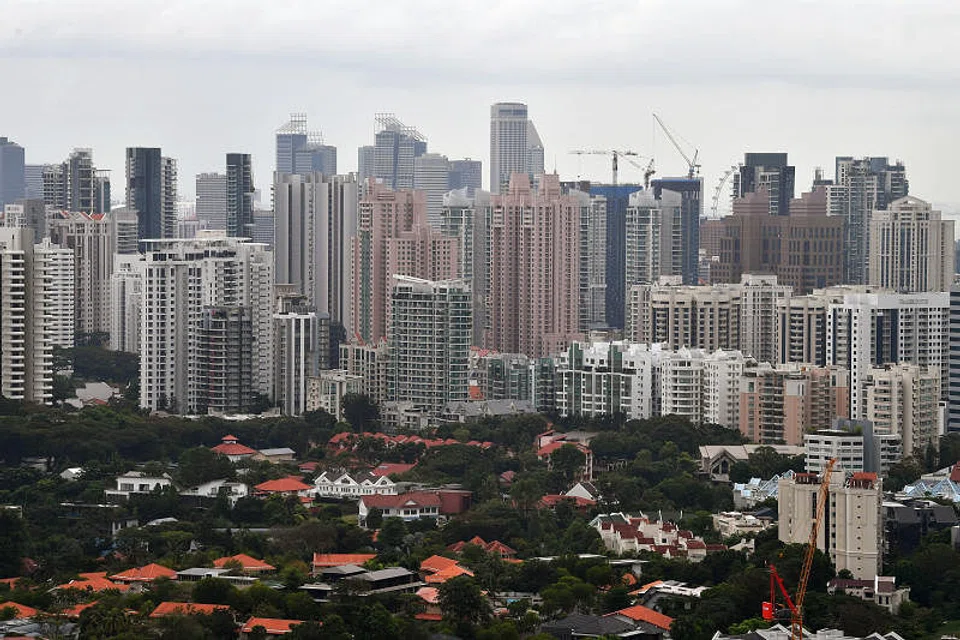
PROPERTY analysts continue to debate the odds of cooling measures and how targeted they would be, with Singapore's Q2 private home prices rising for the fifth straight quarter, flash estimates showed on Thursday.
It comes too as Singapore's central bank flagged this week that it is watching closely the risk of runaway housing prices, relative to income gains.
Conversations resurfaced after the Urban Redevelopment Authority (URA) released flash figures, which estimated that the overall residential price index in Q2 2021 rose by 0.9 per cent for the second quarter from Q1 2021. The quarter's gain comes after Q1 2021 saw a 3.3 per cent rise.
For the half year, prices increased by 4.3 per cent. Meanwhile, they rose 7.3 per cent compared to Q2 2020, when the "circuit-breaker" period began on April 7 last year, noted Mark Yip, chief executive officer of Huttons Asia.
Noting the Monetary Authority of Singapore (MAS) managing director Ravi Menon's speech on Wednesday, Mr Yip suggested that property curbs "remain a possibility".
During the launch of the MAS's annual report, Mr Menon noted that the property market is not considered overheated at this juncture. But MAS remains "highly vigilant" to the risk of a sustained increase in housing prices relative to income trends, with a prolonged divergence seen as unsustainable
Mr Yip said: "Cooling measures are likely to be targeted at a certain group of buyers, such as multiple home owners with higher ABSD (additional buyer's stamp duty) or lower LTV (loan-to-value) or couples who decide to buy multiple homes to encourage prudence."
In a report, Citi analyst Brandon Lee said the "benign" 0.9 per cent rise in Q2 2021 private property prices was a surprise, given the strong residential sales momentum.
"Living a day at a time," said Mr Lee. "Given the slate of launches in Q3 2021, incremental re-opening activity post pickup in vaccination roll-out and strong HDB resale prices, we expect market to continue focusing on policy risk in the near term."
The tightened restrictions during Phase 2 (Heightened Alert), which took place from May 16 to June 13, contributed to the slower growth pace in Q2 2021, analysts said.
The 3.3 per cent rise in Q1 2021 was the sharpest quarterly increase since the second quarter of 2018, when private residential prices rose by 3.4 per cent.
Mr Yip said that the additional measures deterred some developers from launching new projects, pushing buyers to turn to the resale market, which is typically tagged with lower prices. Resale volume made up a bigger chunk of the transactions in Q2 2021 at 61.1 per cent, compared with 57 per cent in Q1 2021, he added.
Christine Sun, senior vice-president of research and analytics at OrangeTee & Tie, said that the trend towards larger homes may have resulted in lower per square foot prices for some locations.
"Space has become a valued asset as many homeowners saw their daily lives suddenly confined to their properties. Many owners were looking for homes with outdoor space and additional areas for solitude," she said.
She expects demand to remain resilient, backed by strong job creation in the first half of the year, a "flood" of Housing Development Board (HDB) upgraders, as well as local and foreign investors looking for long-term rental income.
Leonard Tay, head of research, Knight Frank Singapore, said given the Q2 2021 flash estimates, overall private residential prices now looks to increase by more than 5 per cent year-on-year, but but will not likely surpass 10 per cent for all of 2021.
"The proceeds from the resale of HDB flats have enabled households to make that transition into the private residential market, especially if these are families comprising young professional couples who have benefited from general wage increases in the past decade as reflected in the Population Census 2020," he said.
Mr Tay noted that the proportion of resident households earning S$20,000 and over more than doubled from 6.6 per cent in 2010 to 13.9 per cent in 2020.
"Notwithstanding the pandemic-led recession in 2020, the present resilience of the private home market comes at a time when the current low interest rate environment is also a contributing factor as credit remains affordable."
In non-landed property, the three months saw a 0.9 per cent quarter-on-quarter (qoq) rise after climbing 2.5 per cent in Q1.
The quarter's largest driver of prices was in the suburbs or outside central region, which saw prices advance 1.8 per cent, steeper than the first quarter's 1.1 per cent increase.
This was likely due to the performance of executive condominiums - such as Provence Residence, Parc Central Residences and Ola - as well as Treasure at Tampines, which has consistently been in the top 10 best-selling projects list since its launch in 2019, said Tan Tee Khoon, country manager of PropertyGuru Singapore.
"There is still a strong demand for affordable entry-level condos, likely fuelled by the market of HDB upgraders whose flats recently fulfilled their Minimum Occupation Period in 2020 and 2021," he added.
In the city fringe or rest of central region, prices increased 0.3 per cent qoq, compared to 6.1 per cent in the previous quarter.
Meanwhile, prime areas or core central region saw prices advance 0.6 per cent in Q2, close to the 0.5 per cent growth seen in Q1.
The URA also said that prices of landed properties rose 0.8 per cent qoq in Q2, after they scaled 6.7 per cent in the previous quarter.
The flash estimates are compiled based on transaction prices given in contracts submitted for stamp duty payment, and data on units sold by developers up to mid-June. The statistics will be updated on July 23, when the URA releases its full set of real estate numbers for the second quarter.
Still, when the full Q2 2021 results are announced, it is more likely that the marginal gain in the property index will be fairly similar to the flash estimates, said Knight Frank's Mr Tay. This is due to the lack of new launches in June 2021, as a result of safe-distancing restrictions.
Separate flash estimates released on Thursday showed that HDB resale prices climbed for the fifth consecutive quarter but eased from recent highs.
Resale prices rose 2.8 per cent in the three months to June this year from the previous quarter, compared with a 3 per cent rise in the first quarter.
Year on year, HDB resale prices were up by 10.8 per cent.
READ MORE: Are property curbs looming?
TRENDING NOW
Grab CEO’s wife Chloe Tong on life with Anthony Tan and finding her purpose
Three ex-employees of Envy group join Ng Yu Zhi in bankruptcy
He built the Vingroup empire. Now South-east Asia’s richest man is handing some key roles to his sons
If AI has a one-in-five chance of destroying us, what do we do with the remaining four?