Are the days of Singapore’s en bloc fever over?
Last year saw just four completed collective sales and a success rate of 25 per cent

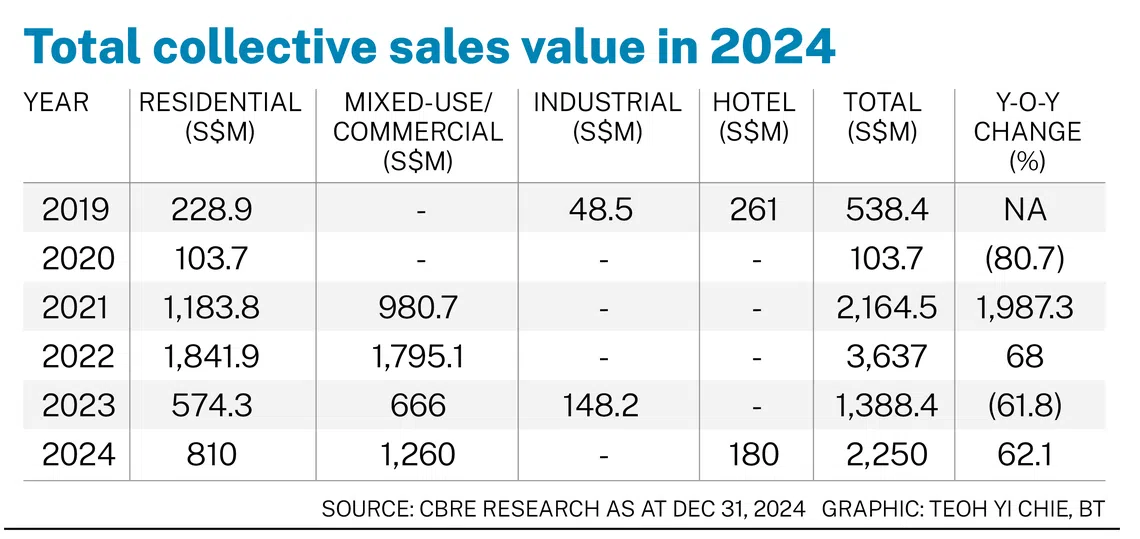
IT WAS yet another quiet year for the collective sales market in 2024, with four successful deals out of just 16 properties put on the market – half of 2023’s 32 properties.
Market watchers noted a prolonged drought in the market, particularly for residential en bloc deals as the mismatch in price expectations between buyers and sellers continued. All eyes have now turned to the commercial market, which appears to hold more potential for investors and developers with higher yields and greater demand.
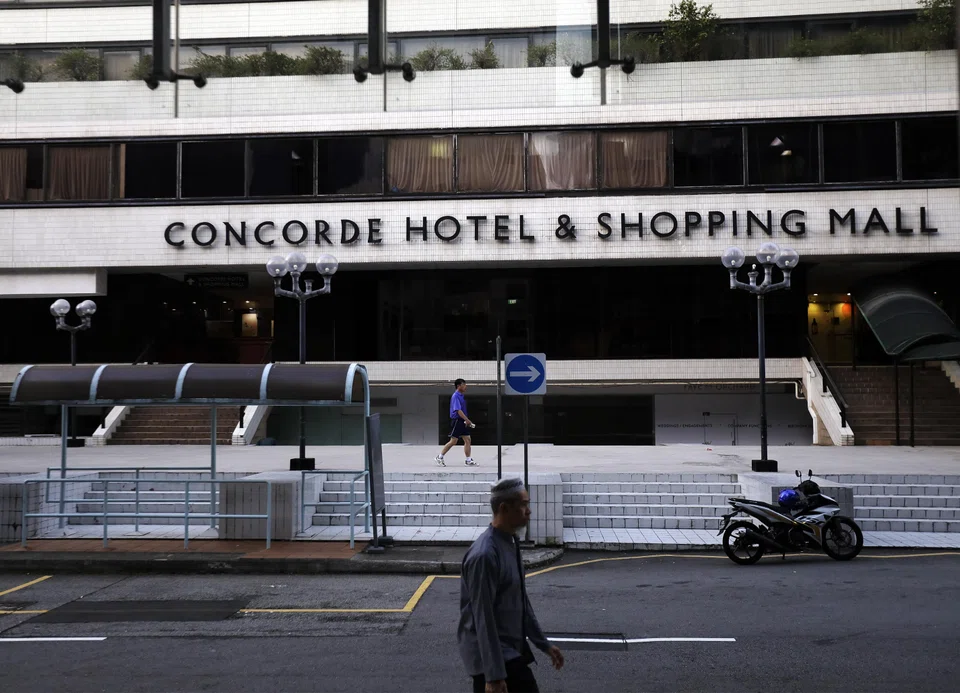
According to data crunched for The Business Times by real estate consultancy CBRE, some S$2.3 billion worth of residential and commercial collective sales concluded as at Dec 31, 2024. These include Concorde Hotel and Shopping Mall, which was bought out by majority-owner Hotel Properties Limited for S$821 million in November, making it the largest transaction of the year.
The sole residential deal – the sale of Thomson View Condominium – chalked up S$810 million and accounted for slightly over a third of all transactions at 36 per cent. Commercial deals – which include mixed-use and hotel sites – were valued at S$1.4 billion.
Other completed deals include that of Delfi Orchard for S$439 million in May, and Katong Plaza for S$180 million in October. Overall, the market saw a dismal success rate of 25 per cent in 2024. A S$678 million deal for High Street Centre fell through on a missed payment deadline, while the S$1.3 billion Roxy Square site found no takers.
2023 saw a similar success rate, with 25 per cent of sites – eight out of the 32 that were put on the market – sold. In the year before that, about 33 per cent or 12 properties were sold out of 36 put up for sale.
Chia Mein Mein, Knight Frank Singapore’s head of capital markets for land and collective sale, said momentum in the collective sale market has been slow since late 2022, coinciding with the rise of interest rates. “When coupled with owners’ high price expectations as well as the increased cost of development, activity in the collective sale market was muted.”
The highest point in the latest cycle in 2022 was just S$3.8 billion, less than half of the last peak in 2018 at S$10.7 billion, noted JLL executive director of capital markets Tan Hong Boon.
En bloc activity was further curbed by cooling measures as well as the government’s harmonisation of floor-area definitions, which reduced the amount of saleable area for developers, said Cushman & Wakefield capital markets senior director Christina Sim.
Developers consequently adopted cautious bidding and land banking strategies, which has continued to this day even with a potential uptick in appetite, she said.
Tricia Song, CBRE head of research for South-east Asia, added that the tightening of the total debt servicing ratio threshold and higher medium-term interest rate floor eroded buyer demand further.
“Developers preferred to replenish their land banks through the Government Land Sales (GLS) programme instead, given the greater certainty of deal completion and pricing discretion,” she said.
At the same time, the government has made available more attractive sites under the GLS programme, with even more up for grabs in the coming year, said Jeremy Lake, Savills Singapore managing director of investment sales and capital markets. This has diverted attention away from the en bloc market.
The latest GLS programme for the first half of 2025 will see the release of enough land for 5,030 private homes, including executive condos, similar to the 5,050-unit supply for the H2 2024 confirmed list.
State land sales totalled S$8.8 billion in 2024, up 13.1 per cent from 2023’s full-year figure of S$7.7 billion.
Turning tides
The sale of Thomson View condominium in late November sparked speculation about a potential revival of en bloc activity, especially as buying momentum returned to the home sales market.
But analysts reckoned that the sale is unlikely to signal a change in tide, given the challenging currents that remain.
In the case of Thomson View, Colliers research head Catherine He noted that the development had been on the market for a long time and gone through multiple en bloc attempts.
“It was a matter of time before it got transacted, (and) it only attracted renewed interest from developers with its lower offer price,” said He. The price tag of S$810 million was nearly 12 per cent lower than the original asking price of S$918 million.
Knight Frank’s Chia said some investors and developers have turned their eyes towards commercial and mixed-used developments for a higher chance of success.
These sectors provide opportunities for diversification and potentially higher yields and margins, said He.
Song from CBRE said developers also have more confidence in undertaking the redevelopment of commercial sites, thanks to improvement in indicators such as retail sales, as well as eased border and domestic restrictions.
“However, even in non-residential sectors, prized assets are often tightly held in Singapore,” said Chia. “Often, premiums are required to pry properties from their current owners.”
JLL’s Tan added that save for the sale of Concorde Hotel and Shopping Mall last year, the transaction volume for hotel and industrial en bloc deals remains relatively small.
Sim of Cushman said even though investor interest may have diversified across markets, the shift of development capital from residential to commercial or industrial projects is likely to be limited.
This is partially due to the specialised expertise and experience required for each distinct property type, said Sim. “Commercial, industrial, and hotel developments are usually built with the intention of generating recurring income (except for properties where strata sale is feasible), unlike private residential projects which are typically developed for sale.”
Mixed expectations
Still, there are some bright spots ahead, market watchers said.
Chia believes that smaller residential projects with good real estate attributes will continue to draw interest, although owners should “realistically evaluate the asking price for a sale to materialise”.
Developers may continue favouring commercial sites, said Lake. “(But) if developers’ costs start to fall significantly, they may be willing to pay higher prices for residential collective sale sites which could narrow the ‘price gap’ and facilitate more successful collective sales.”
A major property on the market would be the District 15 site Roxy Square. “The owners are currently in the midst of signing a supplemental agreement to lower the reserve price to the level in line with current market value so as to attract competitive bidding from developers,” said JLL’s Tan
He from Colliers expects more interest in the industrial market with its higher yields, as well as the data-centre segment, which has been drawing the most attention with tight vacancies and high demand.
For the collective sales market to fully recover, He said property prices have to correct so that the replacement cost for sellers is not too high, and the supply of GLS sites should be limited.
Construction and labour costs must also ease to improve margins for developers, and some cooling measures lifted to strengthen demand from both local and foreign buyers, said He.
Still, Tan emphasised that collective sales will always play a supplemental role to the supply of land by the government.
“While we may not expect an ‘en bloc fever’ this year or the next, the future market may still potentially move unexpectedly fast, and the supply of sites may then fall short to open up a window of opportunities for collective sale sites.”