

Budget 2026: HDB to roll out 60-storey BTO blocks in plan to ‘build more, faster, higher’
Pearl’s Hill BTO in Outram will have tallest HDB in Singapore; fresh supply to be injected into Toa Payoh starting with Caldecott BTO

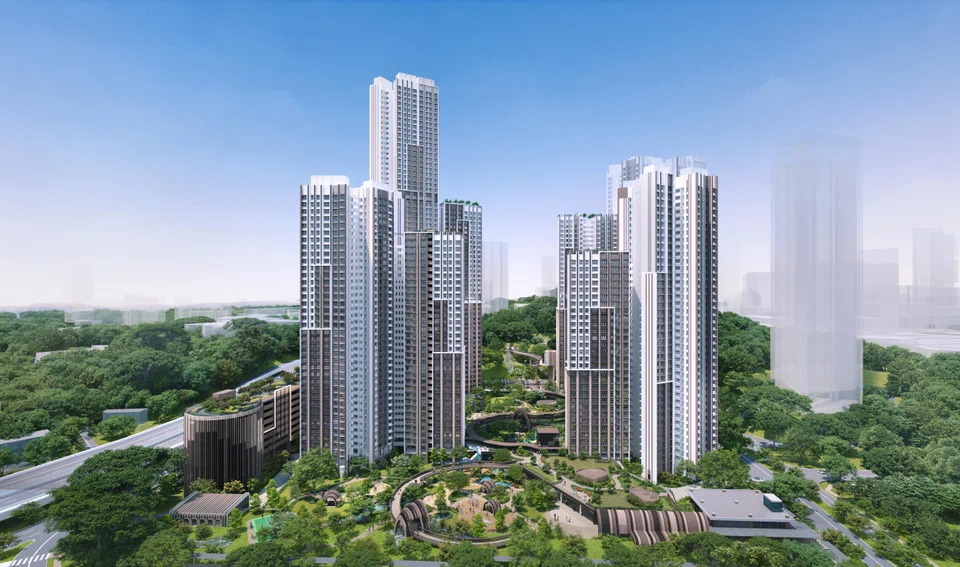
[SINGAPORE] The government is scaling up its public housing building programme with plans to “build more and build faster” as well as much taller, to expand supply ahead of growing demand for homes.
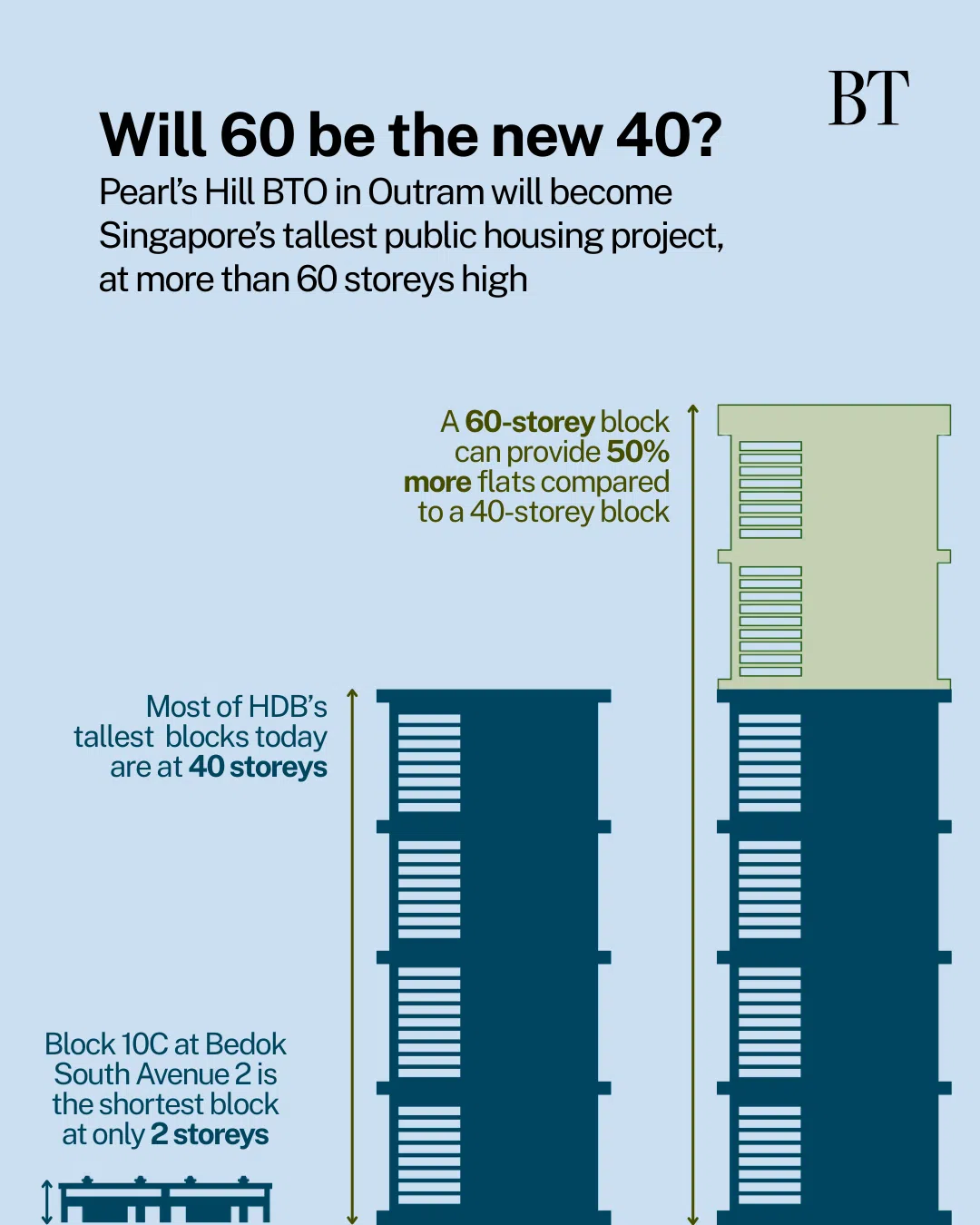
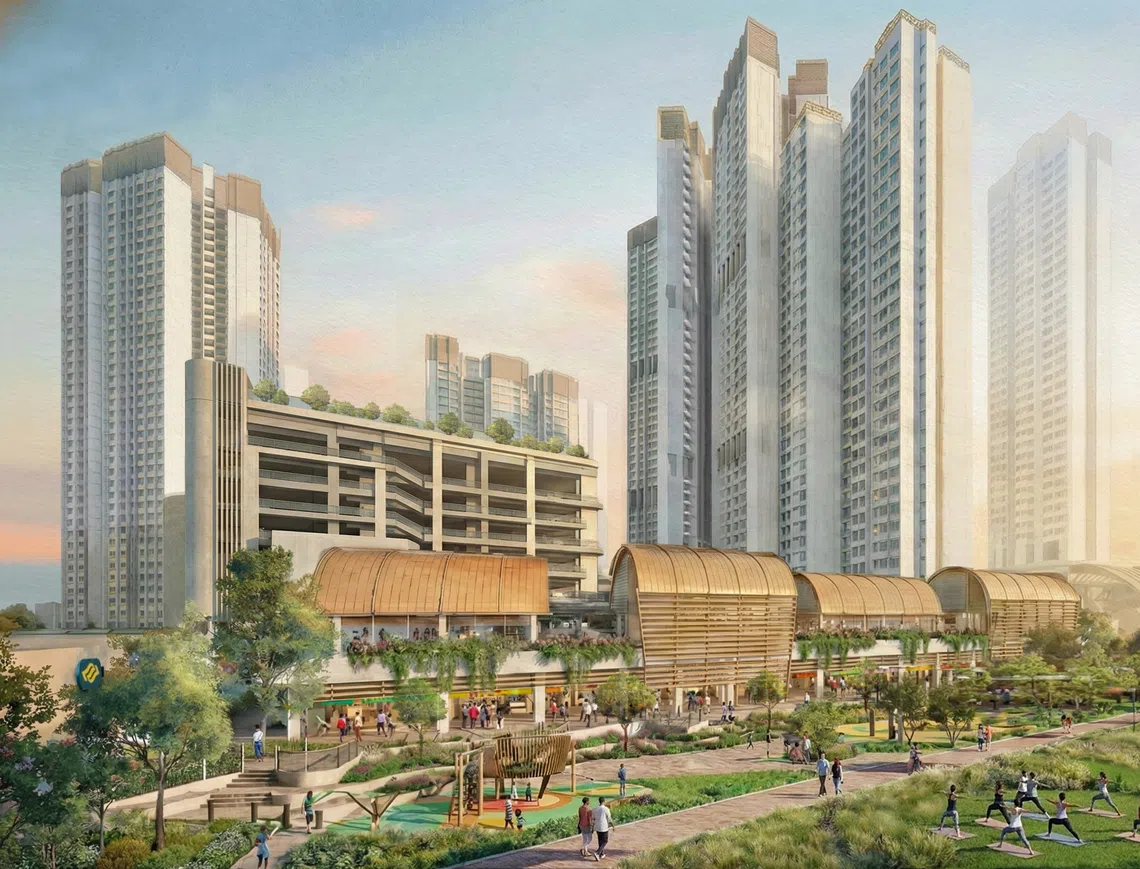
The push upwards will start with an over-60-storey block in a Build-To-Order (BTO) project at Pearl’s Hill in Outram, which will become Singapore’s tallest public housing project.
The block can provide 50 per cent more flats compared with a 40-storey block, the height of most of the city’s tallest Housing & Development Board (HDB) blocks today.
“This is part of our efforts to find ways to build more public housing, by intensifying land usage and building taller where possible,” said Minister for National Development Chee Hong Tat during the ministry’s Committee of Supply debate on Wednesday (Mar 4).
While application rates for first-timer families in line for a BTO flat have fallen, demand from singles and seniors continues to far outpace the supply of new flats available to these groups.
The numbers “reflect the continued strong demand for public housing and why we need to sustain a robust supply in the years ahead”, said Chee.

HDB will launch around 19,600 BTO flats this year – about the same level as 2025. The government is also increasing the two-room flexi supply by almost 50 per cent from 2026 to 2028, to meet growing demand from seniors and singles.
With expanded supply and four rounds of cooling measures, home prices have moderated.
Chee said that “as at mid-February, HDB resale prices for 2026 have shown a slight decline of 0.1 per cent”. In 2025, resale flat prices rose 2.9 per cent, significantly less than their 12.7 per cent gain in 2021. Private residential prices have similarly moderated, registering their smallest increase in prices since 2020.
SEE ALSO
In his speech, the minister addressed calls by MPs to increasing the income ceiling for BTO flat purchases and lower the eligibility age for singles to buy HDB flats, saying the government is reviewing policy.
As a higher income ceiling will result in more applicants, “we will need to ensure supply is adequate before making these changes”.
New flats in old towns
The Pearl’s Hill BTO flats – to be launched within the next few years – will be more than 10 storeys taller than The Pinnacle@Duxton, which has 50 floors and is currently the tallest public housing project in Singapore.
Regulatory changes to aviation height restriction requirements around airports allow for taller buildings near airports and in flight paths. The relaxation of rules could allow buildings in different areas to be built potentially up to 15 storeys more for residential buildings and up to nine storeys more for industrial and commercial buildings.
“With these regulatory changes and our experience in Pearl’s Hill, HDB will find more opportunities to build taller flats across Singapore,” said Chee.
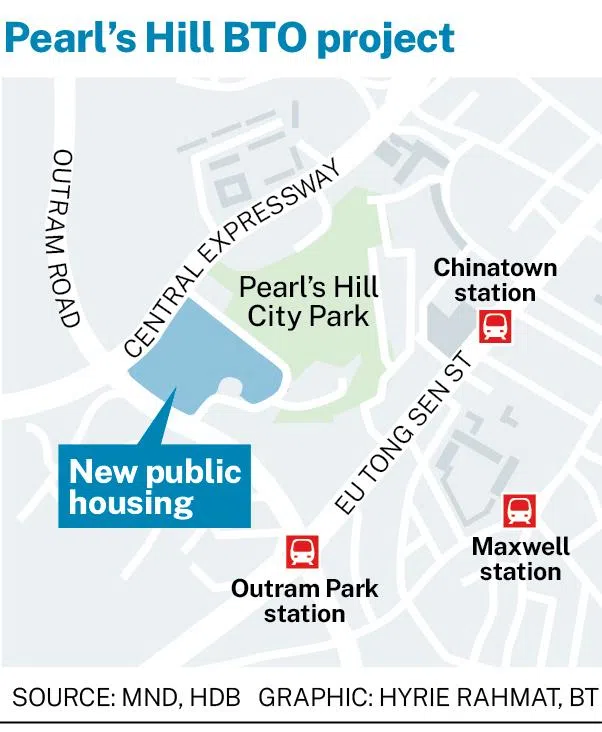
Located adjacent to Outram Park MRT station, the Pearl’s Hill project will comprise about 1,700 two-room flexi, three and four-room units, and more than 140 public rental flats. It will be the first public housing project to be launched in the area in more than four decades. The development is part of efforts to renew and rejuvenate older towns.
HDB also plans to inject fresh supply in Toa Payoh, “the first town to be comprehensively planned and built from scratch in the mid-1960s”, said Chee.
A new BTO project next to Caldecott MRT station will be launched in October 2026. With about 1,600 units across five blocks, including 590 two-room flexi units, 580 four-room flats and 230 public rental flats, it will add to the 4,500 new homes introduced in Toa Payoh in the last 10 years.
The new project will include 240 units of Community Care Apartments for seniors.
A new mixed-use development in Toa Payoh West, combining private residential units, retail and community uses will also be built, said Chee. This will include a shopping centre of similar scale as Woodleigh Mall in Bidadari. Woodleigh Mall, which opened in November 2023, spans three storeys and has about 206,000 square feet of net lettable area.
In all, the government will launch more than 10,000 new public and private housing units across Toa Payoh West and Mount Pleasant.
From the June 2026 BTO exercise onwards, the Third Child Priority Scheme (TCPS) allocation quota will be raised from up to 5 per cent to up to 10 per cent. Families expecting their third child will also be eligible for the priority allocation scheme. From 2020 to 2024, more than 2,800 BTO applicants tapped the scheme.
Relooking income ceilings
Workers’ Party MP Pritam Singh suggested that HDB remove the income ceiling for Plus and Prime flats entirely, in view of additional restrictions imposed on these flats. HDB currently sets a S$14,000 income ceiling for a couple looking for a BTO flat, and a S$16,000 threshold for executive condominiums (ECs).
Singh asked whether HDB would consider allowing first-timer couples who exceed the income ceiling to purchase a new BTO flat, subject to conditions.
Chee replied: “With the New Flat Classification framework, the income ceiling is still necessary to ensure that highly subsidised BTO flats are prioritised for those who are earning below the income ceiling, as higher-income earners can access other housing options.”
He added: “We need to understand what are the trade-offs, including that after we remove the income ceiling there will be additional competition coming from those with higher incomes who have exceeded the income threshold, for the buyers whose income fall below the income eligibility threshold.”
Review of EC policy
MPs’ also raised concerns over the affordability of ECs, introduced in 1995 as a public-private hybrid to cater to a higher-income segment who may not be able to afford private property.
Workers’ Party MP Louis Chua pointed out that the median price of EC units stood at S$1,754 per sq ft in 2025, 14 per cent higher than the S$1,537 psf in 2024 and more than double the S$797 psf recorded in 2015.
Chua said that the prices of EC units had “skyrocketed” in the past 10 years. In 2024, the average price of an EC unit was S$1,531 psf, 154 per cent higher than that of an HDB resale flat at about S$603 psf. In comparison, the average price of an EC unit in 2016 was S$782 psf – 84 per cent over the average S$424 psf for an HDB resale flat.
Market players have previously proposed various ways to improve affordability in the face of rising new EC prices, such as raising the income cap and tweaking the mortgage limit for EC purchases.
Minister Chee noted that broadly, prices of new EC units are about 20 to 30 per cent lower than comparable private condos, and eligible buyers can tap a grant of up to S$30,000.
He acknowledged MPs’ concerns, saying: “We are reviewing the policy and we will consider your suggestions as part of the review.”
Compensation for Vers
MPs Henry Kwek and Xie Yao Quan spoke on the Voluntary Early Redevelopment Scheme (Vers), where older HDB towns will be progressively redeveloped, focusing on fair compensation for flat owners.
Flats acquired under Vers would be around 70 years old, with about 29 years or less remaining on their leases, and their market value would be modest, said Xie.
This may be insufficient to match the price of a replacement flat of a similar type with a lease that lasts the homeowner until at least 95 years old, he noted. Affected homeowners – likely to be seniors and no longer working – would have to make a cash top-up.
Xie urged the government to consider structuring the baseline Vers compensation package such that affected homeowners would not need to top up cash for a replacement flat. “This effectively means that the government may have to come in and subsidise the cash top-up for affected homeowners instead,” he said.
Such a scheme would require the government “to pay a premium beyond market value of leases to achieve fairness for current affected homeowners”.
To justify the additional public spending, Xie suggested recognising that there is a fair cost to orderly urban renewal, including the cost of relocating and resettling lives.
Chee told Parliament that the government plans to start with a few sites in the first half of the next decade, before scaling up the programme from (the) late 2030s. It aims to flesh out as much of the Vers policy framework as possible in the current term. “When we are ready with our initial proposals, MND and HDB will engage Singaporeans to take in further views and feedback, before we firm up the policy,” Chee said.
MPs Ang Wei Neng and Cai Yinzhou asked about the 15-month wait-out period for private property owners to purchase resale flats.
The minister said: “While the recent data looks promising, it is prudent to monitor for a while more before making any adjustments. We will remove this restriction when conditions allow.”
Decoding Asia newsletter: your guide to navigating Asia in a new global order. Sign up here to get Decoding Asia newsletter. Delivered to your inbox. Free.
Copyright SPH Media. All rights reserved.
TRENDING NOW

LTA proposes combining car COE categories, adding rebate-surcharge system

StarHub to acquire MyRepublic’s mobile business amid ongoing telco consolidation

DBS, OCBC, UOB rout lops billions off STI as inflation, rate concerns spook investors

Grab CEO’s wife Chloe Tong on life with Anthony Tan and finding her purpose

