

A butterfly landing on Orchard: PLP Architecture blends sustainability with design
Its concept for Park Nova condo is based on a ‘very simple set of logical principles’, says co-founder of London-based firm

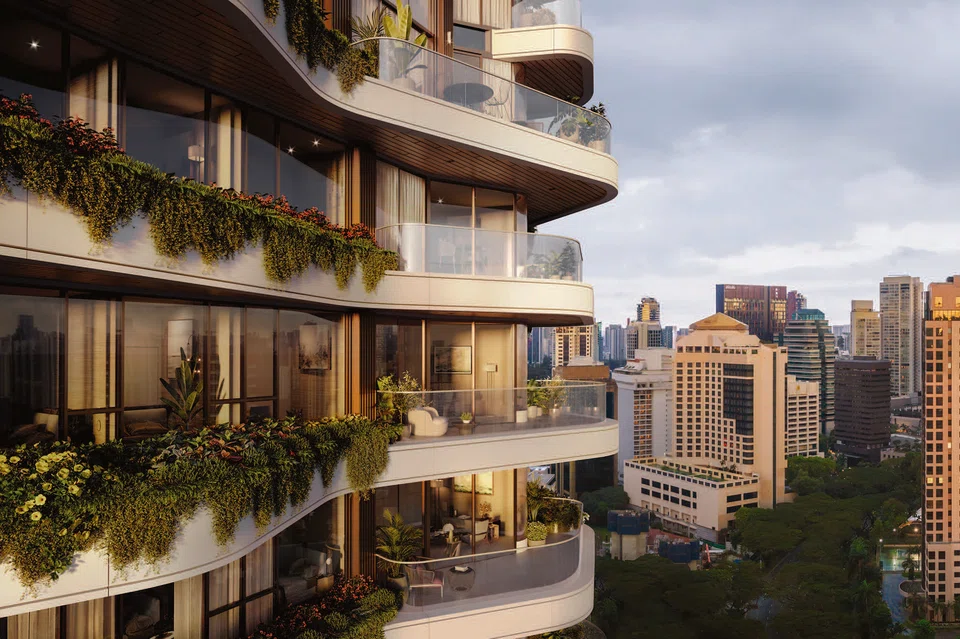
[SINGAPORE] When London-based PLP Architecture designed luxury condominium Park Nova in Tomlinson Road, the concept that its co-founder Lee Polisano had in mind was of “a butterfly landing on an orchard with its wings fluttering”.
This was a tribute to Orchard Road’s history as a home to nutmeg plantations, Polisano said in an interview with The Business Times. The butterfly effect was created by having the building’s balconies and terraces curve outwards.
He said: “We wrapped a set of balconies around the building, and we varied them from floor to floor so that they create light and shadow, which has the benefit of creating comfortable and sheltered environments for the units above and below...
“It’s a very simple set of logical principles, and it’s just what we have applied in a beautiful way.”
The distinctive curves of the building were achieved as a result of PLP Architecture extending the planters in some parts of Park Nova by up to 3 metres, which was made possible after obtaining permission from the Urban Redevelopment Authority (URA).
Communal planter boxes typically have a maximum width of 1 m for them to be excluded from the gross floor area of the building.
“The URA allowed us to do this because they saw the benefit of the biophilia introduced,” shared Tina Qiu, director at PLP Architecture.
She added: “Everything is very green and lush in Singapore, so we wanted to make sure the ‘butterfly’ held all these plants at every level.”
Qiu noted how the Orchard Boulevard area where Park Nova is located in is dominated by residences.
“There are more opportunities to integrate (a) ‘work’ element (with the concepts of) ‘play’ and ‘live’, which are predominantly what we associate with the Orchard area,” she said.
“Introducing further office use will introduce a wider mix of profiles into the area, increasing the diversity of activities.”
PLP Architecture is currently working on Bankside Yards, the first large-scale, fossil fuel-free, mixed-use development in the UK. It is backed by an international consortium including Temasek and Hotel Properties Ltd.
The 2.2-hectare development is located in the heart of London, in the vicinity of cultural institutions such as the Tate Modern and Royal Festival Hall. The residential-led project also includes offices, cultural and retail spaces, as well as leisure amenities.
Bankside Yards comprises eight buildings and eight public spaces designed to serve the community and support entertainment activities, added Polisano.
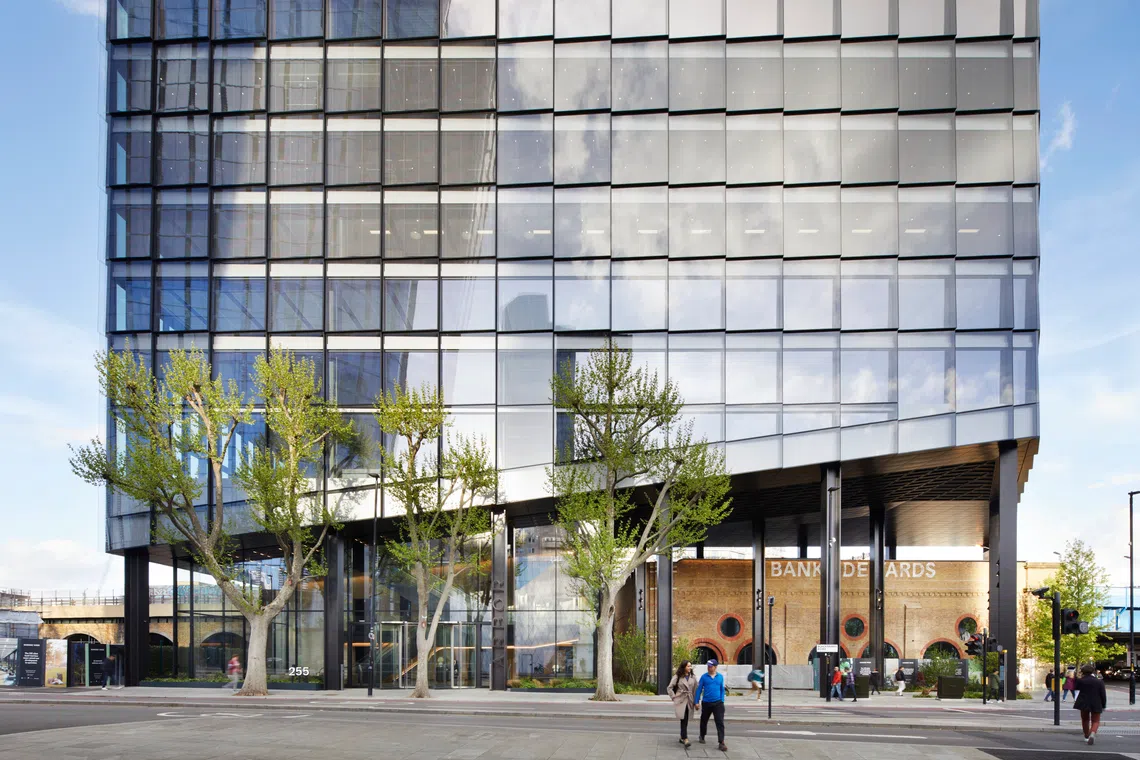
Arbor, a 19-storey office tower, was completed in April 2023 – the first in the development to be finished.
The building, which is carbon-neutral in operations, draws on energy generated from renewable sources, said Qiu.
A heat-transfer system will allow excess heat generated by Arbor’s offices to heat up water at Opus, a 249-unit residential building in Bankside Yards that is set to be completed in 2027.
Sustainability is increasingly on the minds of developers in Singapore as well.
Qiu noted: “We see that Singapore is putting more priority in terms of the reuse of existing buildings. We see more questions being asked by people who approach us (for) new projects (about) whether we can reuse part or some of the building.”
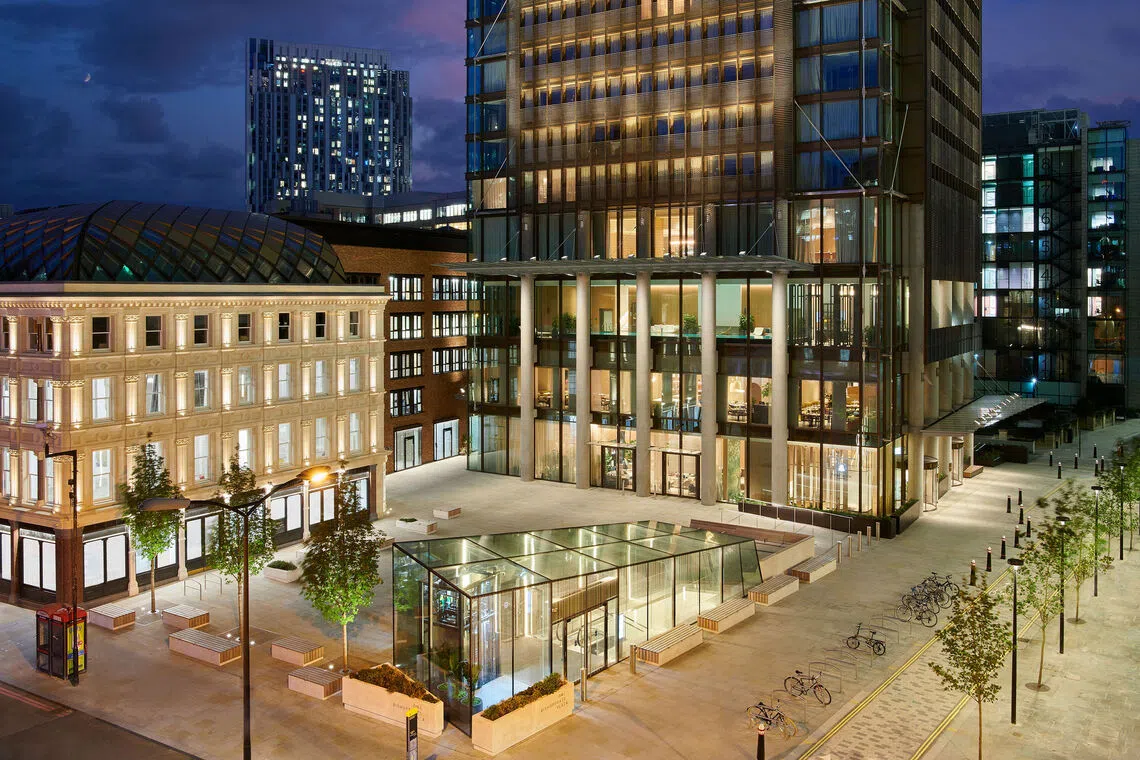
For One Bishopsgate Plaza, a mixed-used development by UOL Group, PLP Architecture refurbished and extended Devonshire House, a Victorian building next to the new Pan Pacific London hotel.
Using scanning and imaging techniques, Devonshire House was restored, with the “ornate details redrawn and rebuilt and recarved”, Qiu said. The building now houses a mix of retail and food and beverage offerings.
An eye on circular economy, bio-based materials
However, it may not always be possible to reuse older buildings, pointed out Polisano.
He said: “Throughout most of the world, in the 60s, 70s and 80s, the quality of buildings that people built was reasonably poor, because the world was coming out of a global war. Most economies needed to build quickly (and) populations were growing...
“Demolishing has an impact on the environment... but keeping a building that has a poor internal environment, low ceilings, uncomfortable feeling, poor daylight, (is) difficult to control climate-wise... has an impact on the people that use it.”
Still, there are ways to demolish buildings sustainably.
Polisano said: “For example, we (did) a project in London where the materials (from) the demolishing (went) back into the circular economy.”
He was referring to PLP Architecture’s fit-out of its studio in London, which reused 92 per cent of all materials from both the firm’s previous office and the new space. This resulted in a 75.4 per cent reduction in embodied carbon.
Material samples and fragments from PLP’s past projects were repurposed into terrazzo worktops, while sofas were reupholstered and wooden chairs reused.
He added: “When in the future we talk about demolition, we should talk about how, at the very least, that material can go back into the circular economy.”
PLP Architecture’s research lab is also working on developing and testing the application of new bio-based materials, such as mycelium.
The team has been testing the material’s acoustic performance, structural properties and fire resistance.
“At the moment, they have proved the use case for using mycelium in lightweight, temporary structures, such as those at exhibitions, festivals or possibly emergency shelters. More research needs to be done to explore possible uses as a more permanent construction material and for buildings of scale.”
The firm is already incorporating these materials in some of its projects. Tree House, a mixed-use building in Rotterdam, the Netherlands, will have a facade made from materials including bioresin, which is derived from agricultural waste.
Polisano said: “We have to look at materials that come from nature. Those kinds of (materials) need to be brought in at scale. But to do that, you need money, and you need a market for it.”
TRENDING NOW

Malaysian king buys stake in Singapore-listed mining firm expanding into rare earths

Grab CEO’s wife Chloe Tong on life with Anthony Tan and finding her purpose

Once staunchly pro-China, Malaysian Chinese businesses are now distancing themselves from Beijing

Longer wait times expected as S’pore healthcare institutions report system disruptions

