CapitaLand Development bets big on food with launch of Gourmet Xchange facility in Kallang
The ‘unconventional’ hub should generate relatively stable returns, says its Singapore CEO

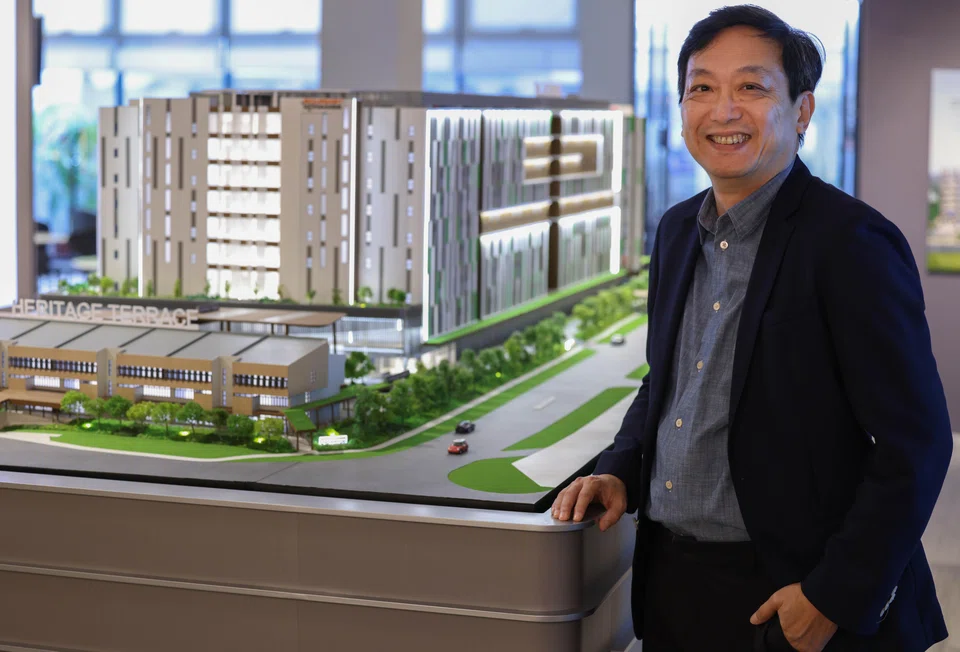
[SINGAPORE] CapitaLand Development (CLD) has set its sights on the food business, with plans to turn its huge new strata-titled food facility into an “unconventional food hub” catering to both end users and the wider community.
Indicative prices for Gourmet Xchange in the Kolam Ayer industrial estate start at S$2.3 million for smaller units of 295 to 393 square metres, and S$6 million for larger units spanning 570 to 758 sq m.
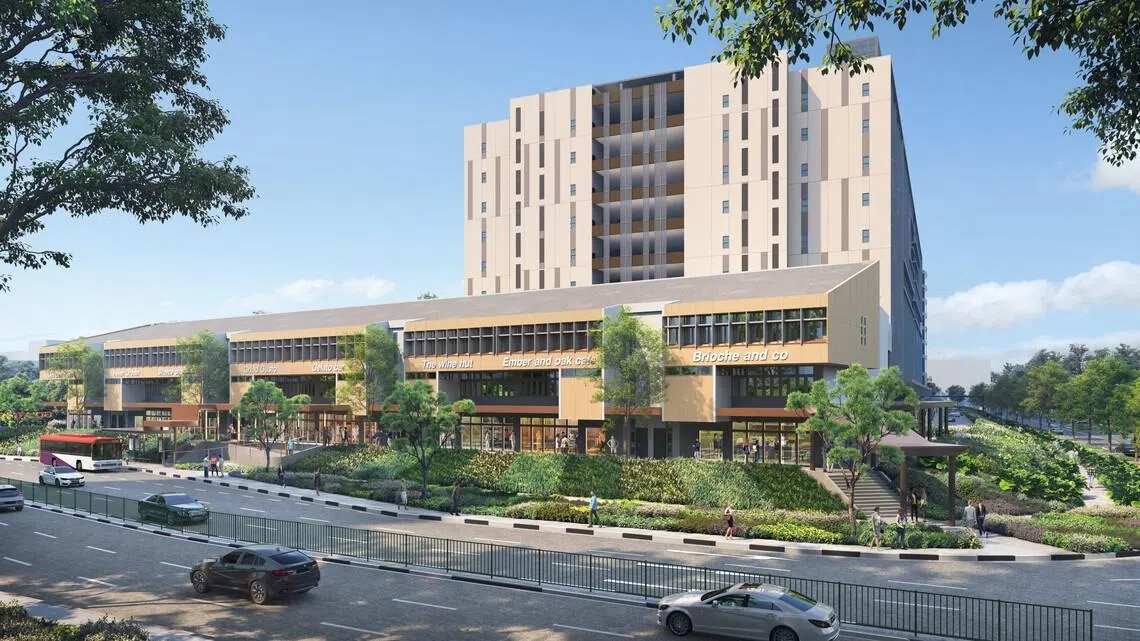
Located along Kallang Way in the city fringe, Gourmet Xchange is a nine-storey food factory on a massive 44,108 sq m site with a maximum gross floor area of 114,239.2 sq m, making it Singapore’s largest strata-titled food development.
The 33-year leasehold development comprises two clusters: the Xchange, a nine-storey block with 264 production and F&B units, and Heritage Terrace, a smaller wing with eight terraced units that adaptively reuse the original three-storey terraced factory built in the 1980s. This is the first industrial government land sales site with adaptive reuse.
The ground-floor units of the Heritage Terrace are set aside for restaurants, with the floors above zoned for Business 1 uses. These typically include clean and light industrial activities such as food logistics and packing.
There will be two other restaurants on site, along with six food kiosks and an industrial canteen.
CLD Singapore chief executive Ronald Tay told The Business Times that the project is well-suited to serve as a satellite food production hub for food businesses in the city centre, as well as operators in the eastern side of Singapore.
While this is not CLD’s first foray into the food manufacturing space, it has been several years since the group last launched a new project in the industrial sector.
It outbid three other contenders for the Kallang Way site in October 2024, with a top bid of S$368.9 million or S$300 per square foot (psf). This was about 16 per cent higher than the next highest offer.
CLD’s recent focus in Singapore has largely been on residential projects. “But when this opportunity came up, we liked the risk profile, and we liked the site,” said Tay. “We believe (Gourmet Xchange) can meet our hurdle rate, so that’s why we decided to invest in it.”
Apart from its relatively accessible location in the city fringe, a key selling point is the size of its units, which span from 295 to 758 sq m. Typical food factory units in Singapore run much smaller, ranging from about 150 to 200 sq m.
Smaller units are generally easier to sell, Tay acknowledged, but CLD saw a gap in the market for larger spaces that could support businesses’ expansion plans.
“As smaller companies grow, they often find there isn’t much product in the market to serve them,” he said. JTC offers larger units, but these are typically leased with three-year contracts.
Tay noted that many food businesses prefer long-term leases and outright ownership. These, he said, can provide “greater long-term cost stability and operational certainty” given the heavy capital expenditure required to fit out production facilities, such as exhaust systems and cold rooms.
“When a business fits out the unit, it would take about six to seven years to break even,” he explained. These assets are also difficult to relocate without losing their efficiency.
CLD sought to create an “unconventional food hub”, he added – onethat caters not just to businesses, but also the wider community. “More importantly, (we hope) it will set a new benchmark for what a forward-looking, future-ready food hub can be.”
Beyond residential
Tay said that CLD’s current industrial capabilities draw on the legacy expertise of Ascendas-Singbridge, which merged with CapitaLand in June 2019.
The group’s industrial projects include food factories and general industrial developments across Singapore, Malaysia, India and China.
Tay pointed to strong underlying demand for food factories.
“Even during (the Covid-19 pandemic), food facilities did not shut down... Through good times and bad, people need to eat,” he said. “So I think this industry, to some extent, is relatively more resilient from a cyclical perspective.”
New supply of food-related industrial space is also limited, he added, with much of the existing stock in older, “first-generation” facilities.
Tay declined to disclose a target internal rate of return for Gourmet Xchange, but said it is higher than what the developer typically expects from residential projects, given the segment’s riskier profile.
Given the current interest rate environment, CLD is “quite confident that we should be able to hit, if not exceed, our target”, he said.
He believes the project will also be attractive to investors. While a food hub is a “very specialised” type of industrial real estate, prospects are “underpinned by fundamental economic activity”, he said. “So I think it should generate relatively stable returns for investors.”
Elsewhere in its industrial portfolio, Tan said CLD has completed phase one of its Singapore Science Park redevelopment.
For the next phase, CLD is keen to introduce another one or two residential projects into the area, where the government is moving to better respond to evolving business needs.
“When the whole (estate) is fully rejuvenated, it will be around 75 per cent business park, about 20 per cent residential and the rest, commercial retail,” Tay said in an earlier interview. The area was previously fully zoned for business park use.
Tay said CLD was “actively engaging” with the authorities on the second phase of Science Park. “We hope to make some announcements soon.”
CLD will start booking sales for Gourmet Xchange on Mar 13.