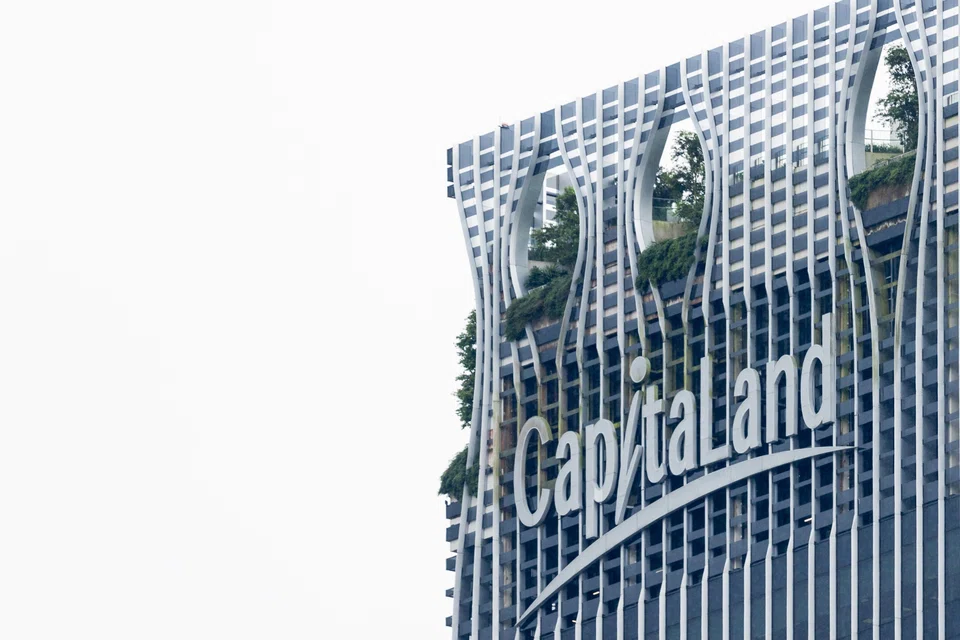
CapitaLand Investment sets sights on single flagship C-Reit to drive scale
In the longer term, it hopes to combine CapitaLand Commercial C-Reit with a second China Reit slated to list this year

[SINGAPORE] CapitaLand Investment (CLI) aims to eventually combine its two China real estate investment trusts, or C-Reits, into a single flagship vehicle as it builds scale.
The global asset manager listed its first internationally sponsored retail C-Reit, CapitaLand Commercial C-Reit, in September 2025, seeded by CapitaMall SKY+ and CapitaMall Yuhuating.
It plans to list a second commercial C-Reit in the second or third quarter of 2026, said Puah Tze Shyang, chief executive officer of CLI China, at the group’s annual general meeting (AGM) on Tuesday (Apr 28).
The second C-Reit will be seeded by two assets: Raffles City Shenzhen, a mixed-use development comprising retail, office and serviced residence components; and CapitaMall Fucheng, a retail mall in Sichuan province.
“If we are able to combine the two... subject to regulators’ guidance and support, we could have bigger scale and greater diversity across asset classes, and I think these are the factors that will lead to a more robust-performing C-Reit,” said Puah.
“The intention is to have a single flagship C-Reit that will allow us to recycle capital on some of our stabilised China assets.”
For the 2025 financial year, CLI’s earnings were at S$145 million, down 70 per cent from S$479 million in FY2024, due mainly to lower portfolio gains and higher revaluation losses on the group’s China portfolio.
Significant non-cash revaluation losses within its China portfolio pushed CLI’s full-year overall revaluation loss in FY2025 to S$439 million, widening from FY2024’s S$261 million.
CLI generated a return on equity (ROE) of 1.1 per cent in 2025. However, excluding China, ROE would have been about 6.9 per cent, improving from 6.7 per cent and indicating steady underlying progress, noted the group.
Portfolio optimisation efforts in China “remain a strategic priority” for CLI, it said in a bourse filing on Apr 23, responding to shareholders’ questions ahead of the AGM.
It added that its “domestic-for-domestic approach provides multiple pathways to progress divestments”, including C-Reits, renminbi-denominated fund structures and selective third-party asset sales, which allow the company to recycle capital while building fee-earning funds under management.
While China’s economy is recovering gradually, with gross domestic product reaching 5 per cent in Q1 2026, the recovery has been uneven across sectors, said Puah, noting that CLI’s greatest exposure is to commercial real estate.
Lee Chee Koon, the group’s CEO, said at the AGM: “There has been an oversupply of commercial real estate in various Chinese cities, and the challenge is more pronounced in the office and business parks segments.”
He added: “A lot of foreign companies are not expanding in China, and locally, some of the Chinese companies are taking a wait-and-see approach. However, retail, hotels and rental apartments are doing relatively well, and we are starting to see green shoots of recovery.”
CLI does not expect recent geopolitical developments to have a material direct impact on its China divestment plans, but prolonged tensions could affect global risk sentiment – which may indirectly influence transaction activity and pricing, the group said in its Apr 23 filing.