Central area retail rents, prices resume slide after short recovery

Singapore
THE Urban Redevelopment Authority's rental and price indices for retail space in Singapore's central region both resumed their downtrend in the second quarter after inching up briefly in the previous quarter.
Islandwide, the vacancy rate of retail space fell to 7.3 per cent as at the end of Q2 2018, from 7.5 per cent at the end of the previous quarter.
"The retail vacancy contraction in tandem with a sustained rental decline are telling of the sector's re-balancing act as retail landlords trade off historically high rents for more stabilised occupancy amidst challenging market conditions," said Colliers International's head of research for Singapore, Tricia Song,
URA's rental index of retail space in the central region slipped 1.1 per cent in the second quarter of 2018 over the previous three months.
This reversed a 0.1 per cent quarter-on-quarter gain in the previous quarter.
In all, the index has chalked up a decline of 17.1 per cent since its most recent peak in Q4 2014. Colliers' Ms Song, however, notes that the 4.7 per cent drop in the rental index last year marked a substantial slowdown from the 8.3 per cent decrease in the previous year.
"We expect the overall retail property market to stabilise over 2018 and 2019," she added.
CBRE's head of research for Singapore and South-East Asia Desmond Sim said that rentals from prime space at malls remain resilient from the fairly tight vacancies in this category.
"Any corrections in rental growth is likely to be attributed to the secondary areas and corridors. The need to fill up vacant space has tipped the balance between rental growth and occupancy," he added.
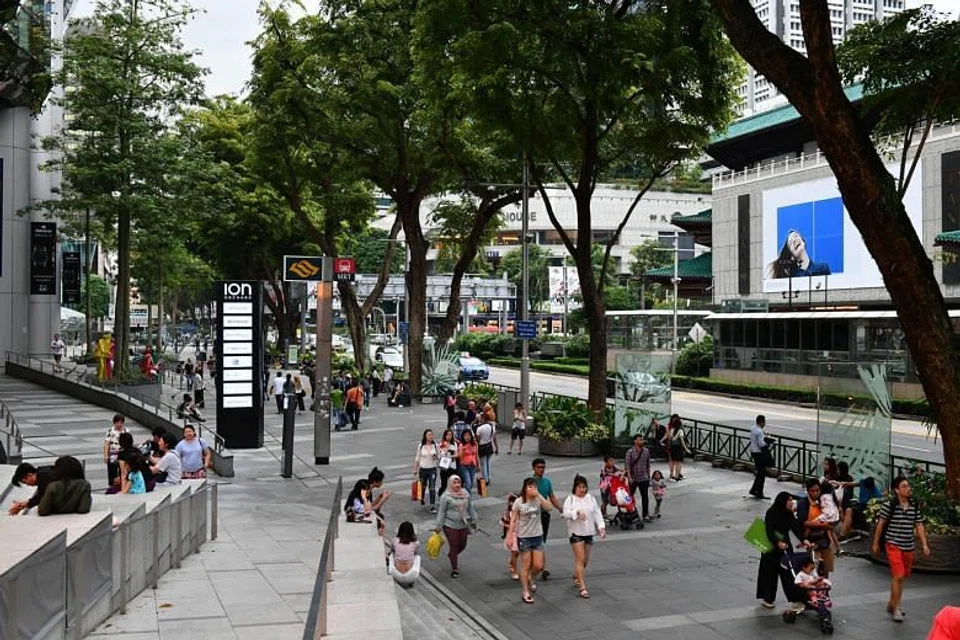
The vacancy rate for private-sector retail space in the Orchard Road planning area continued to display resilience, inching downwards to 5.6 per cent in Q2 2018 - the lowest in 14 quarters.
"This is possibly attributed to the lack of new supply introduced. At the same time, a growing tourism market will support the demand for Orchard Road space," Mr Sim opined.
JLL's head of research and consultancy for Singapore, Tay Huey Ying, highlighted that changing tenant profile and their location preference arising from the shift in consumers' shopping habits are also contributing factors to the continued softening of rents.
"For example, traditional fashion retailers are increasingly being supplanted by retailers of lifestyle and entertainment products and services such as gyms, even on prime spaces. These tenants generally take up large spaces and look for low rents."
She added that notwithstanding the steadier consumer sentiment amid healthier economic and employment environment, the growing online/omni-channel shopping culture is expected to see retailers approaching expansion with caution.
"Until consumers have a compelling reason to return to the physical brick-and-mortar retail shopping, mall rents are likely to stay competitive, especially in light of the large pipeline supply," Ms Tay argued.
URA's price index of retail space in the central region fell 1.3 per cent quarter-on-quarter in Q2 2018, after inching up 0.1 per cent in Q1 2018.
The islandwide supply pipeline has tightened, with projects as at the end of Q2 2018 due to add 498,000 square metres of gross floor area (GFA) of retail space, down from the 530,000 sq m GFA in the previous quarter.