

China's falling home prices cast another shadow over economy
The 0.08% drop in new-home prices across 70 cities in Sep may be small but it could hurt an economy that counts on property-related industries for almost a quarter of output
 Add BT as a preferred source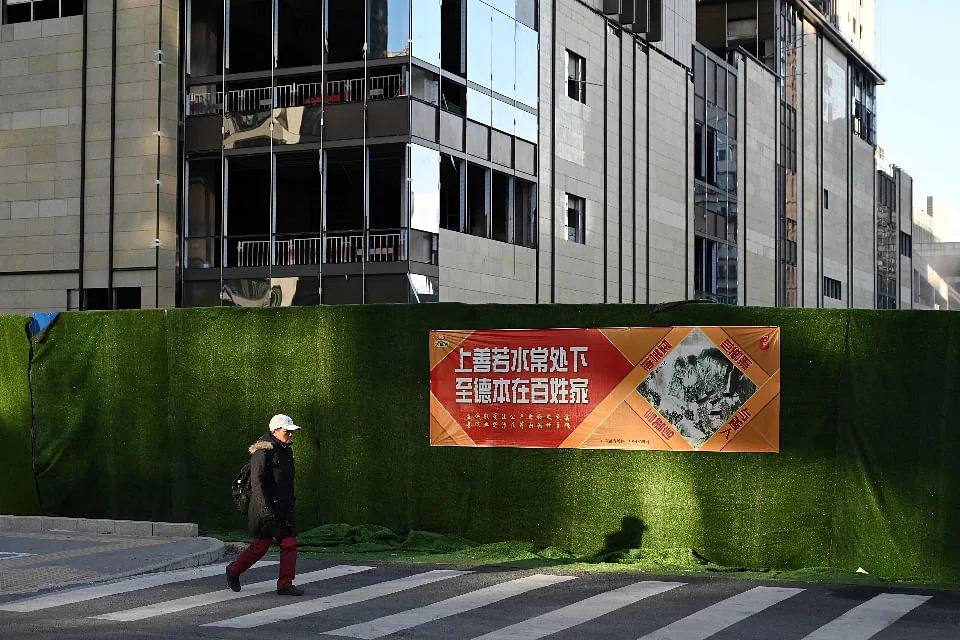
Shanghai
CHINA'S housing market slump has intensified in recent weeks as sales plunge and more developers default on their debt. Now the downturn has reached another milestone: home prices have begun falling for the first time in six years.
The 0.08 per cent drop in new-home prices across 70 cities in September may be small, but it poses a potentially big blow for an economy that counts on property-related industries for almost a quarter of output.
Homebuyer sentiment is evaporating as a crisis at China Evergrande Group ripples through the industry. With prospective buyers already wondering whether cash-strapped builders can deliver their apartments, the risk is that they may stay away in droves on fears that real estate is no longer a safe bet.
"Now the priority is to prevent a state of panic," said Yan Yuejin, research director at Shanghai-based E-house China Research and Development Institute. "The home market has clearly entered a downward cycle."
Developers are struggling with regulatory tightening that has helped to choke off fresh financing and made it harder to pay bills. Evergrande alone owes more than US$300 billion, and has yet to finish homes for 1.6 million buyers who put down deposits.
Navigate Asia in
a new global order
Get the insights delivered to your inbox.
The drop in confidence has affected people like Carl, a property investment consultant in eastern Hangzhou. He says the number of prospective clients tumbled around 90 per cent last month from the second quarter.
"Business is so light," Carl said, asking not to give his full name while talking about government policy. One customer "became less and less interested each time we called him, and later on he wouldn't even pick up our calls".
The real estate downturn is already hurting China's economy, which is also being dragged down by power shortages. Economic growth slowed in the third quarter as the property and construction industries contracted for the first time since the start of the pandemic.
September is traditionally a peak season for the home market. Yet residential sales tumbled 17 per cent, investments slid for the first time since early 2020, and the rate of failed land auctions climbed to the highest since at least 2018 - potentially hurting local government coffers.
Smaller cities, where the economy is weaker, were hit the most by last month's price declines. Existing-home values slid 0.21 per cent in 35 so-called tier-3 cities, the most since early 2015, National Bureau of Statistics figures showed on Wednesday (Oct 20). Zhanjiang in southern Guangdong province saw values slump 1 per cent. Even in the four biggest cities including Shanghai and Shenzhen, prices of existing homes declined across the board. About three-quarters of cities saw second-hand home values fall from a month earlier.
A price war is set to intensify in the coming months as landlords in wait-and-see mode surrender to the cooling trend, Yan said. The downturn has continued into this month. Existing-home sales plunged 63 per cent from a year earlier in the first 17 days of October, according to a Nomura Holdings Inc note on Monday (Oct 18).
"The effects of developers' price discounts are waning," Yang Kewei, a research director at China Real Estate Information Corp, said before the figures were released.
Fears of contagion from the crisis at Evergrande are brewing. Sinic Holdings Group Co became the latest Chinese real estate firm to default as investors wait to see whether Evergrande will meet overdue interest payments on dollar bonds this week.
Yields on Chinese high-yield dollar bonds, which are dominated by builders, have climbed to their highest in about a decade, hurting a key funding channel for the sector. That will have a knock-on effect on the broader economy, since Goldman Sachs Group estimates the property sector and related industries make up about 23 per cent of gross domestic product.
So far, authorities are largely resisting the urge to ease up on the industry. Regulators have told banks to speed up mortgage lending again, Bloomberg reported last week, but the central bank signalled on Oct 15 it would keep monetary policy broadly unchanged in the near term, saying risks posed by Evergrande can be contained.
Some analysts expect the current real estate slump to be less harsh than previous ones because inventories remain relatively low.
Developers have been more rational about building projects in coastal cities where demand is higher, said Chen Long, a partner at Beijing-based consultancy Plenum.
"The relatively low stock of unsold housing limits the risk of a major downturn," Oxford Economics said in a note on Wednesday (Oct 20). "We think the most likely scenario is a contained short-term downturn."
Still, any recovery will be difficult until home values resume rising. "If property prices stop rising, we won't buy," said Jack, a tech worker in Shenzhen who didn't want to be identified by his surname for fear of reprisals from his company. "Right now, I'll sit and watch." BLOOMBERG
Decoding Asia newsletter: your guide to navigating Asia in a new global order. Sign up here to get Decoding Asia newsletter. Delivered to your inbox. Free.
Share with us your feedback on BT's products and services
TRENDING NOW

Middle East-linked energy supply shocks put Asean Power Grid back in focus
Strengthening Asean’s economic resilience through RCEP’s 2027 review

How China’s young workers are securing their future even as AI disrupts job market, triggers pay cuts

US-China rivalry and the Kindleberger Trap: Why inaction – not escalation – is the biggest risk

