AI may wreak havoc on Singapore’s office buildings
Many office-based jobs risk being decimated, eroding demand for work space

UNLIKE in many major cities, office buildings here survived the Covid-19 pandemic well. Many knowledge workers in Singapore now largely work out of physical offices. This contrasts with the resistance of workers in some other cities to return to physical offices.
Helped by political stability, rule of law, strong connectivity, good infrastructure and growth prospects in the region, Singapore has also done well in drawing businesses from diversified sectors to grow their operations here.
Compared with the pre-pandemic period in Q4 2019, the Urban Redevelopment Authority’s property rental index of private sector office space in the central region rose 18.7 per cent in Q3 2024. Meanwhile, the vacancy rate of public and private sector office space islandwide was 11 per cent in Q3 2024 versus 10.5 per cent in Q4 2019.
In recent times, flight to quality among users has led Grade A office spaces to outperform lower grade spaces. Many businesses choose pleasant and sustainable work spaces to boost corporate branding, collaboration among staff, building of team culture and talent retention.
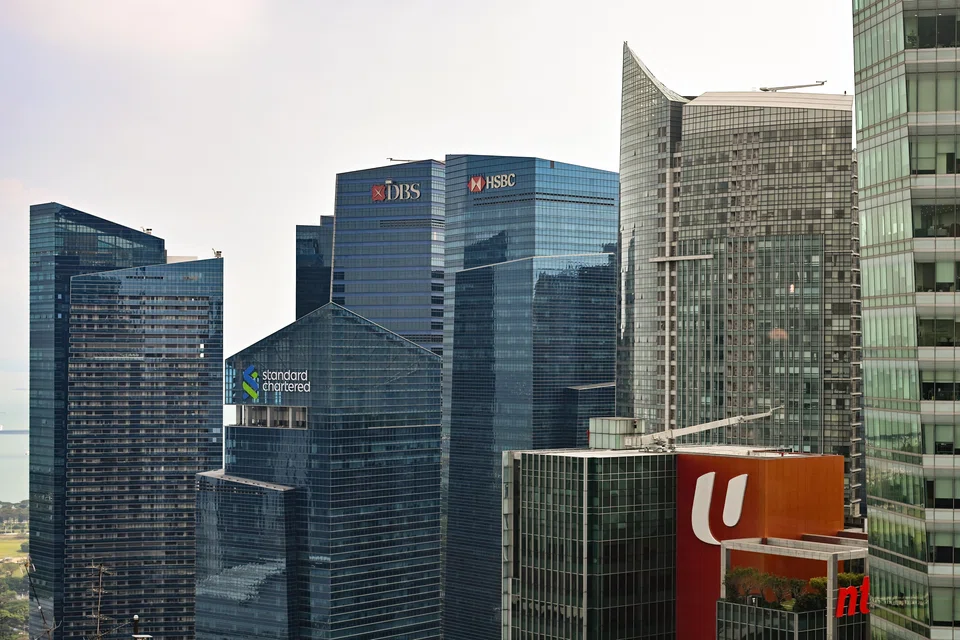
Between end-December 2019 and end-June 2024, the valuation of Keppel Reit’s interests in several Grade A office buildings in Singapore’s Central Business District (CBD) rose. For example, the valuations of Ocean Financial Centre, One Raffles Quay and Marina Bay Financial Centre Tower 3 climbed 2.6 per cent, 4.7 per cent and 5.2 per cent, respectively.
There is also demand for chunky CBD office buildings in the investment sales market. Recently, CapitaLand Integrated Commercial Trust sold 21 Collyer Quay in Raffles Place for S$688 million, representing a premium to the property’s end-2023 valuation.
Artificial intelligence’s impact
Even as major office landlords here successfully navigate the rise of remote working, another key challenge looms, namely, the rise of artificial intelligence (AI).
While uncertainty abounds over the potential of generative AI, its ability to generate content that is indistinguishable from human-created output and break down communications barriers between humans and machines reflects a major advancement with potentially huge macroeconomic effects. Generative AI could lead to many jobs globally being automated.
Might AI’s rise deplete the ranks of knowledge workers and destroy the values of office buildings, creating widespread losses for owners and lenders?
Sure, history suggests that major technological breakthroughs need not generate mass unemployment. Many jobs may be destroyed by technological disruption, with new ones created on the back of the new technology.
However, the danger for office landlords is that AI could eliminate office-based jobs while many new jobs may be created in sectors that do not have large premier office space requirements.
Think of automating away legal and accounting tasks. Or organisations becoming leaner by removing numerous middle management and corporate support jobs.
Perhaps, as AI grows more powerful and becomes widely adopted, countless office-based jobs could be lost, like how automation eliminated many manufacturing jobs in recent times.
Financial institutions, legal firms, accounting practices and consultancies might profit by leveraging AI for productivity gains. But these businesses, which are big office space users, may in future operate with much smaller headcounts and office spaces.
Certainly, some new businesses could emerge due to AI’s rise that have office space needs.
Still, with an ageing population and greater focus on mental wellness in much of the developed world, many new jobs could be in the care and wellness sectors, which may have insignificant demand for prime office space.
Moreover, as AI frees up people from more mundane tasks, many people may take on roles helping others pursue sporting and artistic pursuits, or explore new areas in the creative sector.
Office landlords here have been upping the ante to make physical work spaces compelling. The newish Guoco Midtown in Beach Road focuses on meeting the physical and mental wellness of its office space users through a wide range of retail, garden and recreational spaces including a swimming pool as well as a jogging track.
Also, substantial efforts are being made to reduce the carbon footprint in building and operating office towers to meet the needs of increasingly environmentally-conscious space users.
Nonetheless, despite owners here future-proofing their office properties, potential massive office-based job losses can be devastating to office buildings, including top grade ones here.
Building conversions
However, even if demand for physical office space falls sharply in future, office landlords here can be hopeful.
Office buildings could be converted to other uses, provided regulatory authorities are adaptable and forward-thinking.
Perhaps Singapore’s office-centric CBD will become a precinct filled with many homes and hotels as well as healthcare, wellness and leisure facilities. After all, the CBD occupies a prime location, is well-planned and is well-served by transport nodes.
Singapore has a good track record of converting spaces for more optimal uses. Closed-down schools have made way for housing and other developments. Among new confirmed list sites in the government land sales programme for the first half of 2025 are the first private housing sites at the former Keppel Golf Course and Bukit Timah Turf City. Amid dwindling interest in horse racing, the Singapore Turf Club’s Kranji site will be redeveloped for housing and other needs.
In land scarce Singapore, authorities work assiduously to ensure optimal land use. Land is constantly recycled and repurposed to meet evolving needs in a timely manner.
Nevertheless, building conversions can be challenging. Some sites have constraints that make converting to other uses tricky. Much money might need to be spent to convert a building. And in the meantime, a landlord could suffer from loss of income as tenants vacate the building. Also, an office landlord has to acquire new asset management skills in a different asset class.
Office landlords have gained from Singapore luring businesses across diverse sectors to grow their regional operations here.
Going forward, all is not lost for leading office landlords here even if AI’s rise destroys many office-based jobs. Provided Singapore with its proactive government policies, strong fiscal position, social cohesion and well-educated workforce manages AI’s rise well, office properties here will remain valuable perhaps after being repurposed.
TRENDING NOW
Three ex-employees of Envy group join Ng Yu Zhi in bankruptcy
He built the Vingroup empire. Now South-east Asia’s richest man is handing some key roles to his sons
Grab CEO’s wife Chloe Tong on life with Anthony Tan and finding her purpose
Incidence of civil servants buying property near unannounced MRT stations ‘a concern’, but may not establish misconduct: PSD