

From ‘cowboy’ times to cooling measures: real estate veteran Chia Ngiang Hong on Singapore’s market
CDL’s group general manager looks back as he is honoured by Redas with a Lifetime Achievement Award

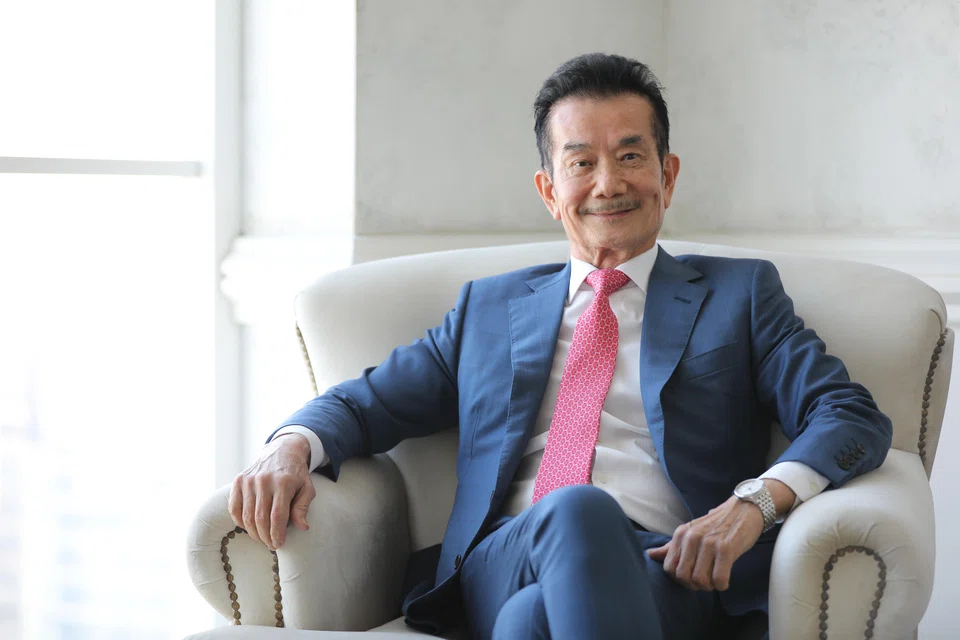
THE real estate sector in Singapore has become “very orderly, transparent and very reliable” over the past 40 years, said industry veteran Chia Ngiang Hong, adding that for property development to remain a viable business, the government can consider relooking some restrictions.
Gone are the days when private-property buyers could flip an option to purchase, or when developers used money collected from the sale of units to buy more land, noted the group general manager of City Developments Ltd (CDL), in an interview with The Business Times.
“Last time, everything was quite ‘cowboy’. Along the way, a lot of things got cleaned up – such as how people use their Central Provident Fund savings, how they tried to sell options. There were a lot of creative people trying to make a quick buck in the early days.”
Chia, who has served in the Real Estate Developers’ Association of Singapore (Redas) since the 1980s, recalled how the industry introduced the Project Account scheme after a question was raised on what would happen if a project’s contractor goes bankrupt.
It was suggested that developers create project accounts to hold money collected from buyers in escrow, and that the money be withdrawn only for construction or other approved purposes.
“Over the years, two or three condominium developers went bankrupt, but the projects were still able to be completed using money from the project account. Whereas in China now, if the developer disappears, buyers are left hanging.”
Such regulations ensure that the Singapore property market is very stable, Chia pointed out.
He added: “You see, if you have a project with 1,000 buyers and the contractor or developer collapses, 1,000 people will be very unhappy. With this, at least whoever comes in will have the money in the bank to finish up the project.”
Great honour
For his contributions to the real estate industry, Chia was presented with the Redas Lifetime Achievement Award on Friday (Nov 15), at the association’s 65th anniversary dinner.
“This honour places him among giants who have exemplified dedication and vision, leaving an indelible mark on Singapore’s real estate sector,” stated Redas. Past awardees include CDL executive chairman Kwek Leng Beng and Far East Organization’s Philip Ng.
Chia said: “Being the first professional manager to receive the Lifetime Achievement Award is a tremendous honour. I hope this can set a positive precedent, reflecting Redas’ openness to contributions from professionals as we build on the strong foundation laid by our founders.”
He observed: “The transformation of (Singapore’s) skyline is due mostly to Redas’ members. We grow with Singapore’s economy, which is something I’m very proud of for the whole industry.”
Changes in the sector
Reminiscing about the real estate landscape in the past, Chia described how with fewer players in the market, it was easy for big developers to buy land.
He said: “My founder chairman (Kwek Hong Png) bought a lot of big parcels of land in Pasir Ris, in Hume Park and many other places. From there, we accumulated a very healthy land bank and the good thing was that there were no restrictions; you (could) hold the land as long as you (liked)...
“Now, the moment you buy, you’ve got to start running. You have to develop and sell everything within five years. If not, you have to pay a hefty penalty.”
He added: “Everything must be completed and sold within five years, regardless of the size. This is the part where we feel quite aggrieved as developers. (Constructing) a 50-unit project versus a 1,000-unit project – (there) is a lot of difference. And the number of buyers (needed) to buy 1,000 units is also not easy...
“Many of my Redas colleagues have lobbied for the government to do something to this land ABSD (Additional Buyer’s Stamp Duty) because the penalty is frightening. The penalty started low – the land ABSD started at 10 per cent and now it’s 40 per cent, including a 5 per cent non-remittable portion.”
The government could consider helping developers by tweaking the formula for calculating the ABSD payable, Chia said.
“The objective of land ABSD is to prevent people from hoarding the land. If I already start developing and the project (is) almost completed, there’s no way I want to hoard. With the high interest (rate) in the market, who would want to carry the unsold units?”
If the formula can be tweaked such that it would apply only to unsold units, this would be fairer, Chia added.
Acknowledging how the ABSD clawback rate was lowered for developers who sell at least 90 per cent of units in the prescribed timeline after this year’s Budget speech, Chia said: “We think it’s a good sign that they are open. Hopefully, after the new government comes in after the election, hopefully (it) can do something more substantive.”
The many layers of cooling measures have made it “quite tough for the development business”, Chia noted.
“A lot of people pivot to other businesses instead of developing. There are a lot of restrictions which make property development quite a tough business. So they go into real estate investment trusts – less risk, asset-light.”
He added: “We are hoping that the government will relook some of these restrictions to make property development more attractive for us to continue as a viable business.”
An eye on overseas markets
A number of developers have turned to investing in properties overseas, Chia noted. For instance, CDL has been quite active in the last few years in the UK, Japan and Australia. “These are the three key (countries) where the laws are more transparent and more in line with our legal system.”
When asked whether it was safe for developers to venture back into China, Chia said they would have to be “very, very selective”.
Referring to CDL’s acquisition of a mixed-use development site in Shanghai for S$1.66 billion with a joint venture partner in November, Chia said the site was “one of the best” in the city.
He added: “We hope that, along the way, the Chinese government can relax more of the rules so that at least when (the) project is ready for launch, the market can be more healthy.”
TRENDING NOW

Grab CEO’s wife Chloe Tong on life with Anthony Tan and finding her purpose
Stocks to watch: DBS, DFI Retail, Frasers Property, Clint, ESR-Reit, Centurion, Coliwoo
DFI Retail to bag US$340 million, Starbucks business in Asia in deal with Maxim’s Caterers
Green fuels, autonomous ships: How Singapore is future-proofing its shipping industry

