Deepening downturn in India's building sector eats into growth
Indebted developers cut employment, slow work on projects to clear unsold backlog of properties
Kumar Noida, India
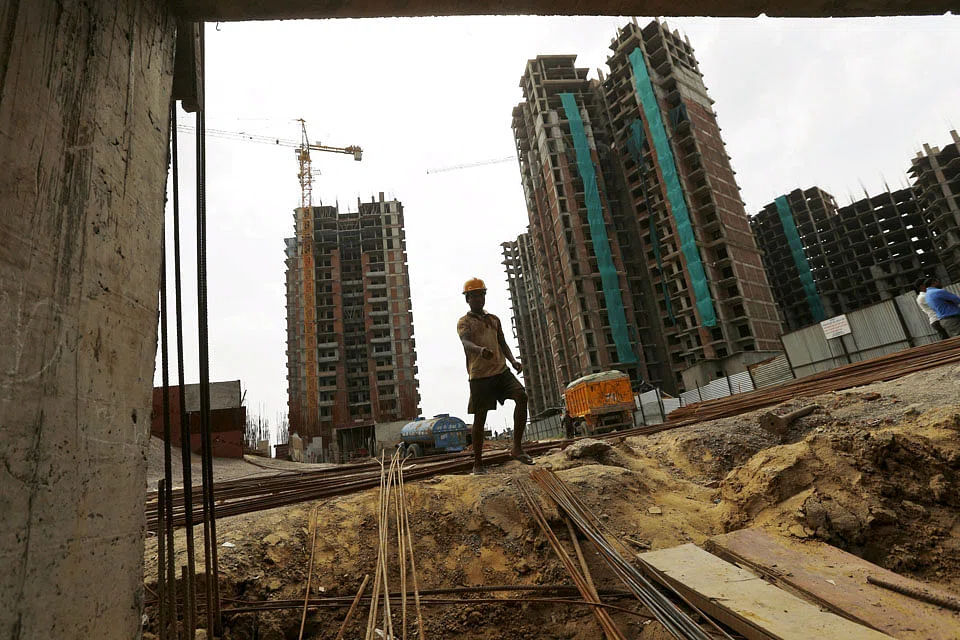
AFTER a decade labouring on building sites around New Delhi, Akhilesh Kumar lost his scaffolding job last month when his employer halted work on an array of 30 residential towers.
He joins more than half a million workers let go from sites around India's capital in the last 18 months, in a stark sign that the ground reality in Asia's third-largest economy is far from as rosy as official data suggests.
The deepening downturn in India's crucial building sector makes it easily understandable why Prime Minister Narendra Modi's image as the country's economic saviour has lost its lustre just over a year after his resounding election victory. "If I don't get another job, I have no other choice but to go back to my village and work as a farm labourer," said Mr Kumar, who is in his twenties.
The decade-long construction boom in burgeoning cities like Noida, where Mr Kumar earned US$165 a month, lured millions of labourers from India's rural hinterlands in search of a better life, creating one in every three new jobs.
That process is now going into reverse, undermining Modi's promise to create more employment for the one million Indians who join the workforce every month.
Indebted developers are cutting staff as they slow work on existing projects and postpone new buildings until they clear a backlog of 700,000 unsold homes.
A law to clamp down on "black money" flows that fund as much as a third of real estate deals is further squeezing demand.
Across India, housing starts fell 40 per cent in the first half of the year, consultancy Knight Frank said. Cement output grew 0.9 per cent between April and June, down from 9.6 per cent a year earlier when Mr Modi took office, government data show. "The slowdown in the construction sector is very, very depressing which will have a negative impact on the overall GDP growth numbers in the first quarter of the current fiscal year," said Samantak Das, chief economist at Knight Frank India.
Rating agency Moody's last week cut India's growth forecast to 7 per cent for this fiscal year, against the government's target of 8 to 8.5 per cent.
Economists say that lower interest rates and a government splurge on infrastructure should eventually help revive construction, which contributes a tenth of Indian GDP.
Mr Modi's party also wants to regulate property markets and tie investor money to specific projects to stop developers diverting cash elsewhere.
The slowdown around Delhi, where unsold inventory is highest, shows no sign of abating, however.
Noida, a city of 640,000, has grown rapidly in the last decade, expanding to a point where its middle-class housing complexes now meld into Delhi's urban sprawl on one side and rustic villages on the other.
Around the site where Mr Kumar worked, half-built high-rises now dot the skyline. Cranes and diggers stand idle. His former employer, The 3C Company, has cut staff on the 3,000-unit "Lotus Boulevard" by more than half, employing some elsewhere. Sales staff at two nearby sites reported a 30 to 50 per cent decline in bookings in the last year.
Real estate association CREDAI's Rohit Raj Modi estimates construction in Noida employed more than a million labourers at its peak in 2013, at least double today's number.
Even when the market recovers, a shift to mechanisation on larger sites would limit demand for new workers. "From a labour point of view, the peak is over," he said. REUTERS