

Detroit's old disused factory to get new life
Packard auto plant is being converted to a commercial, art and residential magnet
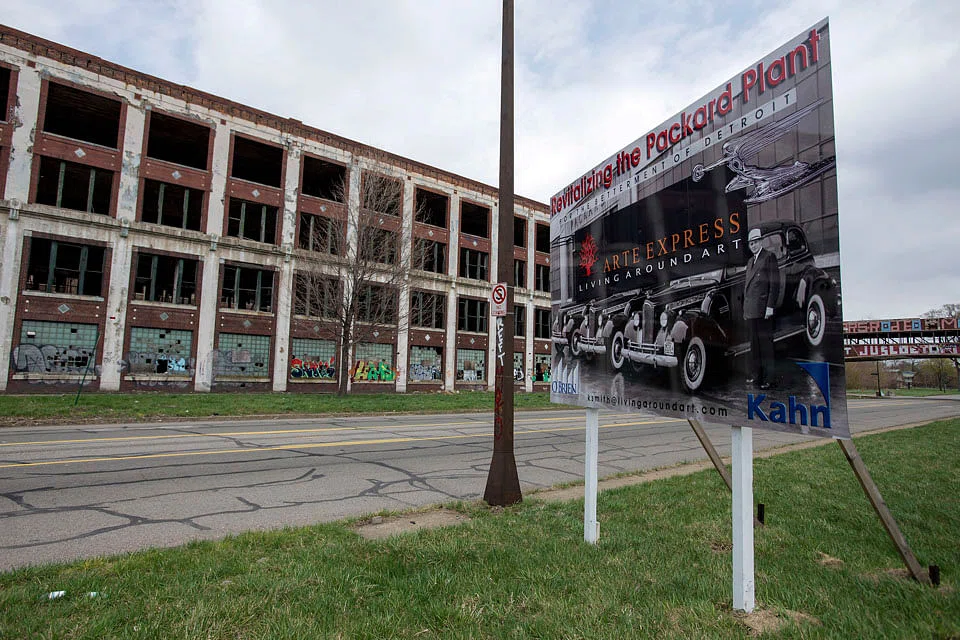
Lansing, Michigan
DETROIT'S biggest ruin, the 16-hectare Packard auto plant, will begin a European-inspired rebirth this summer under a plan that officials hope will revitalise one of the city's poorest neighbourhoods and symbolise a reversal of 50 years of economic decline.
Fernando Palazuelo, a Spanish developer based in Peru, seeks to raise as much as US$500 million to turn the former factory into a commercial, art and residential magnet. Mr Palazuelo, 60, who bought the mammoth eyesore for US$405,000 at a tax sale in December 2013, has hired Albert Kahn Associates, the same Detroit architecture firm that designed the 3.5 million square foot plant in 1903.
While Mayor Mike Duggan searches for money to tear down blighted homes that scar Detroit's 360 square kilometres, abandoned factories remain an additional drag on redevelopment. The Packard plant stands above them all in size and notoriety in a city that lost its industrial clout and 63 per cent of its population since its 1950s peak of 1.8 million before enduring a record US$18 billion municipal bankruptcy.
Closed in 1956 after sales of luxury-class Packard cars slid, the plant once employed 36,000 people. It churned out engines for fighter aircraft and warships during World War II, as Detroit stamped itself the "Arsenal of Democracy".
"In some ways it typifies Detroit," Mr Duggan said at a recent party for a local company's move to a warehouse next to the gutted Packard buildings. "It grew up really fast for World War II and then it shut down really fast. Now it's starting to grow again, and that's a good thing."
Work is planned for August to secure and weatherise a 120,000 sq ft building that was the Packard Motor Car Co's main office. It may be available for occupancy by mid-2016, said Rick Dye, principal and project director at Kahn Associates.
A job training centre is a likely tenant, along with an art gallery and facility for teaching people how to fly drones, said Kari Smith, Packard project manager for Mr Palazuelo's company, Arte Express Detroit. The entire project will take seven to 15 years and cost between US$400 million and US$500 million, she said.
Detroit, which emerged from bankruptcy in December, has seen a spurt of new downtown shops, restaurants and residents. An arena for the National Hockey League's Detroit Red Wings will anchor a planned US$650 million redevelopment led by billionaire Mike Ilitch, founder of the Little Caesars pizza chain and team owner.
Some six kilometres away, the Packard plant crumbles. Its gaping, debris-filled spaces have drawn photographers and gawkers, scrappers, paintball games and rave parties. Arte Express is said to be making the first legitimate attempt to restore the 40 buildings, many made with steel-reinforced concrete that's expensive to demolish.
"There've been multiple people over the years who tried to do stuff out there, and a lot of it just went away," Mr Dye said. "Fernando wants to save as much as he can, restore it to its original condition."
Two similar projects in Europe inspire the Packard project, Ms Smith said. The Lingotto building in Turin, Italy, was built in 1923 as a 1,640 foot long factory for automaker Fiat, and included a rooftop test track. It was abandoned and later restored in the late 1980s with a concert hall, art exhibit, convention centre and hotel designed by architect Renzo Piano.
"It is one of the great monuments of manufacturing and is deserving of loving restoration, just as any great work of architecture," Mr Piano said of the Fiat project, according to his biography on the website of the Pritzker Architecture Prize, which he won in 1998.
In Lodz, Poland, an 18th century textile factory and surrounding buildings were converted in 2006 to a 27-hectare entertainment and shopping district called Manufaktura.
"First, we have to bring jobs and provide security," Ms Smith said. "People need a reason to live in this area. Downtown and midtown are practically full. There's a need for residential in the future."
Mr Palazuelo is seeking foreign investors, federal tax credits and loans, Ms Smith said. No city funds are earmarked for the project. Mr Palazuelo wasn't available for an interview.
In the 1980s, Mr Palazuelo redeveloped real estate bought cheaply in Madrid, Barcelona and Majorca. He filed for bankruptcy after the economic crash of 2008 and moved to Lima, where he refurbished 22 buildings for government and commercial offices.
Mr Palazuleo has said he wants to lure light industry, automotive suppliers, technology companies and artists. The property is near automotive assembly plants, two interstate freeways, rail lines and two border crossings to Canada.
The Packard project would be the "Holy Grail" of converting urban buildings for reuse, though its size makes the task difficult, said Rayman Mohamed, associate professor of urban studies and planning at Wayne State University in Detroit. He said it would need large financial incentives to be profitable.
The plan got a boost recently when Display Group, an event props and design company, moved into an adjacent 260,000 sq ft warehouse built in 1939. Engines were manufactured there for P-51 Mustang fighter planes used in World War II.
Display Group president Rick Portwood said that while he had reservations about moving his family-owned business next to the ruins, he believes Mr Palazuelo will succeed.
"Even if it doesn't go through, I'm pleased to be here," Mr Portwood said. "Someone has to be that person to make an investment, to make the area better." Bloomberg
TRENDING NOW

Nvidia reinstates Jensen Huang as CEO; Trump says move poses no national security risk

Indonesia’s coal tycoon Low Tuck Kwong replaced as Bayan Resources president-director

Nvidia surges 33% after reinstating Jensen Huang, reviving AI trade; stocks soar in US and Europe

Consider lowering homeownership barriers for some non-resident foreigners

